
An infection preventionist collaborates with the microbiology director to build the hospital's annual cumulative antibiogram for empiric antimicrobial stewardship. Which isolate-selection rule should they apply to prevent patients with prolonged stays and repeat cultures from skewing susceptibility percentages?
Select an answer to reveal the explanation.
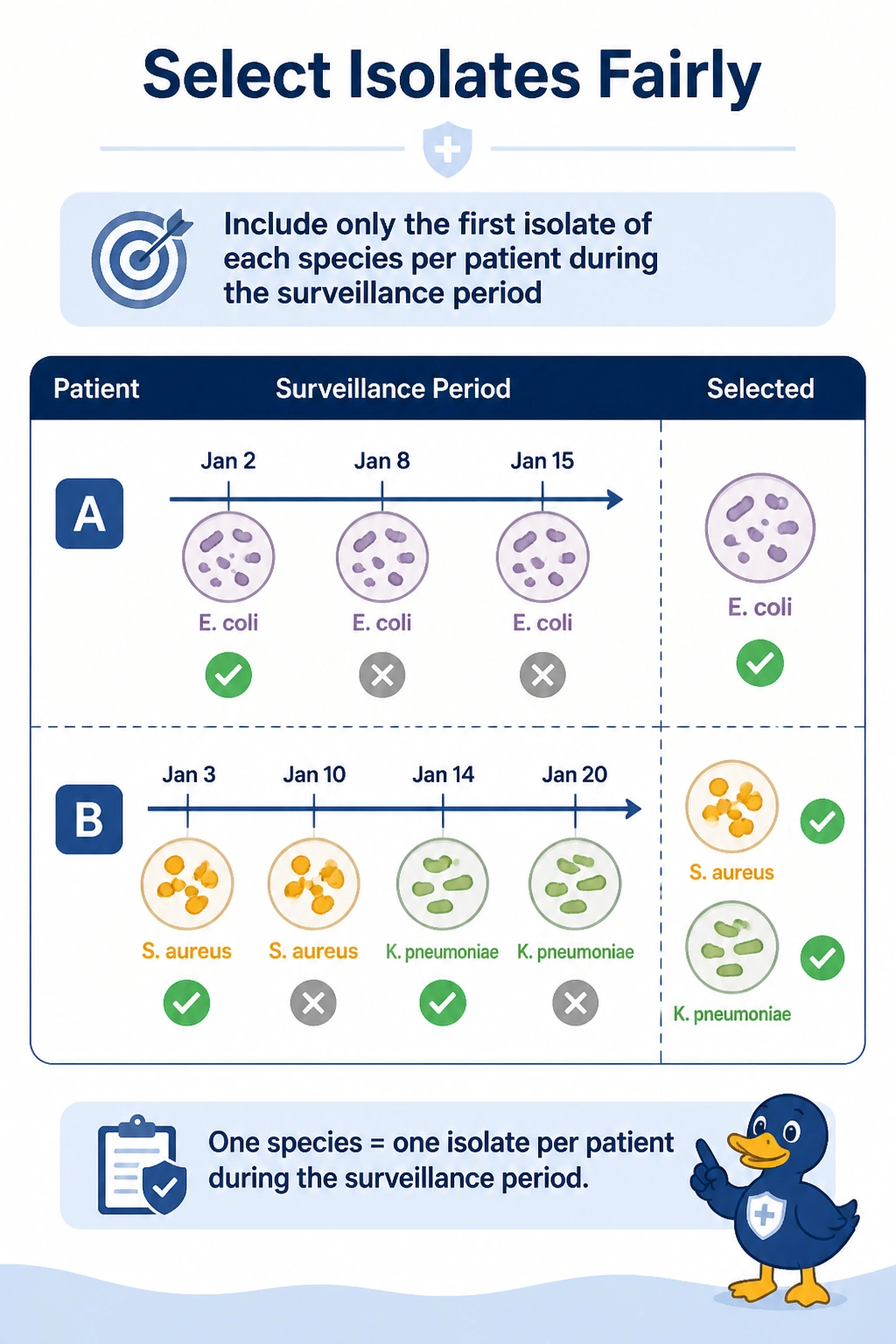
Short Explanation
Counting every repeat culture from one long-stay patient is like polling the same person ten times and calling it a neighborhood consensus. The trap is thinking more isolates make your antibiogram more accurate, when duplicates actually distort empiric guidance.
Full Explanation
Under Clinical and Laboratory Standards Institute (CLSI) M39 guidelines, a cumulative antibiogram is designed to guide initial empiric antimicrobial therapy by estimating the percentage of patients whose infections are susceptible to each agent. To avoid overrepresenting hospitalized patients who undergo frequent repeat culturing, laboratories must Include only the first isolate of each species per patient during the surveillance period. Choosing to Include every positive culture collected from hospitalized patients to capture emerging resistance artificially inflates resistance rates because patients failing therapy or with chronic colonization are sampled repeatedly. Choosing to Exclude all outpatient and emergency department isolates even when collected before admission removes community-onset data needed for emergency department empiric choices, unless a separate inpatient-only antibiogram is intentionally stratified. Choosing to Count only the most resistant isolate from each patient regardless of how many cultures grew introduces a worst-case bias that overstates baseline resistance and drives unnecessary broad-spectrum prescribing. Caveat: CLSI recommends reporting species only when at least 30 isolates are available to avoid unstable percentages. Operational check: audit the laboratory information system deduplication filter annually before publishing the antibiogram.
Prefer to study offline? Printable PDF study book + test engine ($7.50, unofficial). These questions stay free here.