
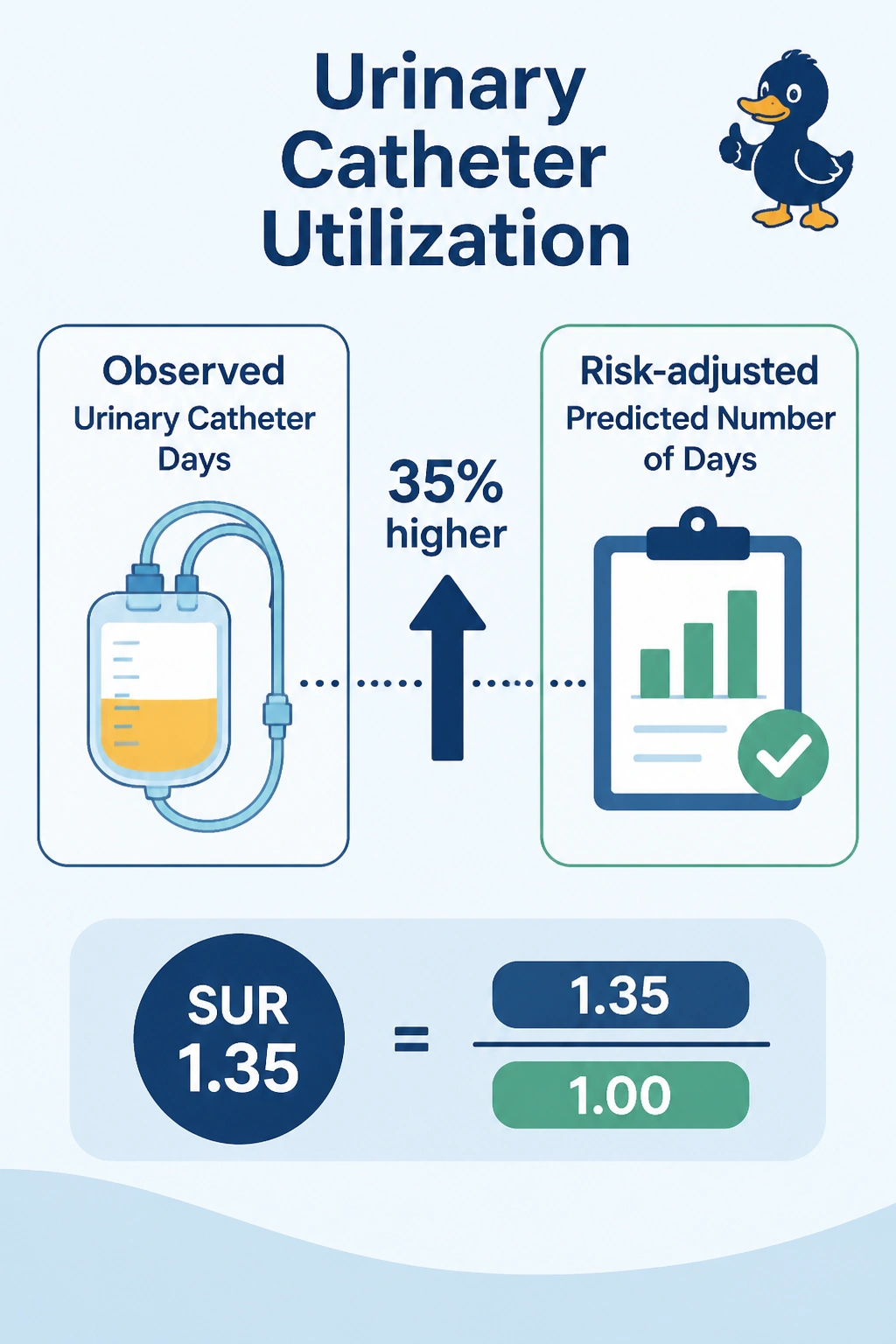
An adult medical intensive care unit reports an NHSN Standardized Utilization Ratio (SUR) of 1.35 (95% confidence interval: 1.20 to 1.52) for indwelling urinary catheters during the first quarter. What does this surveillance metric indicate to the infection preventionist?
Select an answer to reveal the explanation.
Short Explanation
Think of the Standardized Utilization Ratio as a speedometer for device exposure rather than a crash counter for infections. When your unit's SUR sits above 1.0 with a confidence interval excluding 1.0, patients are keeping catheters in significantly longer or more often than predicted. The trap is confusing device utilization with the infection rate measured by the Standardized Infection Ratio.
Full Explanation
In CDC NHSN surveillance, the Standardized Utilization Ratio (SUR) compares the observed number of device days—such as indwelling urinary catheter days—to the predicted number of device days calculated from national risk-adjusted baseline data. Selecting Observed urinary catheter days were 35% higher than the risk-adjusted predicted number of days accurately reflects an SUR of 1.35 whose 95% confidence interval (1.20 to 1.52) lies entirely above 1.0, signaling statistically significant excess device exposure. Conversely, choosing The unit's CAUTI infection rate is 35% higher than the national baseline confuses the SUR with the Standardized Infection Ratio (SIR), which measures infection outcomes rather than device days. Opting for Exactly 35% of patients in the unit have an indwelling urinary catheter misinterprets a ratio of observed-to-predicted days as a simple device utilization proportion. Similarly, stating Urinary catheter use is statistically lower than predicted for this unit type reverses the direction of an SUR greater than 1.0. As a caveat, a high SUR does not prove infections occurred, but it identifies upstream excess catheter exposure that drives future CAUTI risk. For an operational check, review daily catheter necessity audits and nurse-driven removal protocols on the unit to identify opportunities to reduce unnecessary device days.
Prefer to study offline? Printable PDF study book + test engine ($7.50, unofficial). These questions stay free here.