
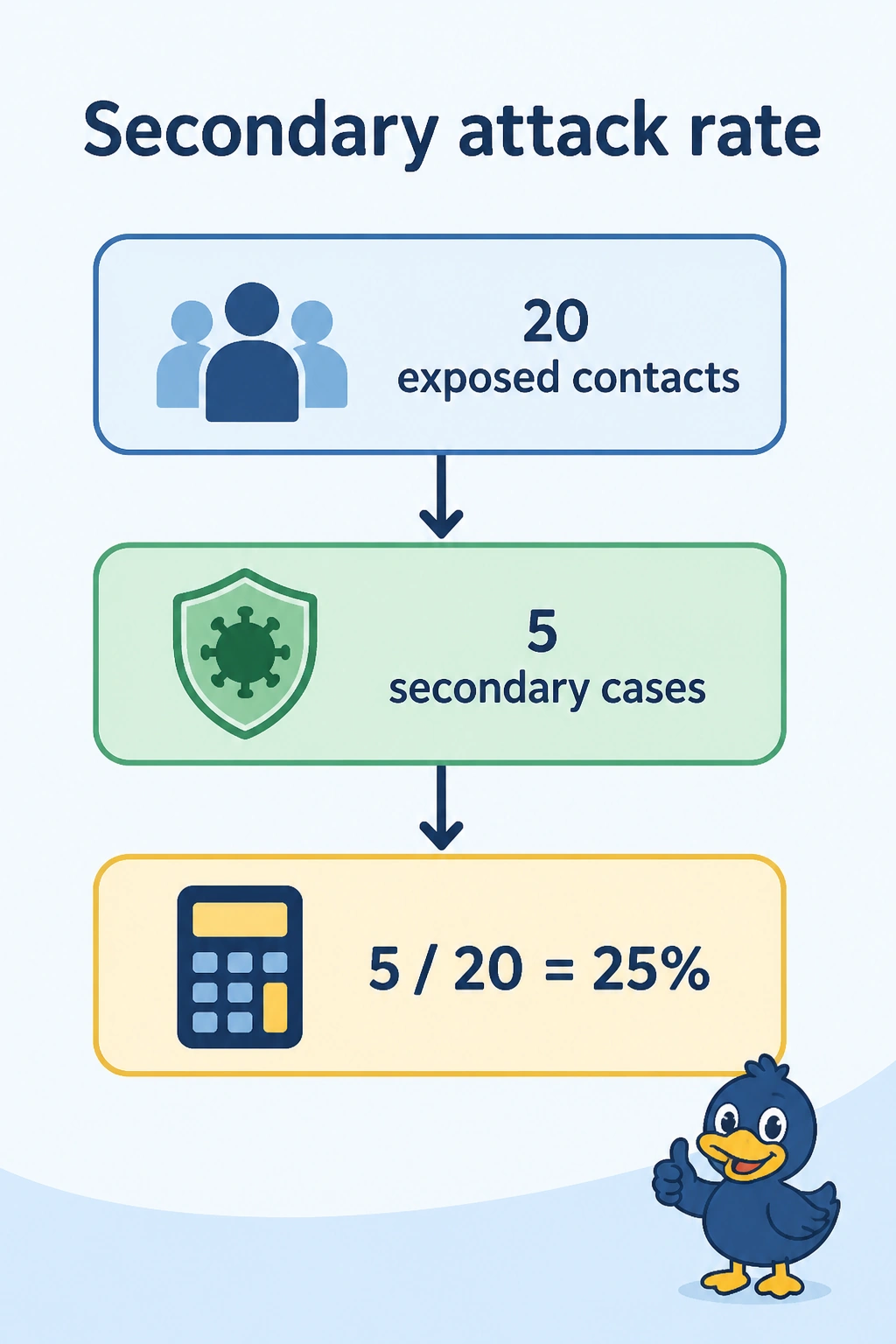
On a 25-bed behavioral health unit, one index patient develops influenza and exposes 20 susceptible roommates and group-activity contacts before isolation is initiated. Over the next four days, 5 of those 20 exposed contacts develop confirmed influenza. What is the secondary attack rate among the exposed contacts?
Select an answer to reveal the explanation.
Short Explanation
When you measure how efficiently an infection spreads from one person to close contacts, you have to take the original spark out of the equation. The classic trap is leaving the index patient in the numerator or using total unit bed capacity as the denominator, which skews the secondary attack rate.
Full Explanation
The secondary attack rate measures person-to-person transmissibility by calculating the proportion of susceptible exposed contacts who develop illness within one incubation period after exposure to an index case. Because the index patient is the source rather than a secondary case, both numerator and denominator exclude the index case, yielding 25%, calculated by dividing 5 secondary cases by the 20 exposed contacts. Selecting 24%, calculated by dividing all 6 unit cases by the 25 total beds on the unit incorrectly includes the index case in the numerator and uses unexposed bed capacity instead of actual exposed contacts. Selecting 28.6%, calculated by dividing all 6 unit cases by the 21 total exposed individuals also erroneously counts the index case in both the numerator and the denominator, inflating the transmission estimate. Selecting 20%, calculated by dividing 5 secondary cases by the 25 total beds on the unit dilutes the risk by including four unexposed unit beds in the denominator. Define susceptibility for the specific circulating pathogen/strain; prior influenza infection or vaccination does not automatically prove immunity to every influenza strain or justify excluding a contact. Operational check: map exact room-sharing and group-activity rosters in your outbreak line list so only truly exposed susceptible contacts enter the denominator.
Prefer to study offline? Printable PDF study book + test engine ($7.50, unofficial). These questions stay free here.