
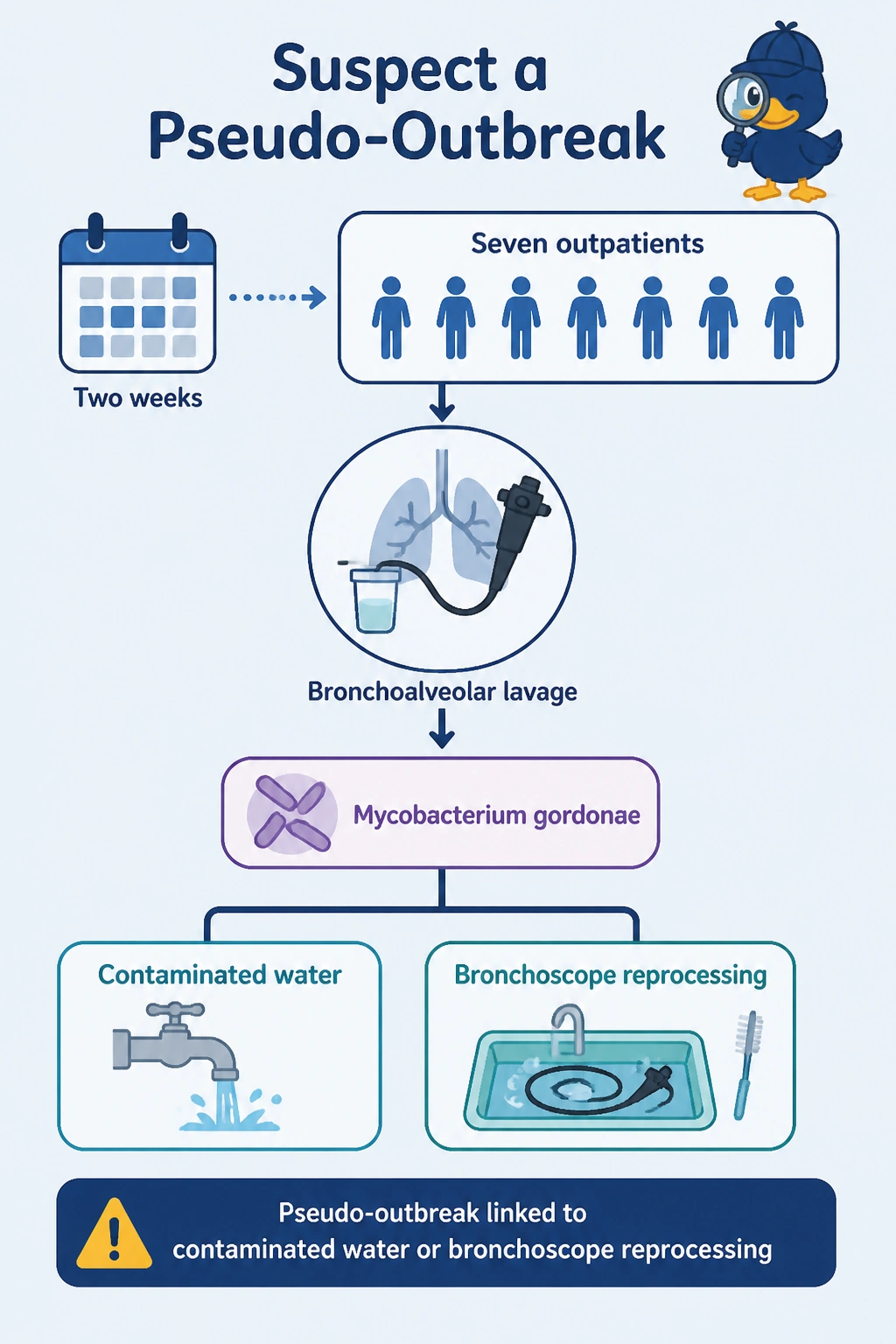
Over two weeks, an acute care hospital's microbiology laboratory isolates Mycobacterium gordonae from bronchoalveolar lavage specimens of seven outpatients, yet none of the patients have fever, worsening cough, or new radiographic infiltrates. What should the infection preventionist suspect and evaluate first?
Select an answer to reveal the explanation.
Short Explanation
When lab results light up like a Christmas tree while patients feel completely fine, you are often chasing a ghost in the equipment rather than an infection in the host. The trap is launching patient-to-patient transmission protocols before confirming whether true clinical disease exists. Your first move is to check for a pseudo-outbreak tied to tap water, reagents, or bronchoscope reprocessing.
Full Explanation
A pseudo-outbreak linked to contaminated water or bronchoscope reprocessing is the primary concern when an environmental organism such as Mycobacterium gordonae appears across multiple procedures without matching clinical illness. Mycobacterium gordonae is a slow-growing nontuberculous mycobacterium commonly found in municipal tap water that can contaminate automated endoscope reprocessors, rinse water lines, or laboratory reagents. Recognizing a pseudo-outbreak prevents unnecessary antimycobacterial therapy and misguided isolation measures. A point-source airborne transmission event inside the bronchoscopy waiting area is unlikely because M. gordonae clusters are usually environmentally acquired or contamination-related; do not infer person-to-person transmission from these cultures alone. An incubation period shift caused by an emerging multidrug-resistant strain fails to explain why every culture-positive patient remains clinically asymptomatic. Unreported community exposure requiring immediate patient contact tracing is inappropriate before confirming true disease and ruling out device or water contamination. Caveat: immunocompromised patients can occasionally develop true infection from contaminated bronchoscopes, so clinical correlation remains essential. Operational check: halt use of the suspect bronchoscopes and reprocessor, inspect water filtration and reprocessing logs, and culture rinse water and scope channels.
Prefer to study offline? Printable PDF study book + test engine ($7.50, unofficial). These questions stay free here.