
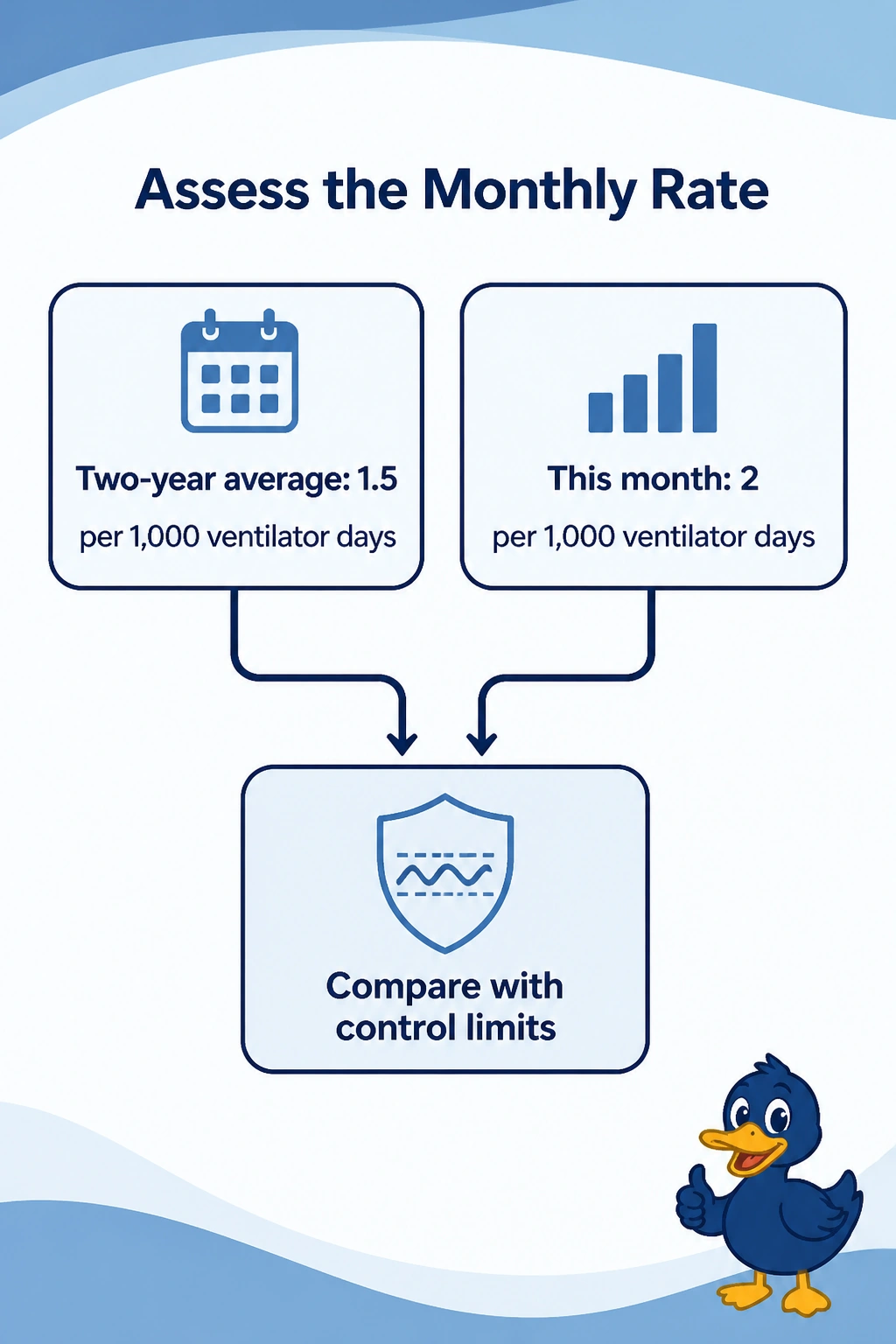
A surgical intensive care unit averages 1.5 ventilator-associated events per 1,000 ventilator days over the past two years. This month, the unit records 2 events over 1,000 ventilator days, and a manager asks whether an outbreak investigation is warranted. How should the infection preventionist evaluate this change?
Select an answer to reveal the explanation.
Short Explanation
A single small bump in a monthly rate is often just statistical weather, not a full-blown storm. You need to check control limits rather than just the mean, and always use current ventilator days for your rate. Even when things look normal, you should still glance at the cases for any shared clinical links.
Full Explanation
Surveillance rates in small monthly denominators naturally fluctuate, so you should Compare the monthly rate against historical baseline control limits to assess for normal variation. Moving from 1.5 to 2 events per 1,000 ventilator days represents a tiny numerator difference that statistical process control charts or Poisson confidence intervals routinely show as common-cause variation rather than a true cluster. A mean is not a control limit, and current exposure denominators are required; review clinical links even without a statistical signal. Treating any month above the two-year mean as special-cause variation without checking dispersion ignores dispersion and control limits, so normal Poisson fluctuation around 1.5 would trigger constant false alarms. Comparing event counts alone because ventilator utilization was reviewed last quarter discards current exposure time, so changes in ventilator days or device utilization this month make counts uninterpretable and noncomparable. Excluding patients ventilated for fewer than seven days from the denominator to stabilize monthly metrics distorts NHSN definitions and introduces selection bias into unit comparisons. As a caveat, even when a rate stays within control limits, you should still review individual cases for common preventable process gaps or shared equipment links.
Prefer to study offline? Printable PDF study book + test engine ($7.50, unofficial). These questions stay free here.