
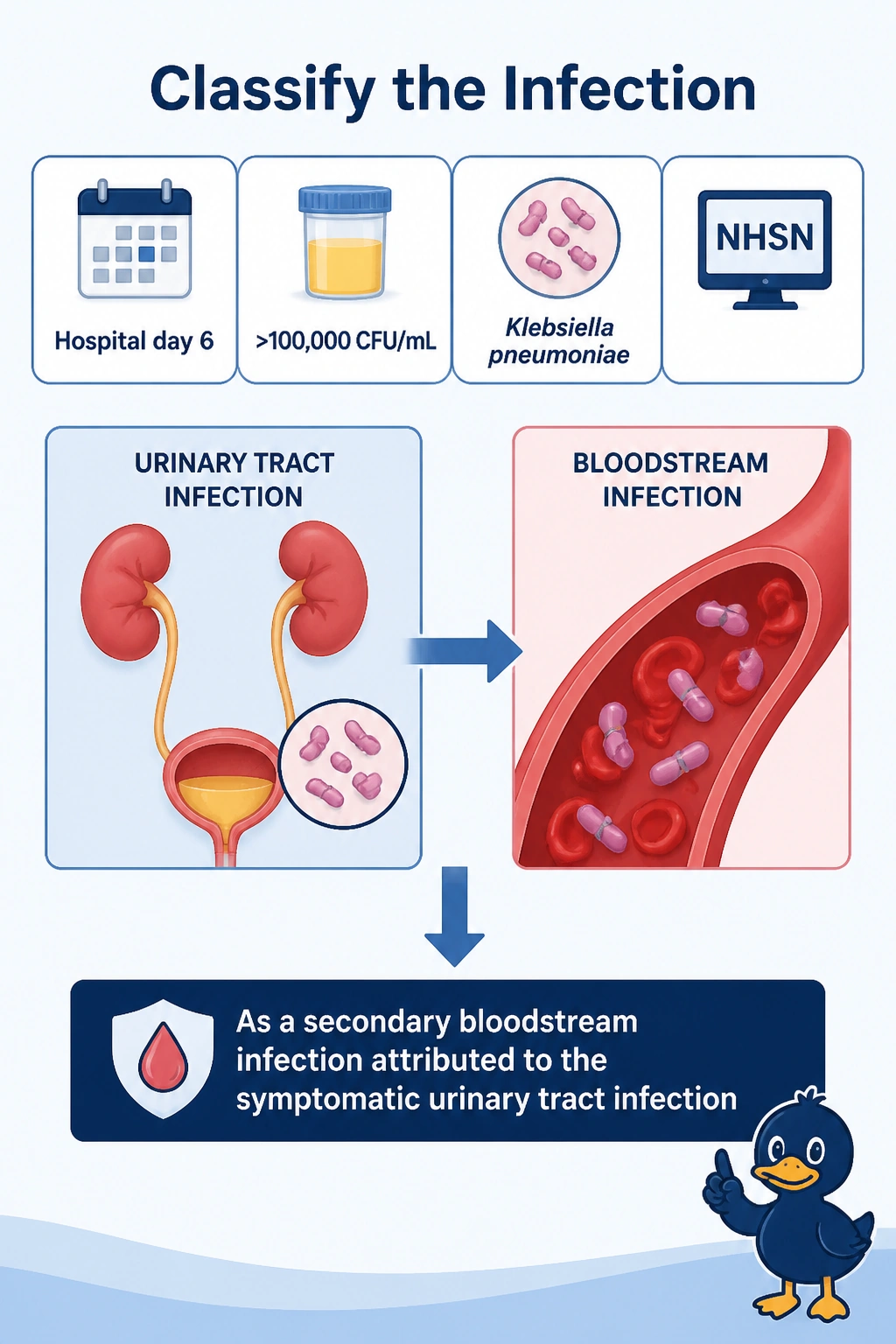
An adult medical-surgical patient with both a central venous catheter and an indwelling urinary catheter develops fever and suprapubic tenderness on hospital day 6. A urine culture grows greater than 100,000 CFU/mL of Klebsiella pneumoniae, and a blood culture collected the next day also grows Klebsiella pneumoniae with no other source identified. How should the infection preventionist classify the bloodstream infection under NHSN surveillance rules?
Select an answer to reveal the explanation.
Short Explanation
Seeing a central line and a positive blood culture in the same patient can tempt you to log a CLABSI right away. Before you do, check whether the same pathogen matches a documented site-specific infection like a UTI, because NHSN rules classify that blood culture as a secondary bloodstream infection.
Full Explanation
As a secondary bloodstream infection attributed to the symptomatic urinary tract infection is the correct NHSN classification because the patient met symptomatic urinary tract infection criteria and had a matching organism isolated from blood within the secondary bloodstream infection attribution period. Under NHSN rules, a bloodstream infection with a confirmed site-specific source is not reported as a primary central line-associated bloodstream infection. As a primary central line-associated bloodstream infection because a central line was in place is incorrect because central line presence alone does not override a documented primary site infection with the same pathogen. As a mucosal barrier injury bloodstream infection related to gastrointestinal translocation applies only when specific neutropenia or graft-versus-host disease criteria are met alongside eligible enteric organisms. As a contaminated blood culture because Klebsiella pneumoniae is a common skin commensal is doubly wrong because Klebsiella pneumoniae is an enteric Gram-negative pathogen, not a skin commensal. As a surveillance caveat, verify that the urine culture and blood culture fall within the exact NHSN secondary attribution window. Perform an operational check by documenting both the urinary infection criteria and matching organism dates in the surveillance record.
Prefer to study offline? Printable PDF study book + test engine ($7.50, unofficial). These questions stay free here.