
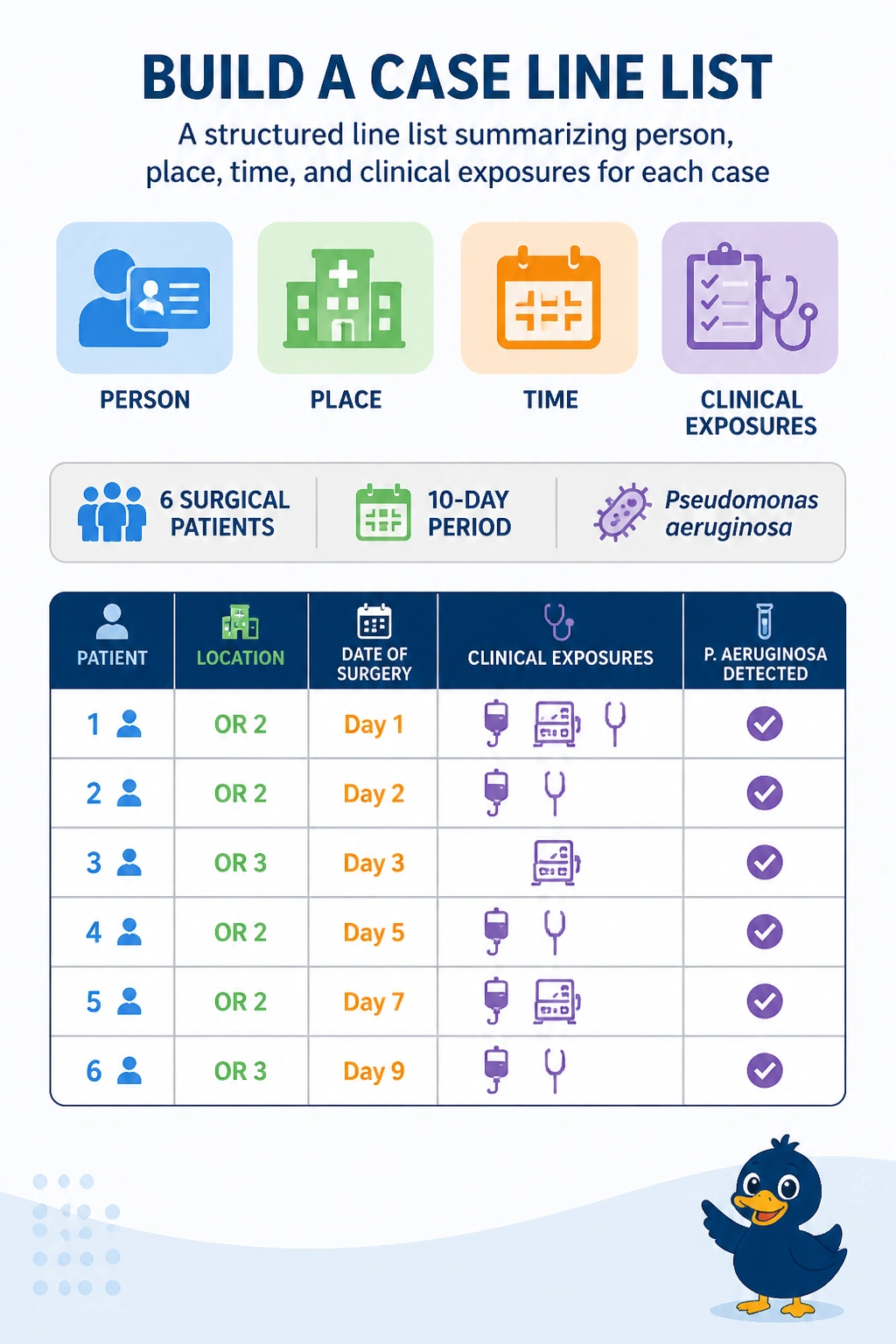
An infection preventionist is notified of six surgical patients who developed postoperative Pseudomonas aeruginosa wound infections over a ten-day period. Before formulating hypotheses about a common source, what epidemiological tool should the infection preventionist create first to organize each patient's demographics, procedure details, staff contacts, and onset dates?
Select an answer to reveal the explanation.
Short Explanation
Trying to spot an outbreak's common thread from scattered chart notes is like solving a puzzle with half the pieces still in the box. Before you run fancy statistics, build a line list so you can compare person, place, time, and exposures side by side.
Full Explanation
A structured line list summarizing person, place, time, and clinical exposures for each case is the foundational descriptive epidemiology tool used in an outbreak investigation. By placing each confirmed or suspected case on its own row with standardized columns for operating room, surgical team, devices, and onset date, patterns emerge rapidly to guide hypothesis generation. A funnel plot compares outcome estimates across organizations or groups against sample size/precision; it is not a chronological case-level exposure line list. A logistic regression model adjusting for patient comorbidities across the past five years is an analytic tool used later to test specific hypotheses, not an initial case-organization step. A facility-wide antimicrobial antibiogram summarizing all inpatient isolates from the prior year tracks aggregate susceptibility trends rather than acute cluster linkages. As an outbreak caveat, use a consistent working case definition before entering patients onto the list so unrelated colonizations do not obscure true links. Perform an operational check by reviewing the completed line list with perioperative and microbiology leads daily until the exposure window and source are clarified.
Prefer to study offline? Printable PDF study book + test engine ($7.50, unofficial). These questions stay free here.