
An intensive care unit patient with prolonged mechanical ventilation develops ventilator-associated pneumonia, and a bronchoalveolar lavage culture grows Stenotrophomonas maltophilia. A resident asks why the microbiology laboratory did not report meropenem as susceptible on the antimicrobial susceptibility panel. Which explanation should the infection preventionist provide?
Select an answer to reveal the explanation.
Short Explanation
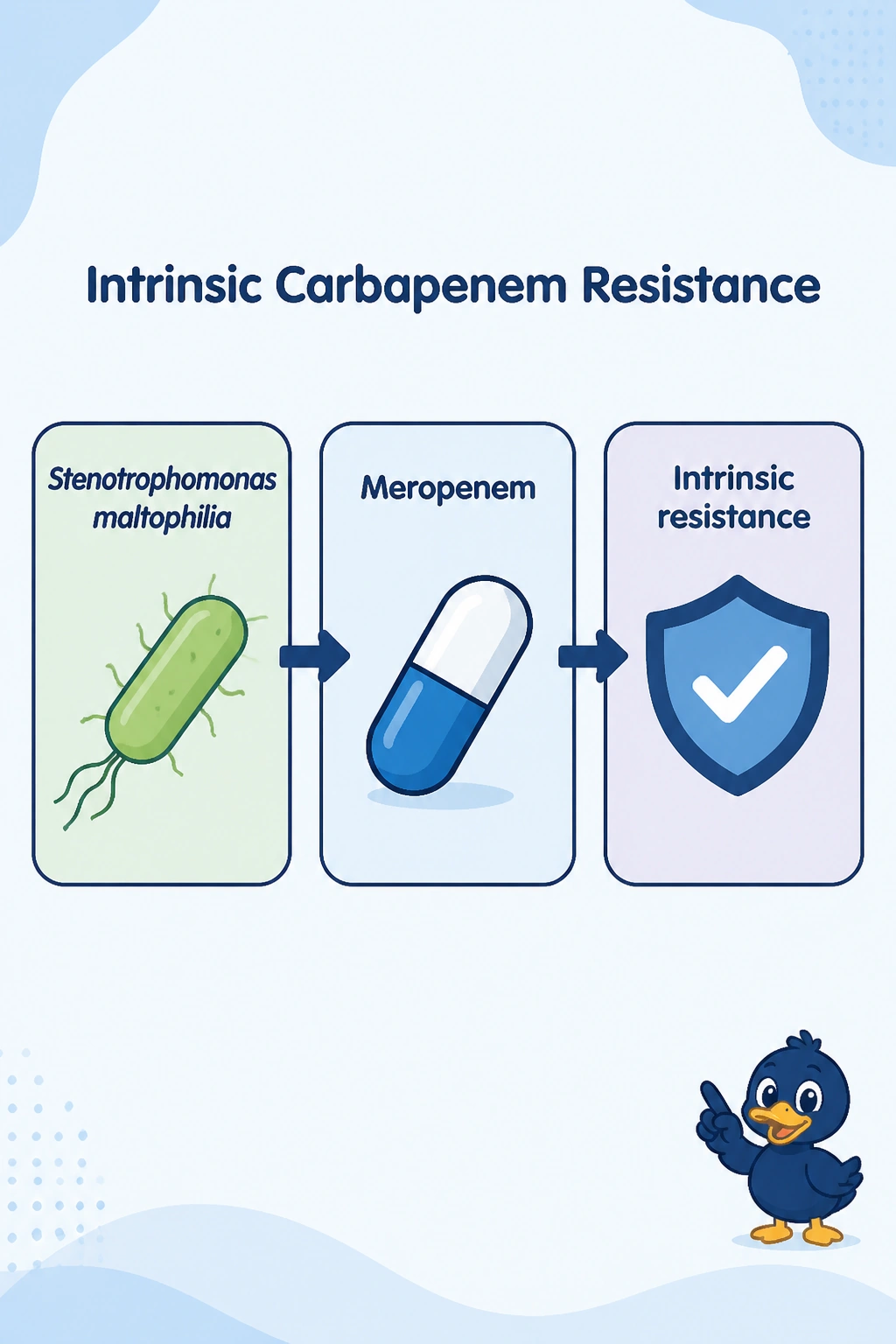
Picture a knight wearing built-in armor that blocks every sword of a certain shape before the battle even begins. Stenotrophomonas maltophilia carries an intrinsic metallo-beta-lactamase that makes carbapenems ineffective from the start, so the trap is assuming any broad-spectrum beta-lactam will cover it when you see a Gram-negative rod.
Full Explanation
The organism is intrinsically resistant to all carbapenem antibiotics because Stenotrophomonas maltophilia chromosomally encodes an L1 metallo-beta-lactamase that hydrolyzes carbapenems, alongside an L2 cephalosporinase conferring broad beta-lactam resistance. Recognizing this intrinsic resistance prevents prescribing ineffective empiric carbapenems such as meropenem. Choose therapy under current IDSA guidance and susceptibilities: 2026 guidance prefers cefiderocol monotherapy for invasive S. maltophilia, while TMP-SMX is an alternative component of combination therapy, with possible step-down after sustained improvement. Claiming that The organism acquires resistance only after prior carbapenem exposure is incorrect because this resistance is native to the species rather than acquired via selective pressure or plasmids. Suggesting that The laboratory withholds carbapenem results to promote oral step-down therapy confuses intrinsic resistance rules with cascade reporting, which hides susceptible broad-spectrum agents when narrower options are active. Asserting that The automated panel cannot detect carbapenem activity in non-fermenters is false because commercial systems routinely test carbapenems against other non-fermenters like Pseudomonas aeruginosa. As a caveat, S. maltophilia can also acquire resistance to first-line agents, so treatment should still be guided by verified susceptibility results. For an operational check, review microbiology reporting rules and empiric pneumonia order sets with antimicrobial stewardship to confirm S. maltophilia prompts active therapy rather than carbapenems.
Prefer to study offline? Printable PDF study book + test engine ($7.50, unofficial). These questions stay free here.