
A hospital microbiology laboratory uses a multi-step Clostridioides difficile testing algorithm and screens a patient's liquid stool specimen with a glutamate dehydrogenase (GDH) antigen enzyme immunoassay, which returns positive. Why must the laboratory perform an additional toxin enzyme immunoassay or nucleic acid amplification test before reporting a positive C. difficile result?
Select an answer to reveal the explanation.
Short Explanation
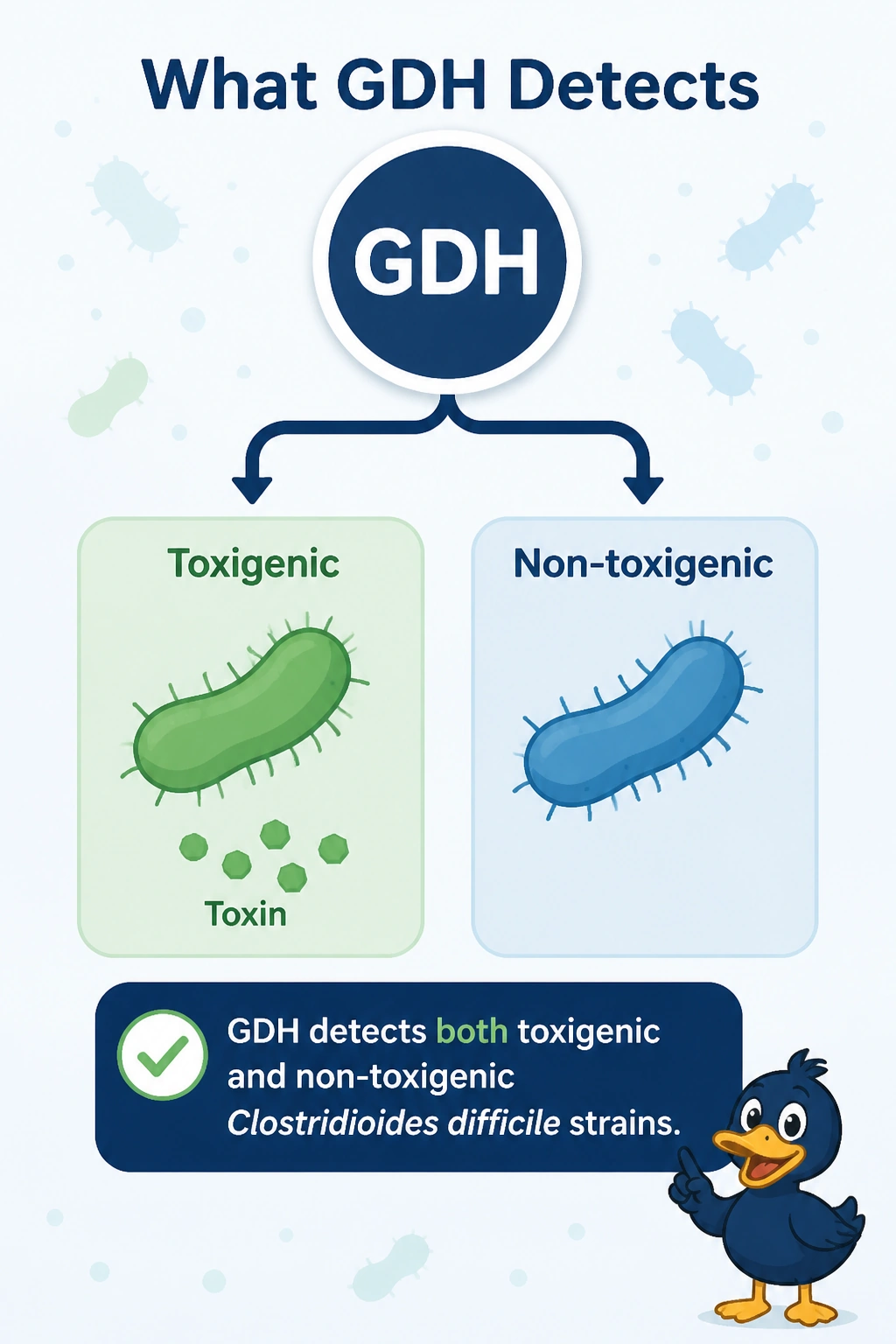
Think of GDH as a uniform worn by every Clostridioides difficile bacterium—both the harmless non-toxigenic ones and the toxin-producing troublemakers. Because GDH cannot tell them apart, you need a toxin or NAAT step next, and the trap is treating a positive GDH screen as proof of active disease.
Full Explanation
Glutamate dehydrogenase is a metabolic enzyme produced in high amounts by all Clostridioides difficile isolates, meaning GDH detects both toxigenic and non-toxigenic strains and therefore lacks specificity for disease-causing infection on its own. A positive GDH screen supports organism presence but can be falsely positive, so a secondary test for toxin A/B (via toxin EIA) or the toxin gene (via NAAT) is required to determine whether the strain is capable of causing colitis. Claiming that GDH antigen degrades rapidly in liquid stool during transport is incorrect because GDH is a stable, abundant antigen that makes an effective high-sensitivity initial screen. Asserting that GDH testing detects only spores and misses vegetative cells is false because actively growing vegetative cells produce large quantities of GDH. Assuming that GDH positivity confirms active toxin production in every colonized patient confuses organism presence with virulence, as non-toxigenic strains lack the pathogenicity locus and do not cause C. difficile infection. A GDH-positive/toxin-negative result is discordant, not proof of a non-toxigenic strain; resolve under the laboratory algorithm, with clinical correlation even after a positive NAAT. Even a positive NAAT detects the toxin gene rather than free toxin.
Prefer to study offline? Printable PDF study book + test engine ($7.50, unofficial). These questions stay free here.