
A hospitalized patient's urine culture grows Enterococcus faecium that is resistant to vancomycin. Which antimicrobial resistance mechanism accounts for acquired vancomycin resistance in Enterococcus species?
Select an answer to reveal the explanation.
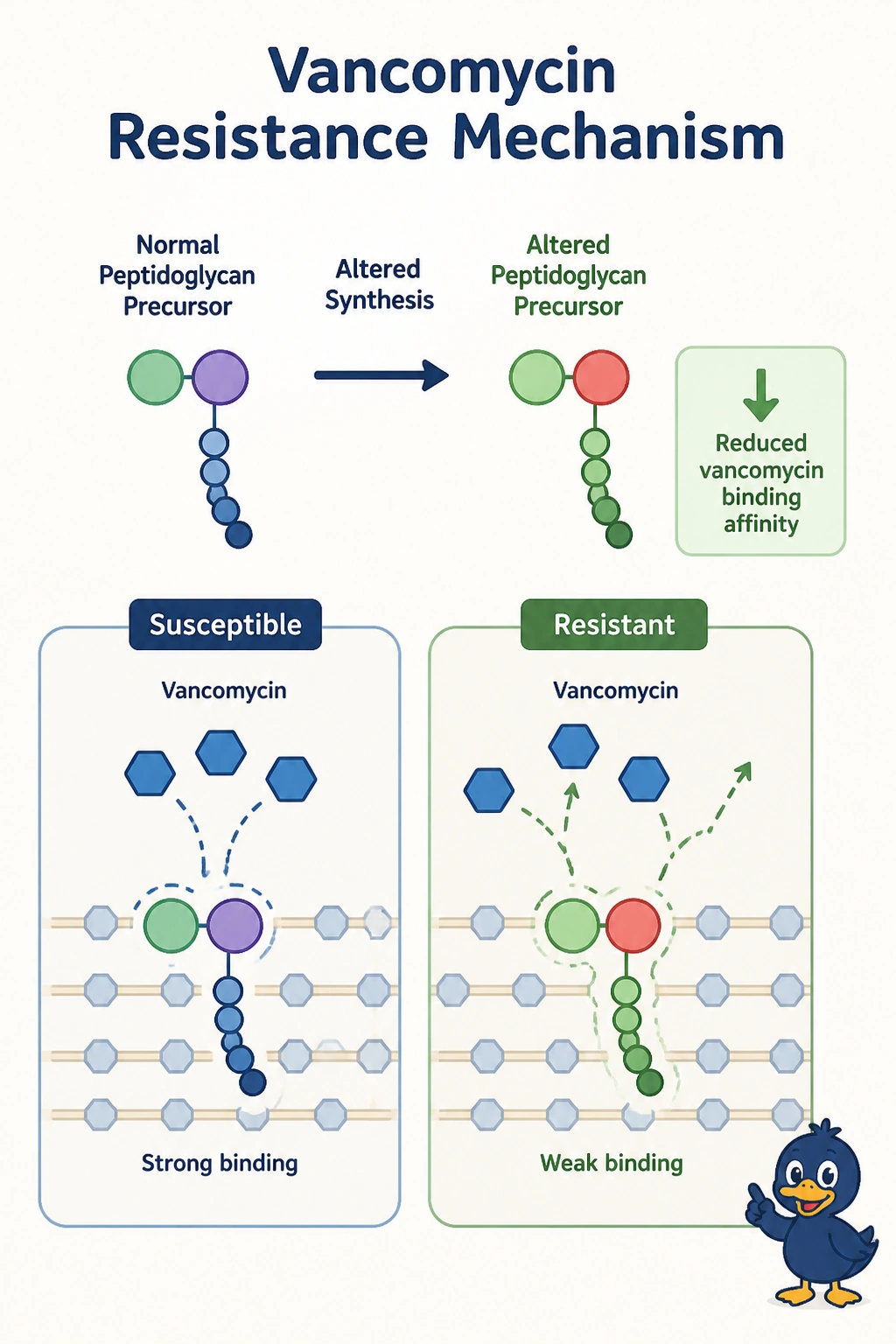
Short Explanation
Vancomycin works by latching onto the building blocks of the bacterial cell wall like a lock and key. In vancomycin-resistant Enterococcus, you see synthesis of an altered peptidoglycan precursor that reduces vancomycin binding affinity, changing the lock so the drug cannot grip. The trap is confusing glycopeptide resistance with beta-lactamase enzymes or missing cell walls.
Full Explanation
Acquired resistance in vancomycin-resistant Enterococcus (VRE) is caused by synthesis of an altered peptidoglycan precursor that reduces vancomycin binding affinity. Normally, vancomycin binds to the D-alanyl-D-alanine terminus of peptidoglycan precursors to block cell-wall cross-linking; resistant enterococci carrying vanA or vanB gene clusters substitute D-alanyl-D-lactate, eliminating a critical hydrogen bond and preventing vancomycin attachment. Choosing production of a plasmid-mediated beta-lactamase enzyme that hydrolyzes glycopeptide rings is incorrect because beta-lactamases cleave the beta-lactam ring of penicillins and cephalosporins, not glycopeptides like vancomycin. Choosing complete absence of a bacterial peptidoglycan cell wall surrounding the cytoplasmic membrane describes organisms such as Mycoplasma species rather than Enterococcus, which possesses a thick Gram-positive cell wall. Choosing overexpression of a broad-spectrum efflux pump that expels all cell-wall-active antibiotics is inaccurate because vancomycin acts extracellularly at the cell wall surface rather than requiring intracellular accumulation. Caveat: some enterococci such as Enterococcus gallinarum carry intrinsic low-level vanC resistance, whereas vanA and vanB can be transferred; vanA commonly confers high-level resistance, whereas vanB-associated vancomycin resistance levels vary. Operational check: review the microbiology susceptibility report and ensure Contact Precautions are initiated promptly for patients with vanA or vanB VRE.
Prefer to study offline? Printable PDF study book + test engine ($7.50, unofficial). These questions stay free here.