
During a routine prenatal visit, an asymptomatic pregnant patient has a reactive Treponema pallidum particle agglutination (TP-PA) test and a nonreactive rapid plasma reagin (RPR) test. Records confirm she completed appropriate penicillin therapy for primary syphilis four years ago, and she reports no new exposures. How should these results be interpreted?
Select an answer to reveal the explanation.
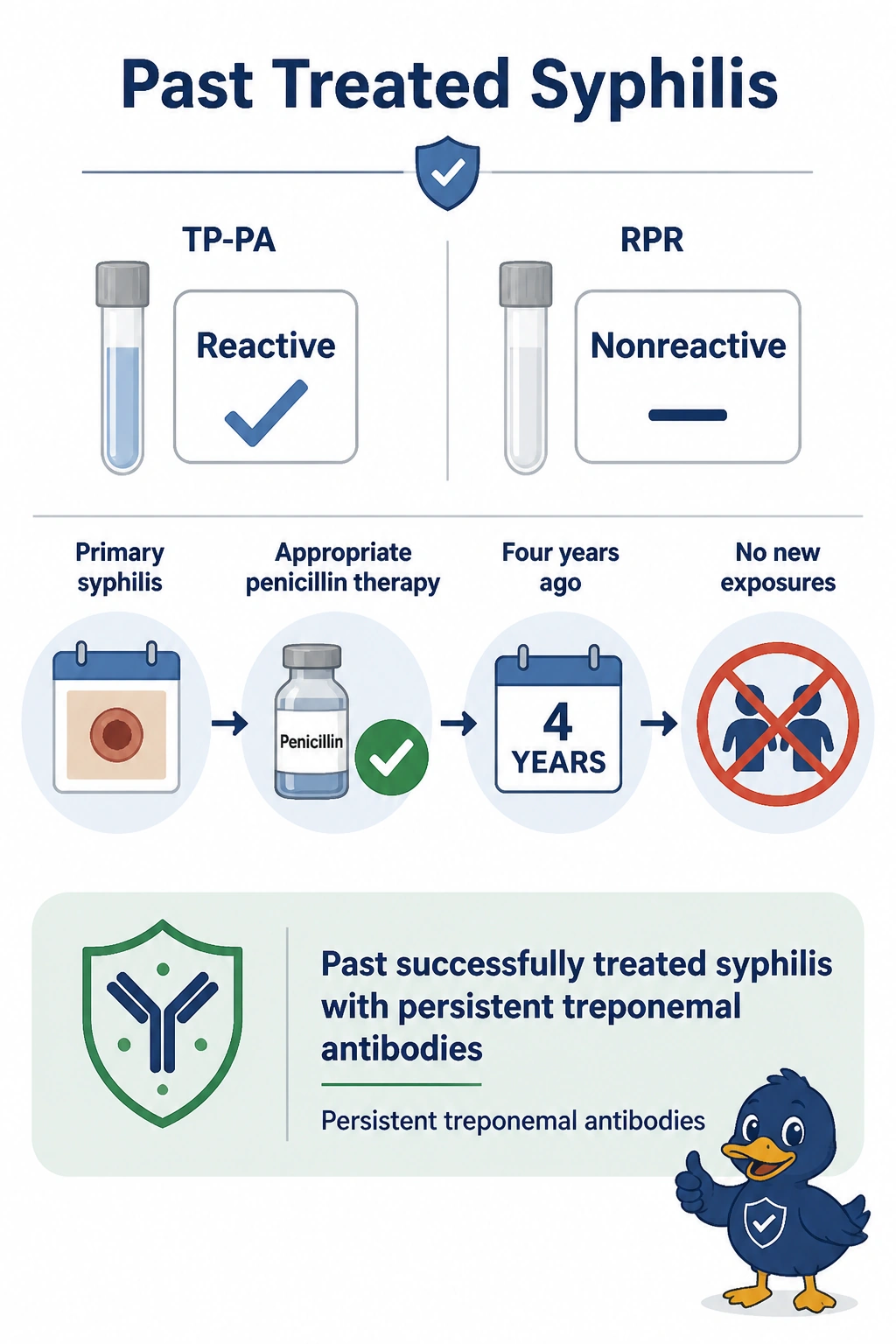
Short Explanation
A treponemal test acts like a permanent tattoo in the immune system, staying positive long after the infection is gone. The trap is seeing a reactive TP-PA and assuming your patient still has active syphilis despite a negative RPR. When treatment history is documented and the RPR is nonreactive, you are looking at past cured disease rather than a new infection.
Full Explanation
Past successfully treated syphilis with persistent treponemal antibodies is the standard interpretation when a patient with documented prior treatment has a reactive treponemal assay and a nonreactive nontreponemal test. Treponemal tests such as TP-PA detect antibodies directed against Treponema pallidum antigens and typically remain reactive for life as a serologic scar, whereas nontreponemal tests such as RPR decline and often become nonreactive after curative therapy. Active tertiary neurosyphilis requiring immediate intravenous therapy is unsupported in an asymptomatic patient with a nonreactive RPR and documented curative treatment. A false-negative RPR caused by laboratory reagent expiration only overlooks the expected serologic pattern following resolved infection. Early primary reinfection occurring before any serologic response can develop is inconsistent with the absence of new exposures and would not explain a reactive TP-PA from a brand-new exposure alone. Caveat: if a patient had high-risk re-exposure, repeat RPR testing in several weeks or clinical exam for chancres may still be warranted. Operational check: confirm documented penicillin completion in the medical record and communicate the serologic interpretation to the obstetric team to prevent unnecessary retreatment.
Prefer to study offline? Printable PDF study book + test engine ($7.50, unofficial). These questions stay free here.