
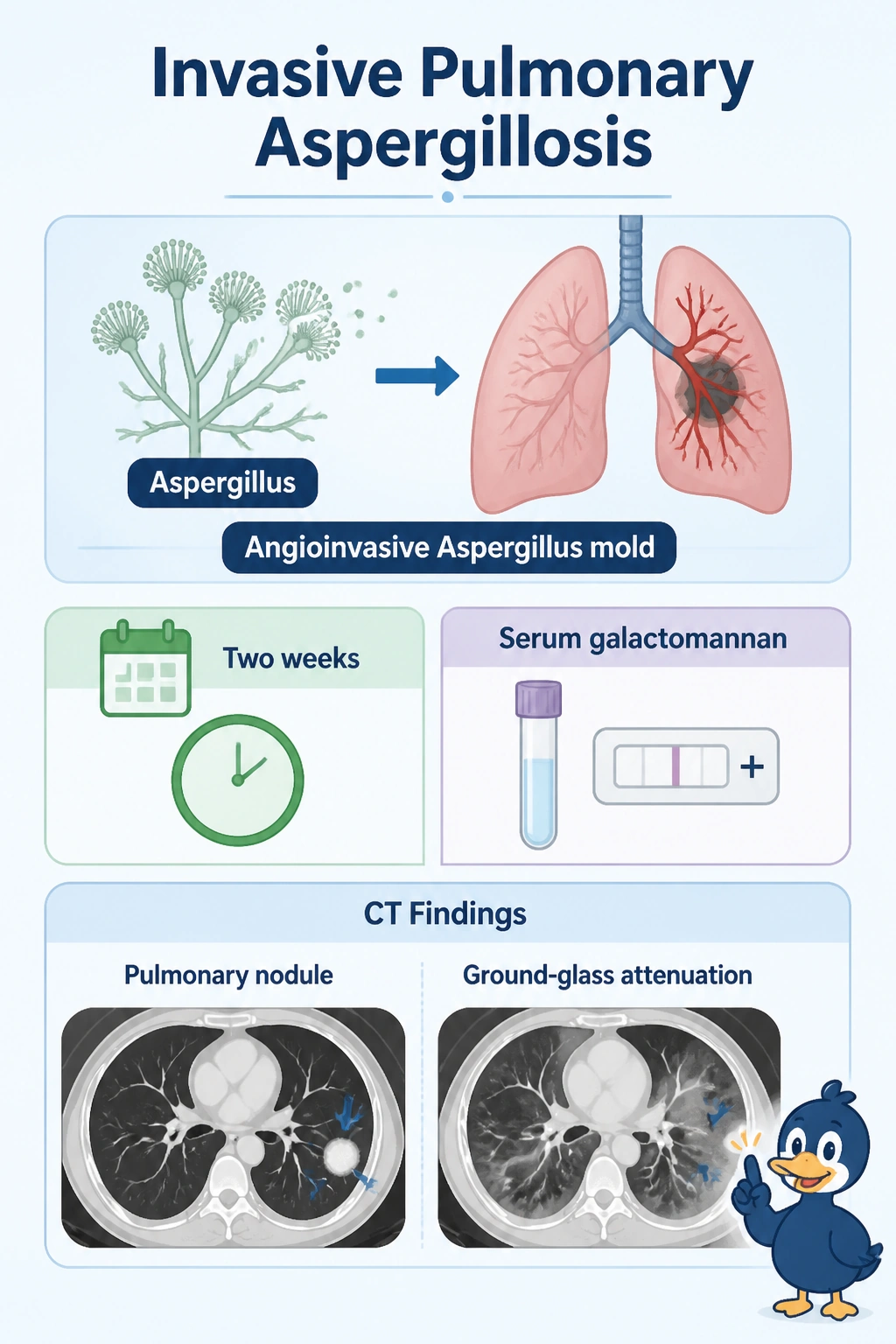
An adult with acute myeloid leukemia who has been profoundly neutropenic for two weeks develops persistent fever despite broad-spectrum antibiotics, pleuritic chest pain, and a positive serum galactomannan assay. Chest computed tomography shows a pulmonary nodule surrounded by ground-glass attenuation. Which opportunistic infection is most consistent with these findings?
Select an answer to reveal the explanation.
Short Explanation
When a profoundly neutropenic patient stays febrile on broad-spectrum antibiotics and develops chest pain with a halo sign, you should think mold, not routine bacteria. A positive galactomannan assay supports invasive pulmonary aspergillosis, and you can contrast that nodular halo pattern with the usual diffuse alveolar involvement of Pneumocystis, remembering that halo and galactomannan support but do not alone prove invasive Aspergillus disease.
Full Explanation
Invasive pulmonary aspergillosis caused by angioinvasive Aspergillus mold is the classic diagnosis in a profoundly neutropenic host with antibiotic-refractory fever, pleuritic pain, a CT halo sign representing perilesional hemorrhage, and a positive serum galactomannan assay. Galactomannan is a polysaccharide cell-wall component released during active hyphal growth of Aspergillus species. Pneumocystis jirovecii pneumonia with diffuse alveolar involvement typically presents with diffuse bilateral interstitial infiltrates and hypoxemia rather than a nodular halo sign or positive galactomannan. Reactivation pulmonary tuberculosis with apical cavitation does not cause an acute galactomannan elevation and usually produces upper-lobe cavitary lesions rather than acute angioinvasive nodules in neutropenia. Legionnaires' disease acquired from municipal water aerosols causes atypical bacterial pneumonia that is negative for fungal galactomannan. The halo sign and positive galactomannan support but do not alone prove invasive Aspergillus disease, as certain beta-lactam antibiotics or fungal cross-reactions can cause false-positive results, so clinical and radiographic correlation remains essential. Perform an operational check by notifying infection prevention and evaluating environmental air quality or construction activity on the hematology unit whenever healthcare-associated aspergillosis is suspected.
Prefer to study offline? Printable PDF study book + test engine ($7.50, unofficial). These questions stay free here.