
A skilled nursing facility transfers a critically ill resident to an acute care hospital, where a blood culture grows a yeast initially identified as Candida haemulonii by a conventional biochemical panel. Why should the infection preventionist coordinate confirmatory testing with the microbiology laboratory?
Select an answer to reveal the explanation.
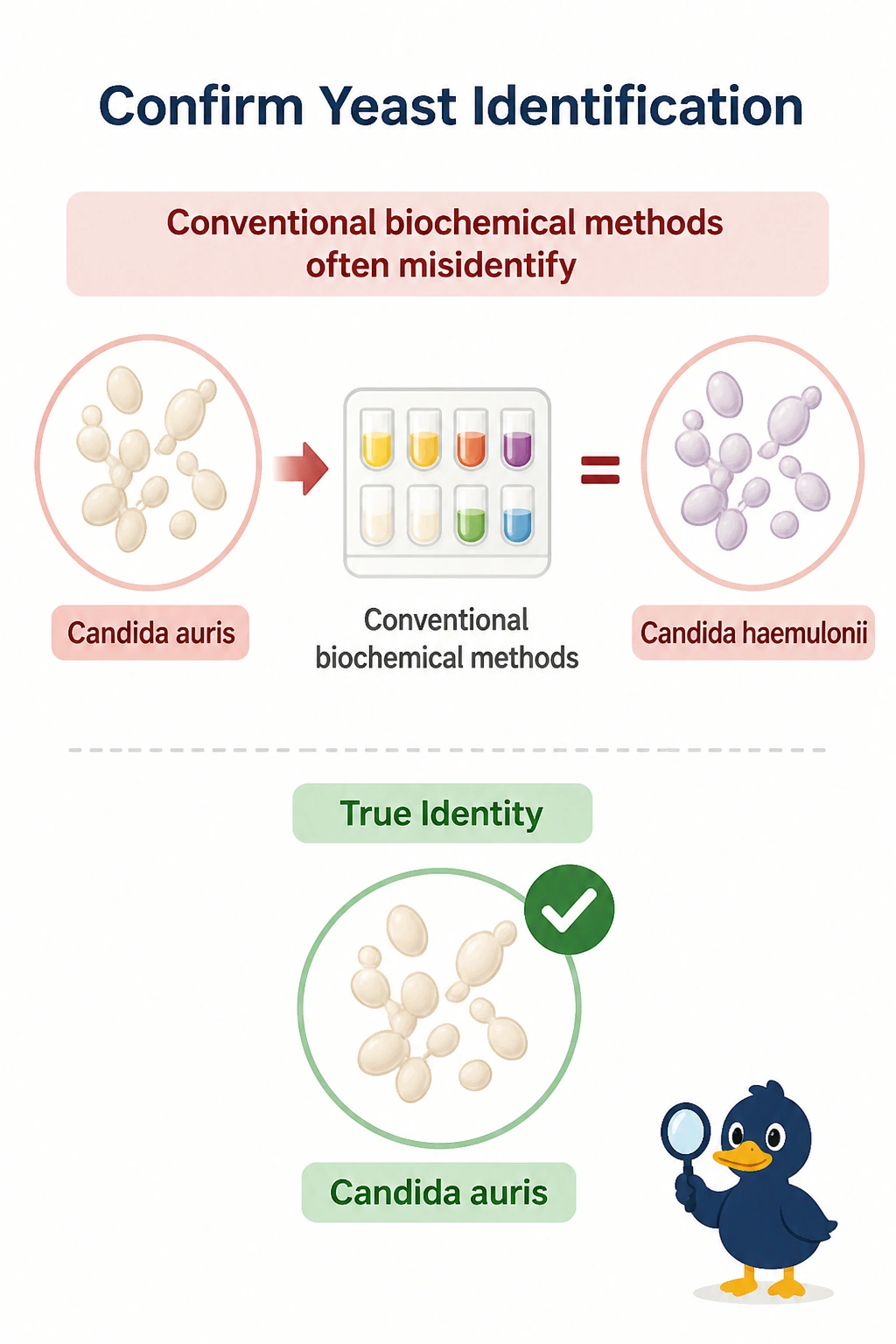
Short Explanation
Candida auris is a master of disguise on older lab panels, often wearing the name tag of a much less alarming cousin. If you accept a biochemical result like Candida haemulonii at face value, a multidrug-resistant outbreak can spread across your unit before anyone sounds the alarm. Watch for that lab red flag and confirm suspicious yeast isolates with MALDI-TOF or molecular testing.
Full Explanation
CDC guidance emphasizes that conventional biochemical methods often misidentify Candida auris as related yeast species, most commonly Candida haemulonii, Candida famata, or Rhodotorula species, depending on the automated platform used. Because C. auris causes invasive infections, frequently exhibits multidrug resistance, and persists on healthcare surfaces, accurate identification using matrix-assisted laser desorption/ionization time-of-flight mass spectrometry (MALDI-TOF MS) with updated databases or molecular sequencing is essential to trigger prompt Contact Precautions, cleaning and disinfection using an EPA-registered hospital disinfectant with a C. auris claim (List P), following its label, and public health reporting. Choosing the claim that conventional biochemical panels routinely misidentify Candida albicans as Candida haemulonii is incorrect because C. albicans is readily distinguished by standard germ-tube and biochemical tests. Choosing the claim that accepts the biochemical identification as definitive if the initial isolate appears susceptible to fluconazole is incorrect. Susceptibility does not establish species identity or exclude C. auris. Choosing the claim that antifungal susceptibility testing is unnecessary once a yeast is identified at the genus level is wrong because resistance profiles vary widely across Candida species and guide therapy. As a caveat, facilities should also implement screening and inter-facility transfer communication when C. auris is suspected or confirmed, and contact public health promptly for suspected identification, not only after confirmation. For an operational check, verify with the microbiology laboratory which automated identification platforms are in use and establish an automatic reflex pathway to confirm any C. haemulonii isolate.
Prefer to study offline? Printable PDF study book + test engine ($7.50, unofficial). These questions stay free here.