
An infection preventionist conducts a retrospective cohort study and finds that patients with central venous catheters for more than 10 days have higher bloodstream infection rates, but these patients are also older and have higher severity-of-illness scores. Which statistical method best evaluates the independent effect of catheter duration while adjusting for age and illness severity?
Select an answer to reveal the explanation.
Short Explanation
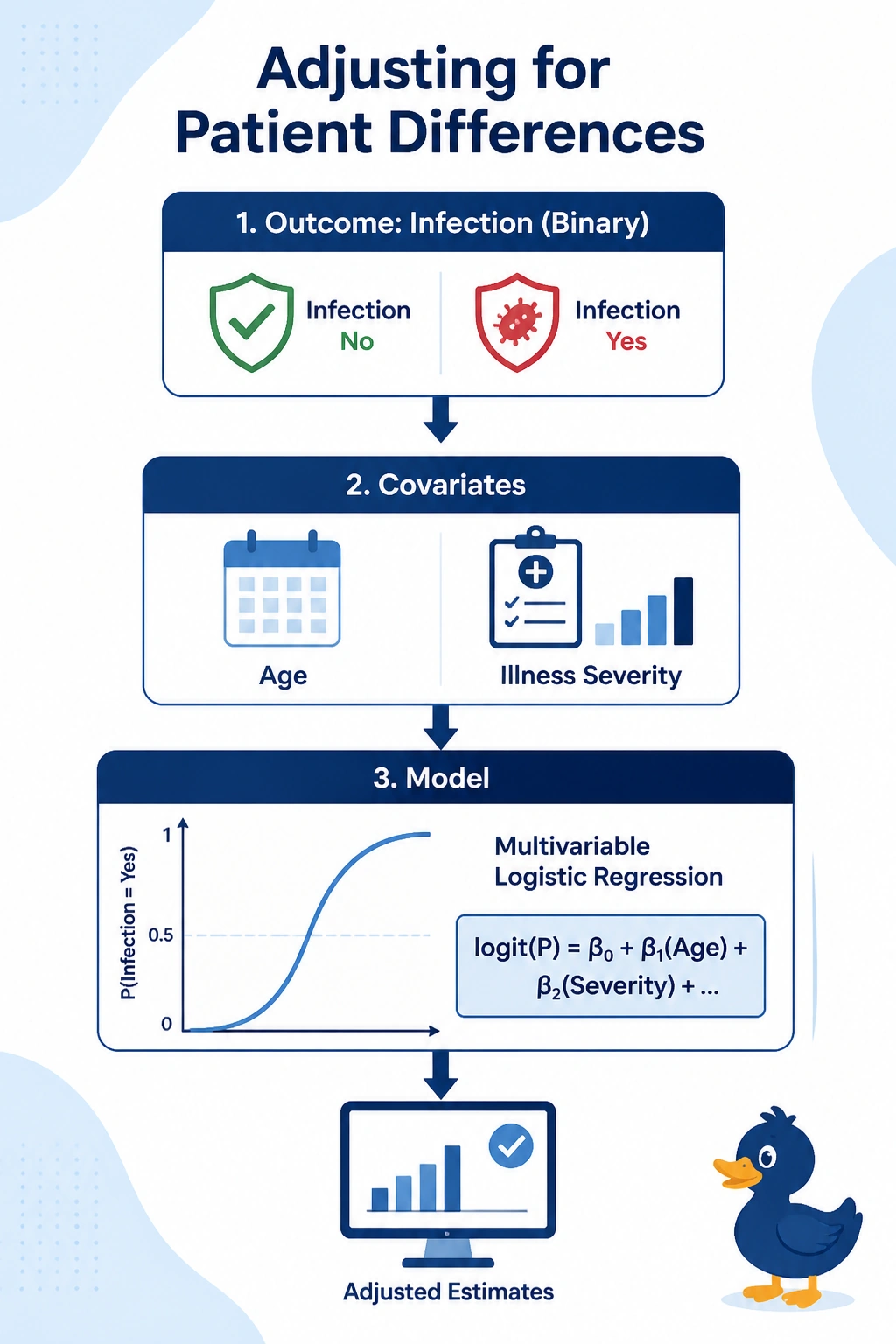
You’re seeing classic confounding: age and illness severity travel with catheter duration and can muddy its relationship with infection. A t-test, chi-square test, or paired Wilcoxon test won’t adjust for those factors in this binary outcome; multivariable logistic regression estimates the adjusted association. Interpret it with the model assumptions and possible residual confounding in mind.
Full Explanation
In an observational infection prevention study, age and illness severity may be associated with both catheter duration and bloodstream infection, so they can confound the exposure–outcome relationship. Multivariable logistic regression models infection as a binary outcome and includes age and severity as covariates, allowing estimation of the adjusted odds association for prolonged catheter duration while accounting for those factors. This approach depends on appropriate model specification and can still leave residual confounding. A two-sample Student’s t-test compares mean catheter days between groups; it does not adjust for age or severity. A chi-square test compares categorical infection proportions across units but likewise ignores individual-level covariates. A paired Wilcoxon signed-rank test is for matched or repeated non-parametric measurements, not adjustment of a binary infection outcome for multiple confounders. Exam caveat: an adjusted association does not establish causation, and too few outcome events for the included covariates can lead to overfitting. Practical check: measure catheter exposure before infection, since infection can prolong catheterization; if exposure changes over time, an appropriate survival model may be needed.
Prefer to study offline? Printable PDF study book + test engine ($7.50, unofficial). These questions stay free here.