
An ambulatory surgery center trains three nurse auditors to score surgical hand antisepsis compliance using a standardized observation checklist. During pilot testing on the same 20 procedures, the auditors' scores frequently disagree on what counts as an adequate scrub duration. Which quality metric should the infection preventionist evaluate before launching routine facility-wide audits?
Select an answer to reveal the explanation.
Short Explanation
Think of your audit team like judges at a gymnastics meet: if three judges give wildly different scores for the exact same routine, the scoreboard cannot be trusted. Before you roll out facility-wide observations, you need consistent scoring across observers. The trap is assuming a guideline-aligned form automatically produces uniform ratings without verifying agreement.
Full Explanation
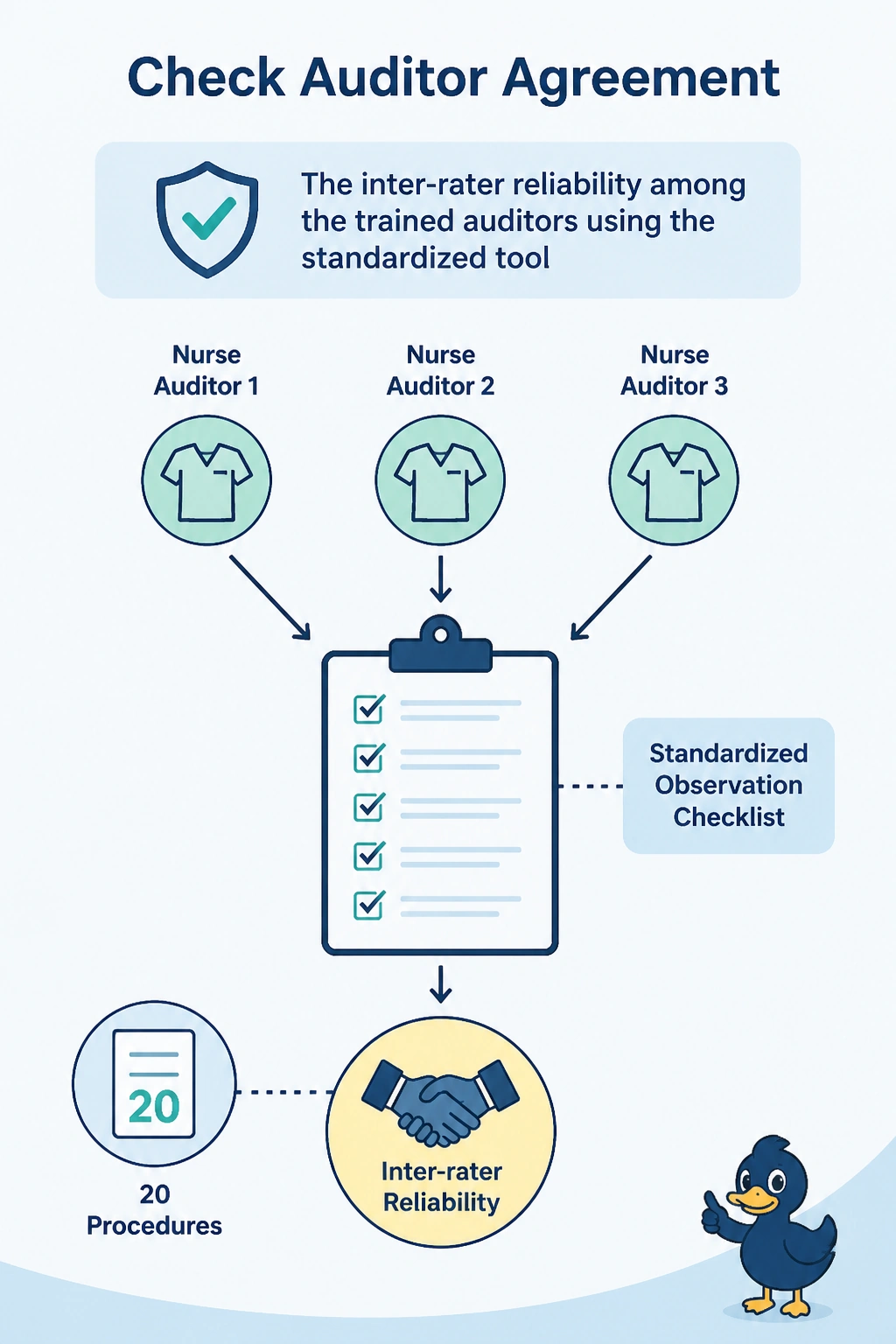
Evaluating The inter-rater reliability among the trained auditors using the standardized tool ensures that different observers score the same clinical behavior consistently, which is essential before comparing compliance rates across units or over time. When auditors disagree on scrub duration definitions, apparent changes in compliance may reflect observer inconsistency rather than real practice shifts. Checking The content validity of the checklist against national surgical guidelines confirms that the form covers the right clinical steps, but even a well-designed tool yields unusable data if raters apply it differently. Assessing The external validity of the surgical checklist across other centers addresses whether findings generalize to outside facilities, which is premature when internal scoring is unreliable. Calculating The positive predictive value of the direct observation checklist measures how often a positive test predicts true disease in diagnostic screening, not agreement between human observers. One caveat is that high agreement during a supervised pilot can still drift over time if auditors receive no periodic recalibration. As an operational check, have all auditors co-observe a sample of procedures independently, calculate percent agreement and an appropriate chance-corrected measure, such as pairwise Cohen’s kappa for two raters or Fleiss’ kappa for three categorical raters; use an appropriate continuous-rating agreement measure if measuring actual duration, and refine operational definitions before launching routine audits.
Prefer to study offline? Printable PDF study book + test engine ($7.50, unofficial). These questions stay free here.