
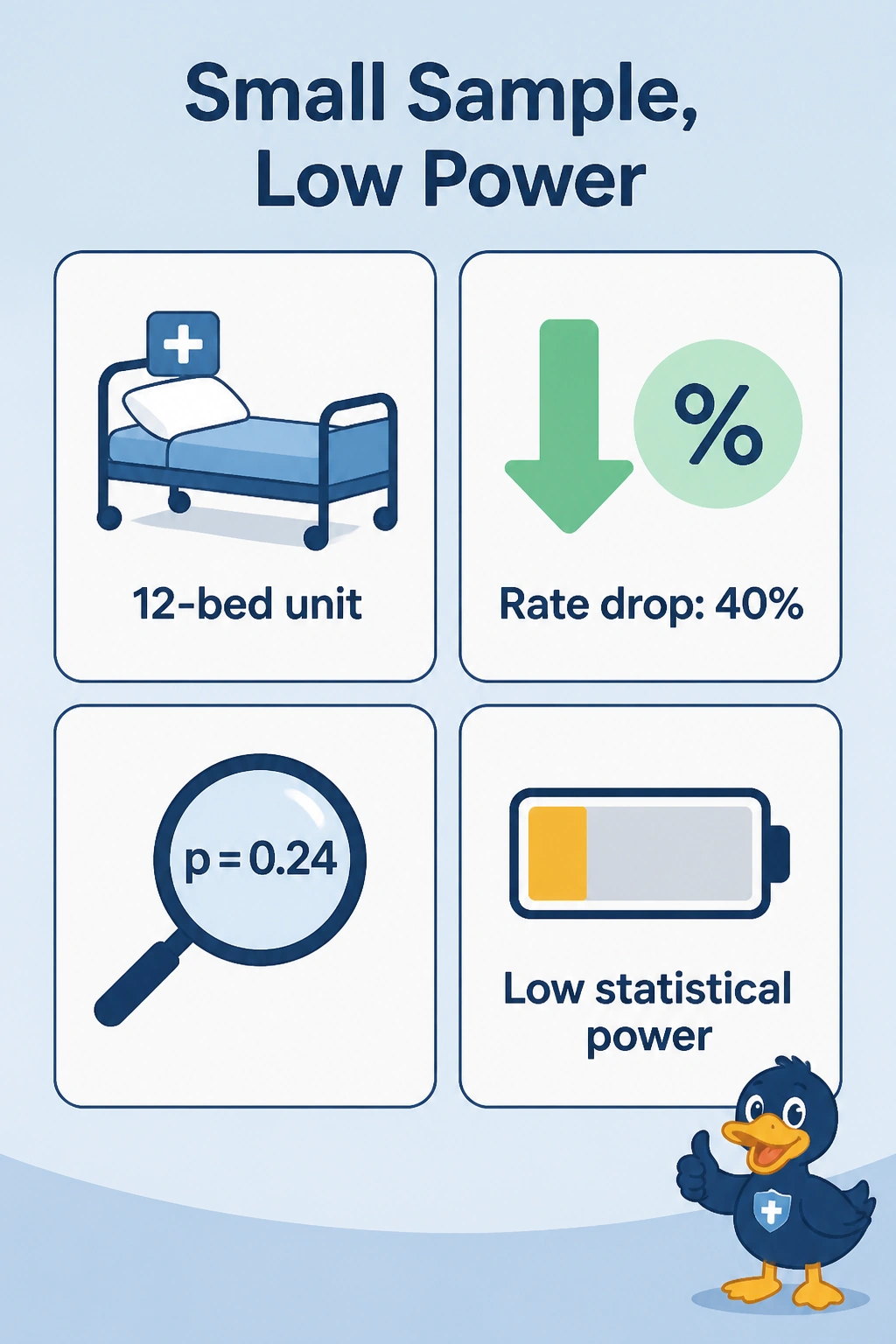
An infection preventionist evaluates a pilot study on a 12-bed unit that found no statistically significant difference in catheter-associated urinary tract infection rates after a new bundle (p = 0.24), even though the observed rate dropped by 40%. Which methodological limitation most likely explains this non-significant result?
Select an answer to reveal the explanation.
Short Explanation
Testing a large clinical drop on a tiny 12-bed unit is like trying to hear a whisper across a noisy stadium—even a real improvement can be drowned out by random variation. When a 40% drop is not statistically significant, you should suspect low statistical power from too few catheter days; a missed true difference is not a false-positive error, and including all beds does not create selection bias.
Full Explanation
Insufficient statistical power due to a small sample size best explains why a clinically meaningful 40% reduction in infection rates on a 12-bed unit can yield a non-significant p-value of 0.24. Statistical power—the ability to detect a true effect—depends heavily on sample size and event counts; in small units with relatively few catheter days, wide confidence intervals make Type II errors (false negatives) common. A Type I error caused by using an overly strict alpha threshold of 0.05 is not the explanation: it confuses a false positive with a false negative, and alpha 0.05 is standard. Selection bias from including all twelve beds is also not the explanation, because enrolling the entire unit avoids sampling bias within that ward. Confounding from calculating a parametric p-value on rate data misidentifies confounding, which involves an external variable distorting an association rather than an inadequate sample size. As an exam caveat, a non-significant pilot p-value does not prove the intervention failed; the study may simply be underpowered to confirm the difference. For a practical check, perform a sample-size and power calculation across multiple units or extended baseline months before launching a formal effectiveness evaluation.
Prefer to study offline? Printable PDF study book + test engine ($7.50, unofficial). These questions stay free here.