
A 25-year-old man with type 1 diabetes is transitioning from multiple daily injections to an insulin pump and asks why an occluded infusion set can cause diabetic ketoacidosis faster than missed meal boluses. Which physiological explanation should the specialist give?
Select an answer to reveal the explanation.
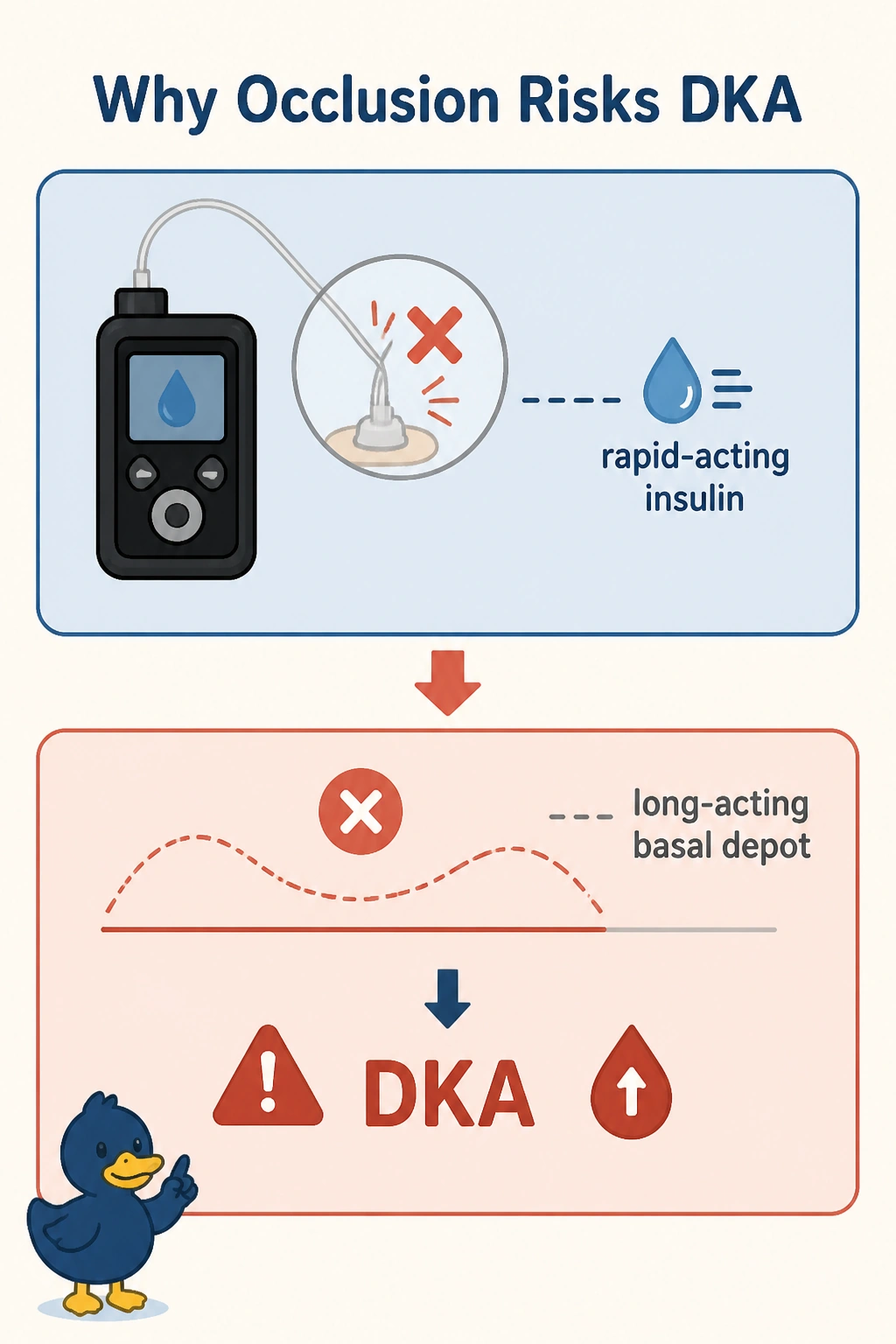
Short Explanation
An insulin pump works like a steady drip faucet with no backup tank underneath. The trap is assuming you have hours of cushion like you did with once-daily basal shots, so you must recognize how fast insulin levels fall when tubing blocks.
Full Explanation
Explaining that Pumps deliver only rapid-acting insulin without a long-acting basal depot clarifies why pump interruptions precipitate diabetic ketoacidosis rapidly in standard rapid-acting-only therapy. Because a pump infuses tiny amounts of rapid-acting insulin continuously, stopping flow leaves no long-acting reserve, allowing unopposed lipolysis and ketogenesis to accelerate within hours. The claim that Pump infusion creates a long-acting depot that remains effective for a full day after delivery stops is incorrect, as no depot forms and circulating insulin falls quickly once delivery stops. Saying that Pump insulin has a longer duration than the same rapid-acting insulin injected by pen misstates pharmacology, because the same molecule has the same short action whether given by pump or pen. Suggesting that Occlusion stops meal boluses but leaves background insulin delivery intact misunderstands mechanics, since basal and boluses share one cannula so occlusion blocks all delivery. As a safety caveat, mild hyperglycemia from an unnoticed occlusion can look identical to a missed bolus at first glance. For an operational check, verify that the patient can state when to check ketones, how to replace the infusion set, and where backup pens or syringes are stored.
Prefer to study offline? Printable PDF study book + test engine ($7.50, unofficial). These questions stay free here.