
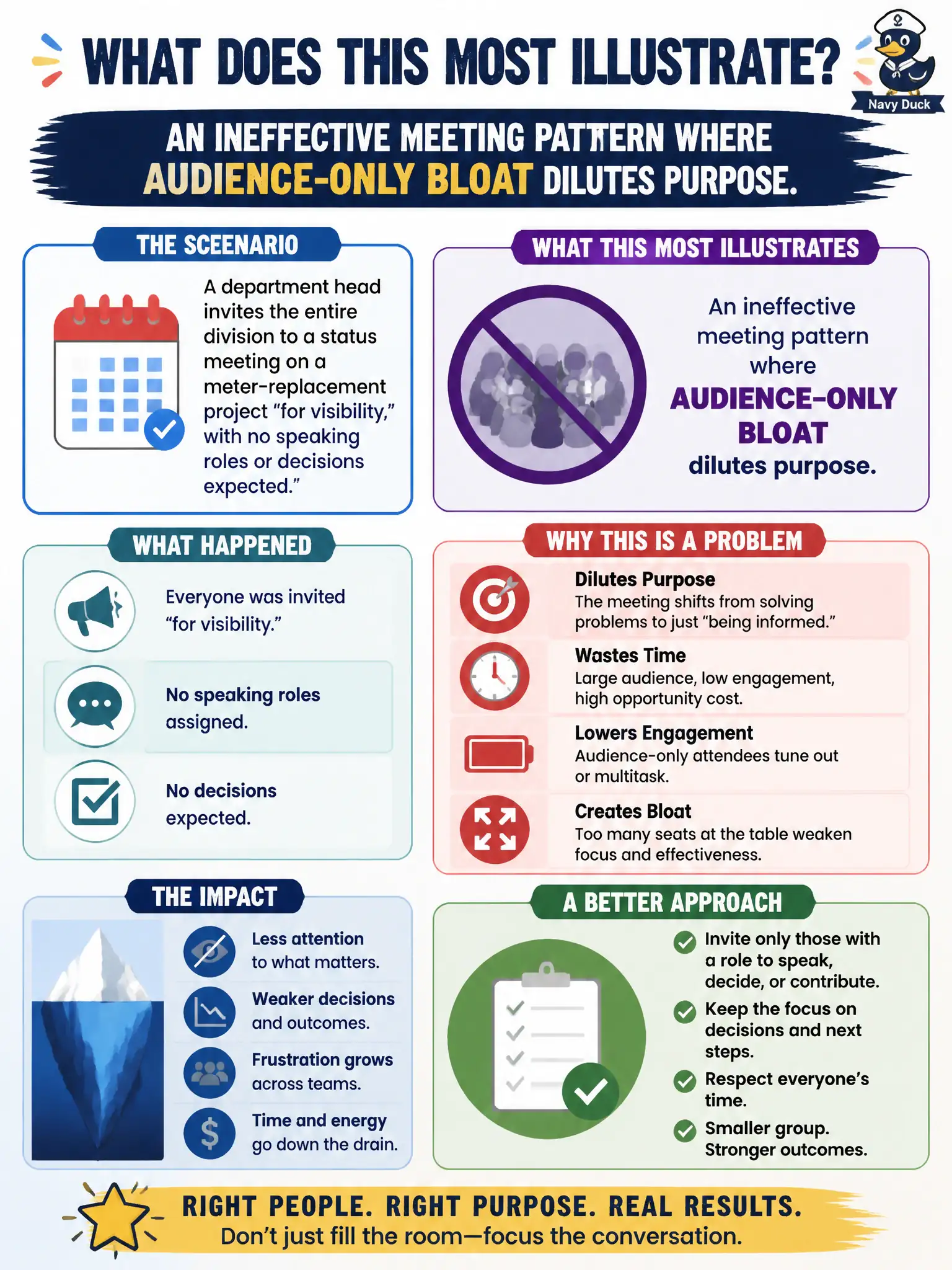
A department head invites the entire division to a status meeting on a meter-replacement project “for visibility,” with no speaking roles or decisions expected. What does this most illustrate?
Select an answer to reveal the explanation.
Short Explanation
Visibility without a job to do is just a crowded room. If nobody speaks and nothing gets decided, you have built an audience, not a meeting. Effectiveness comes from purpose, roles, and outcomes—not headcount.
Full Explanation
Inviting an entire division to a meter-replacement status meeting “for visibility,” with no speaking roles or decisions expected, most illustrates an ineffective meeting pattern where audience-only bloat dilutes purpose. Visibility can be achieved through concise notes or dashboards without consuming dozens of staff hours. Meetings without roles or decisions rarely justify broad mandatory attendance on civic programs.
That pattern is not an effective timeboxed decision forum with clear outcomes. It is not a focus group designed for qualitative concept testing. It is not a standup limited to blockers and next steps. Those formats have intentional participation models this meeting lacks.
Exam caveat: CAPM associates should challenge “invite everyone for visibility” as a default. Right-sizing attendance is part of meeting effectiveness and respectful use of public workforce time.
Operational check: redefine the meeting’s purpose, invite only people with decision or update roles, publish a short status note to the wider division, and measure success by decisions or cleared blockers—not headcount. Status “visibility” for a division is often better served by a one-page dashboard or recorded briefing than by a live audience of dozens. Protect meeting time for roles that change outcomes on meter replacement.