
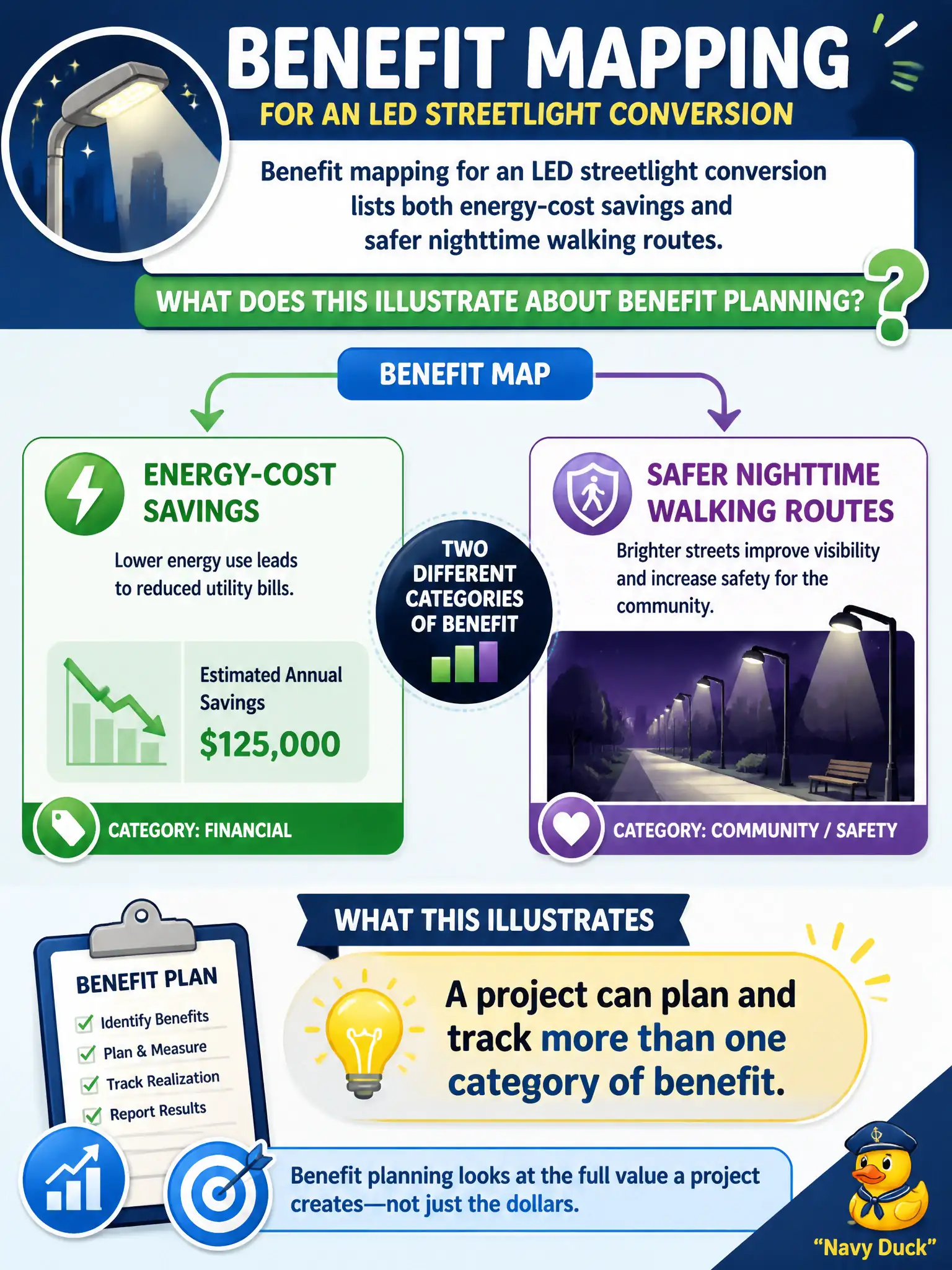
Benefit mapping for an LED streetlight conversion lists both energy-cost savings and safer nighttime walking routes. What does this illustrate about benefit planning?
Select an answer to reveal the explanation.
Short Explanation
Streetlights can save kilowatt-hours and make night walks feel safer—both are real benefits. Good benefit plans can carry more than one category at once. Track the money and the safety outcomes without forcing a single bucket.
Full Explanation
Benefit mapping for an LED streetlight conversion that lists both energy-cost savings and safer nighttime walking routes shows that a project can plan and track more than one category of benefit. Municipal investments frequently combine financial and community-outcome value. Good benefit planning makes each category explicit so neither savings nor safety is treated as an afterthought.
Restricting municipal benefit plans to financial savings alone ignores legitimate non-financial outcomes councils often fund. Claiming safety outcomes cannot be planned benefits contradicts common civic business cases. Saying benefit mapping replaces a schedule baseline confuses value definition with time-phased delivery control.
Exam caveat: CAPM benefit concepts allow multiple benefit types; associates should still insist each benefit is measurable or assessable and owned. Qualitative or safety benefits need indicators, not vague aspiration, even when they are not pure dollar line items.
Operational check: for each mapped benefit, record category, indicator, baseline, target, owner, and reporting method—energy savings via utility data and safety via agreed nighttime incident or perception measures—then keep both on the benefit register.