
A junior analyst on a municipal bridge repair is learning earned value at CAPM depth. Which statement correctly describes schedule variance (SV) and cost variance (CV) without requiring advanced forecasting formulas?
Select an answer to reveal the explanation.
Short Explanation
Keep it simple: schedule variance asks whether earned progress matches the plan date-wise, and cost variance asks whether that earned progress cost what it should. Morale meters and deleting baselines are not the point. Associate-level literacy is knowing what each variance compares.
Full Explanation
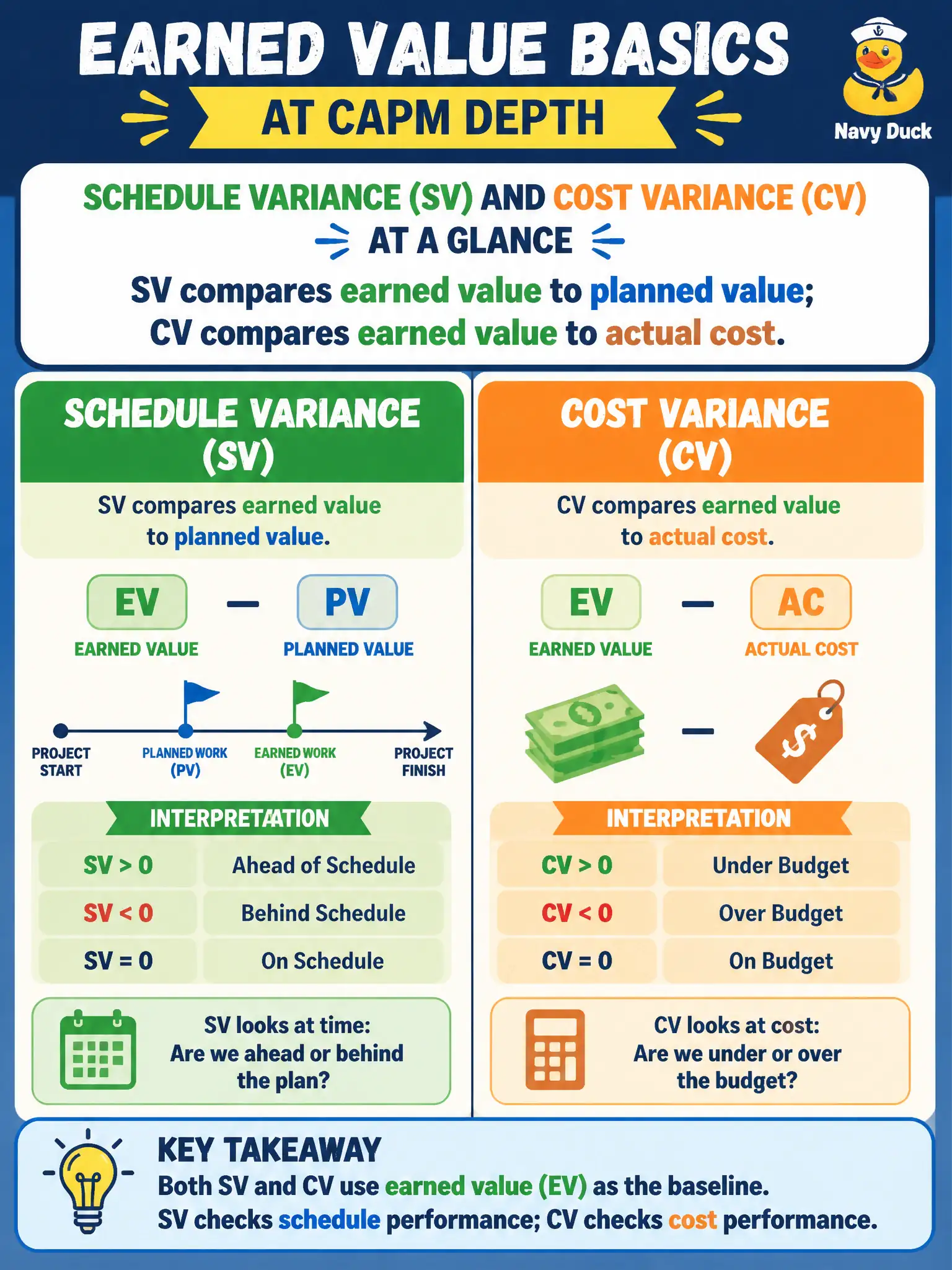
At CAPM associate depth, schedule variance (SV) compares earned value to planned value to indicate whether earned progress is ahead of or behind the plan, and cost variance (CV) compares earned value to actual cost to indicate whether that earned progress cost more or less than expected. On a municipal bridge repair, those two comparisons give separate schedule-side and cost-side readings without requiring advanced forecasting indices. The definitions keep EV as the shared anchor: versus PV for schedule, versus AC for cost.
Claiming SV and CV are identical morale metrics fails conceptually because they are quantitative performance measures against plan and cost, not team-happiness scores, and they are not the same calculation. Stating that SV always equals actual cost and CV always equals planned value fails because that reverses and confuses the formulas. Asserting that SV and CV replace the need for any schedule or cost baseline fails because variances are meaningful only relative to planned value, baselines, and actuals; they inform control, they do not abolish planning artifacts.
Exam caveat: CAPM focuses on comparative meaning of SV and CV; deeper SPI/CPI forecasting nuance may appear elsewhere, but associates must not invent morale meanings or claim variances erase baselines. Operational check: for the bridge package, compute SV = EV − PV and CV = EV − AC from the same EV figure, report schedule and cost positions separately to public-works leadership, and escalate per thresholds when either variance breaches plan limits.