
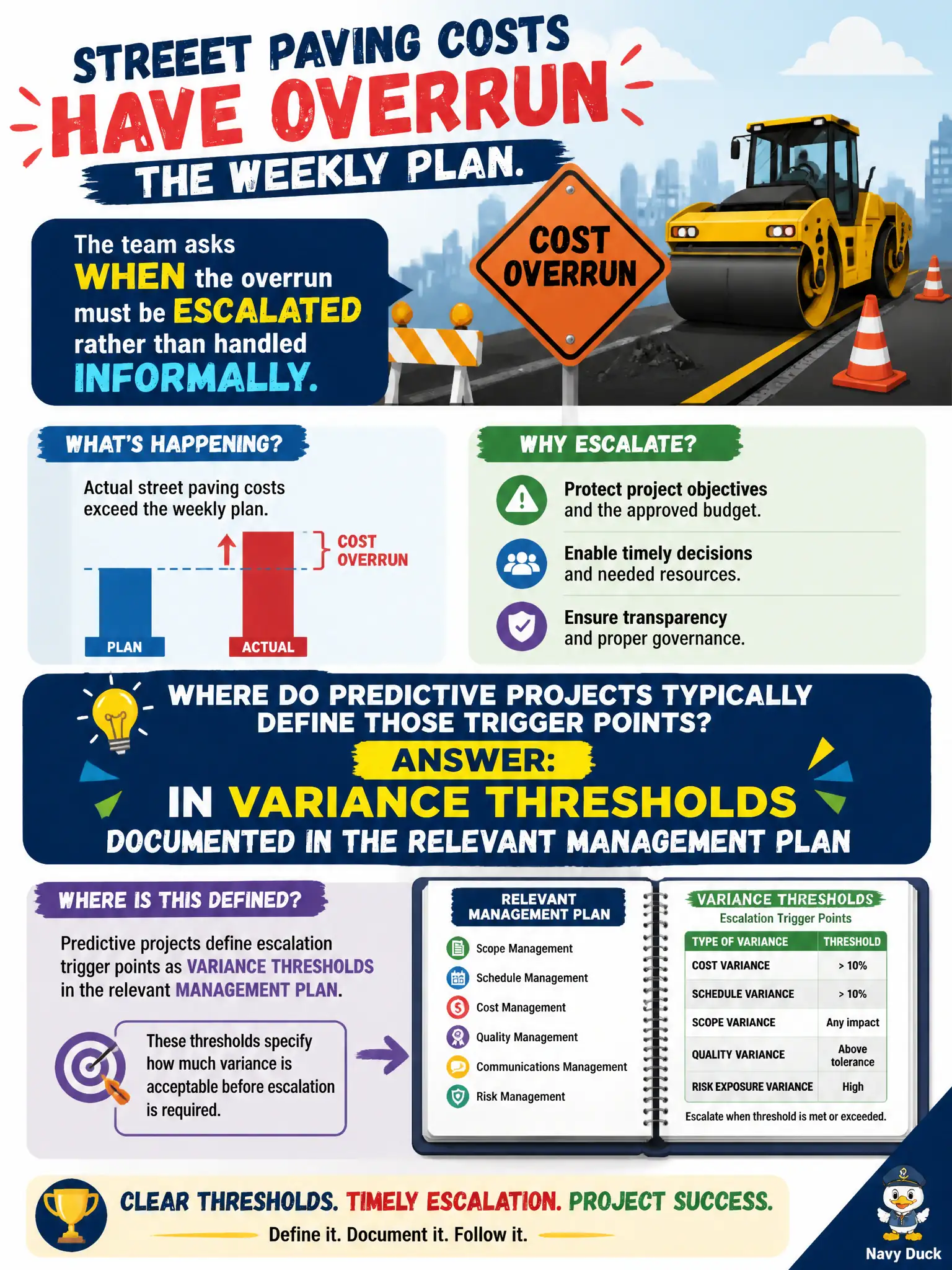
Street paving costs have overrun the weekly plan. The team asks when the overrun must be escalated rather than handled informally. Where do predictive projects typically define those trigger points?
Select an answer to reveal the explanation.
Short Explanation
Variance thresholds are the speed-limit signs in the management plan — they say how far paving costs can drift before you must escalate. Suggestion boxes and social posts are noise, not control rules. The plan turns a calculated overrun into a required action.
Full Explanation
When street paving costs overrun the weekly plan, predictive projects typically define escalation trigger points as variance thresholds documented in the relevant management plan—commonly the cost management plan, sometimes coordinated with schedule or overall project management plan provisions. Those thresholds state how much cost (or schedule) performance may deviate before informal handling must give way to escalation, corrective action, or governance review. They convert measurement into required management behavior for civic paving programs.
An anonymous suggestion box with no cost data fails conceptually because suggestions are not quantitative control rules tied to earned or planned cost performance. A social media comment thread about potholes fails because public commentary is stakeholder noise relative to the project's internal variance governance, not the documented trigger definition. A vendor lunch menu for the paving crew fails because it has no relationship to cost-control thresholds or escalation criteria.
Exam caveat: Associates should look to management-plan thresholds—not informal culture or external chatter—when asked where predictive projects define when variance must escalate. Operational check: open the cost management plan for the paving effort, locate the variance thresholds, compare current overrun magnitude to those limits, and escalate through the stated channel when the threshold is crossed, documenting the action for the municipal record.