
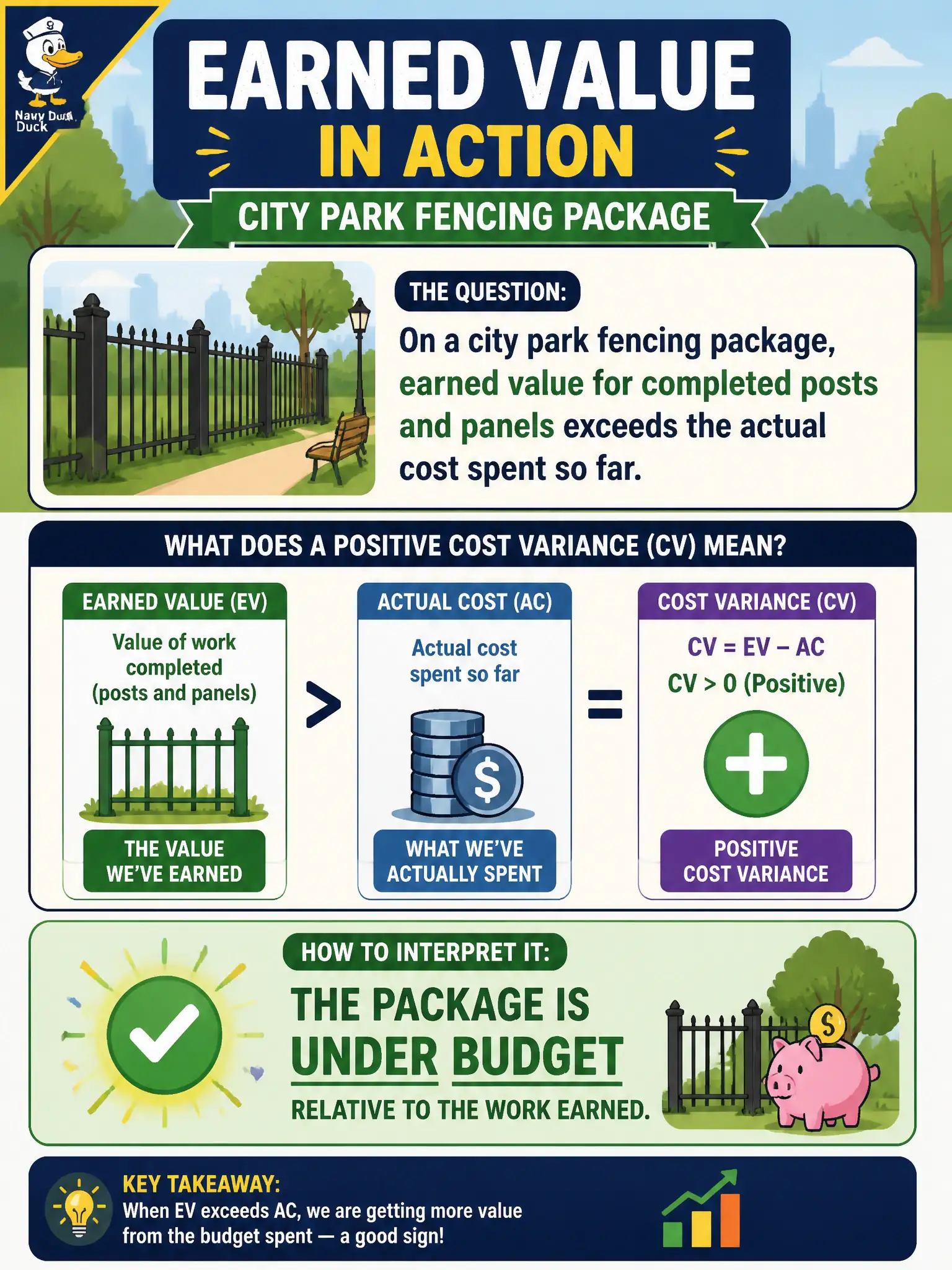
On a city park fencing package, earned value for completed posts and panels exceeds the actual cost spent so far. How should the team interpret the positive cost variance (CV)?
Select an answer to reveal the explanation.
Short Explanation
Positive cost variance is good news on the fencing ledger: you earned more value than you spent, so the work done so far cost less than planned for that progress. It is not a schedule signal and not an automatic cancel button. Under budget relative to earned work is the plain reading.
Full Explanation
Cost variance is defined as earned value minus actual cost (CV = EV − AC). When earned value for completed park fencing posts and panels exceeds actual cost spent so far, CV is positive, which means the package is under budget relative to the work earned to date. In civic fencing terms, the city has received more budgeted worth of completed work than it has paid for that progress—an favorable cost position on the work performed, not a schedule reading by itself.
Interpreting positive CV as behind schedule fails conceptually because schedule performance is assessed with schedule variance (SV = EV − PV) or related schedule measures, not by treating CV as a timing signal. Claiming the package must be cancelled because any variance ends the job fails because variances are control information; favorable or unfavorable readings trigger thresholds and analysis, not automatic cancellation. Saying the package is over budget relative to work earned fails because that is the meaning of a negative CV, the opposite of the positive reading described.
Exam caveat: CAPM associates must keep EV, PV, and AC roles straight and avoid equating every variance with project failure or with schedule status. Operational check: confirm EV and AC for the fencing package, compute CV, report "under budget for work earned" when CV is positive, and still review SV separately before telling parks leadership the full performance story.