
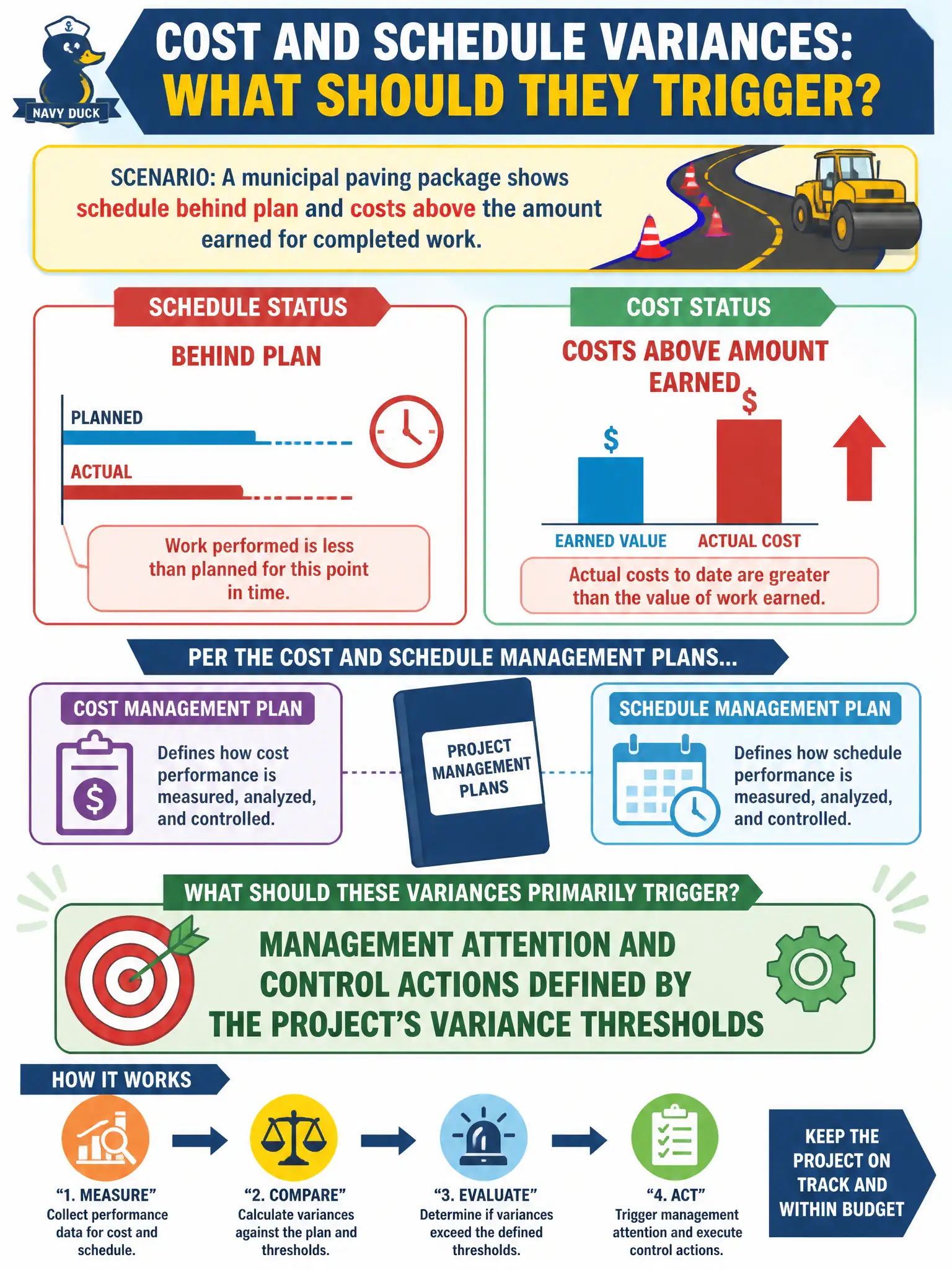
A municipal paving package shows schedule behind plan and costs above the amount earned for completed work. Per the cost and schedule management plans, what should those calculated variances primarily trigger?
Select an answer to reveal the explanation.
Short Explanation
Variances are the dashboard lights on the paving truck — behind schedule and over cost means someone needs to look, not throw the gauge away. Thresholds in the management plan say when those lights force a call upstairs. Deleting the WBS or skipping thresholds just hides the problem.
Full Explanation
When a municipal paving package shows schedule behind plan and costs above the amount earned for completed work, schedule variance and cost variance are performance signals that should primarily trigger management attention and the control actions defined by the project's documented variance thresholds. Cost and schedule management plans typically specify how far performance may drift before escalation, corrective action, or formal recovery planning is required. For civic paving, those thresholds turn raw earned-value results into governed responses rather than ad-hoc panic or silence.
Deleting the WBS so variances no longer appear fails conceptually because destroying the scope hierarchy does not restore performance and removes the structure needed to diagnose and recover work packages. Replacing earned value with only verbal status at the next picnic fails because informal storytelling is not a substitute for quantitative control against baselines and thresholds. Ignoring thresholds because civic projects never escalate fails because public projects still require escalation discipline; civic status does not exempt teams from management-plan triggers.
Exam caveat: CAPM-level earned-value questions emphasize interpretation and threshold-driven response, not inventing exotic indices or erasing planning artifacts when results look bad. Operational check: calculate SV and CV for the paving package, compare them to the variance thresholds in the relevant management plans, initiate the prescribed escalation or corrective path, and document the decision so the municipal record shows why attention was raised.