
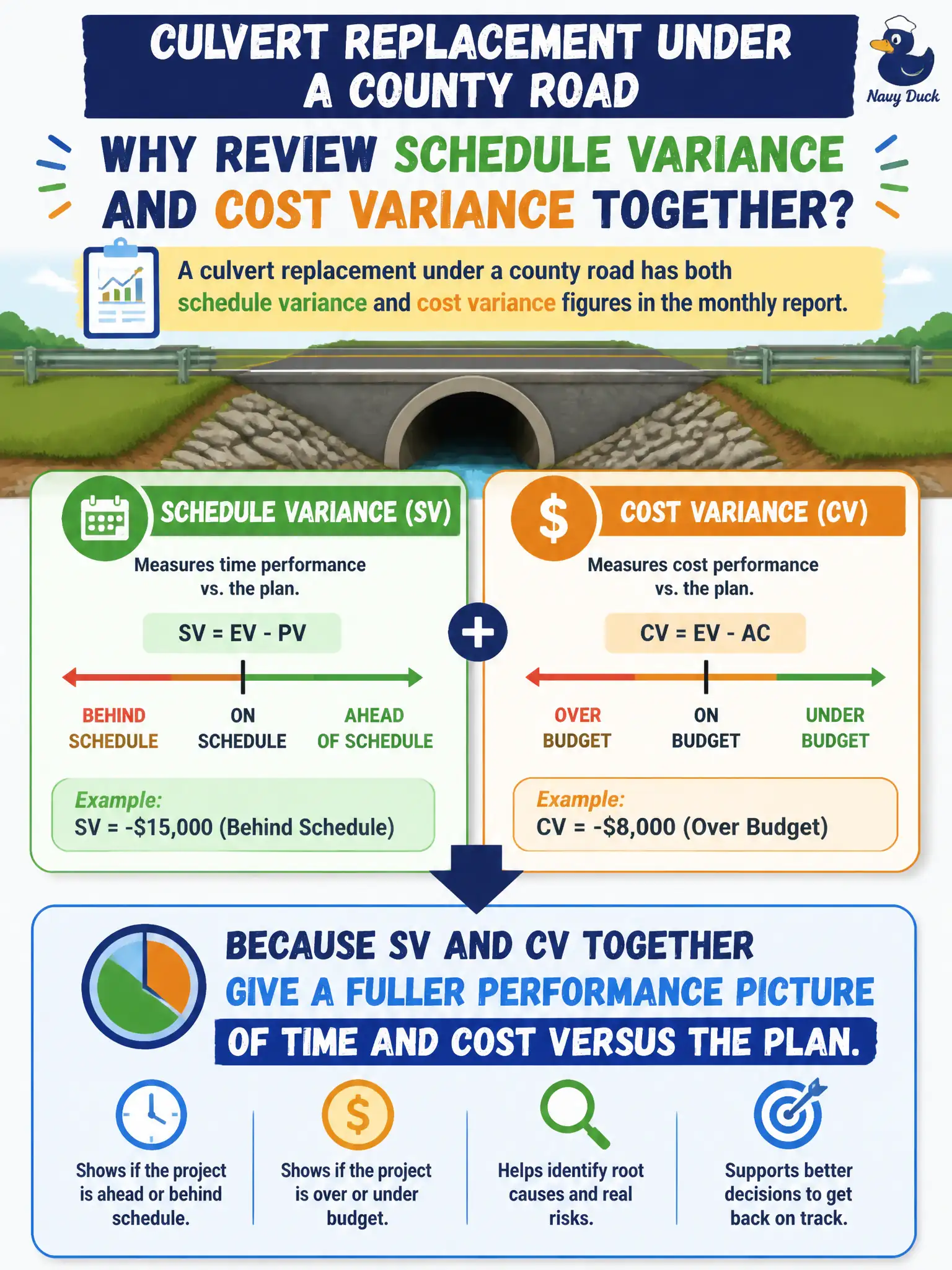
A culvert replacement under a county road has both schedule variance and cost variance figures in the monthly report. Why review them together?
Select an answer to reveal the explanation.
Short Explanation
Looking at schedule variance and cost variance side by side is like checking both the clock and the budget on the culvert—either one alone can lie about overall health. Together they sketch time and money versus the plan.
Full Explanation
A culvert replacement under a county road that reports both schedule variance and cost variance should be reviewed with both figures together because SV and CV together give a fuller performance picture of time and cost versus the plan. A package can be ahead of schedule and over budget, or the reverse; one metric alone misleads civic sponsors. Predictive control is multidimensional.
SV is not the only metric that matters with CV merely decorative on civil jobs. CV is not the only metric with SV unused in predictive methods—both are standard. Variances also do not replace the need for a scope baseline after notice to proceed; scope remains the reference for what work earns value.
Exam caveat: Associates should habitually read SV and CV as a pair, then connect them to scope status and forecasts. Single-metric status calls are a common exam distractor and real-world failure mode.
Operational check: in the monthly culvert report, present SV and CV with plain-language meanings, add trend/forecast, confirm scope baseline alignment for earned claims, and recommend actions that address the weaker dimension without ignoring the other. Add a simple quadrant or narrative that states ahead/behind and under/over together. County sponsors grasp paired SV/CV language faster than isolated percentages.