
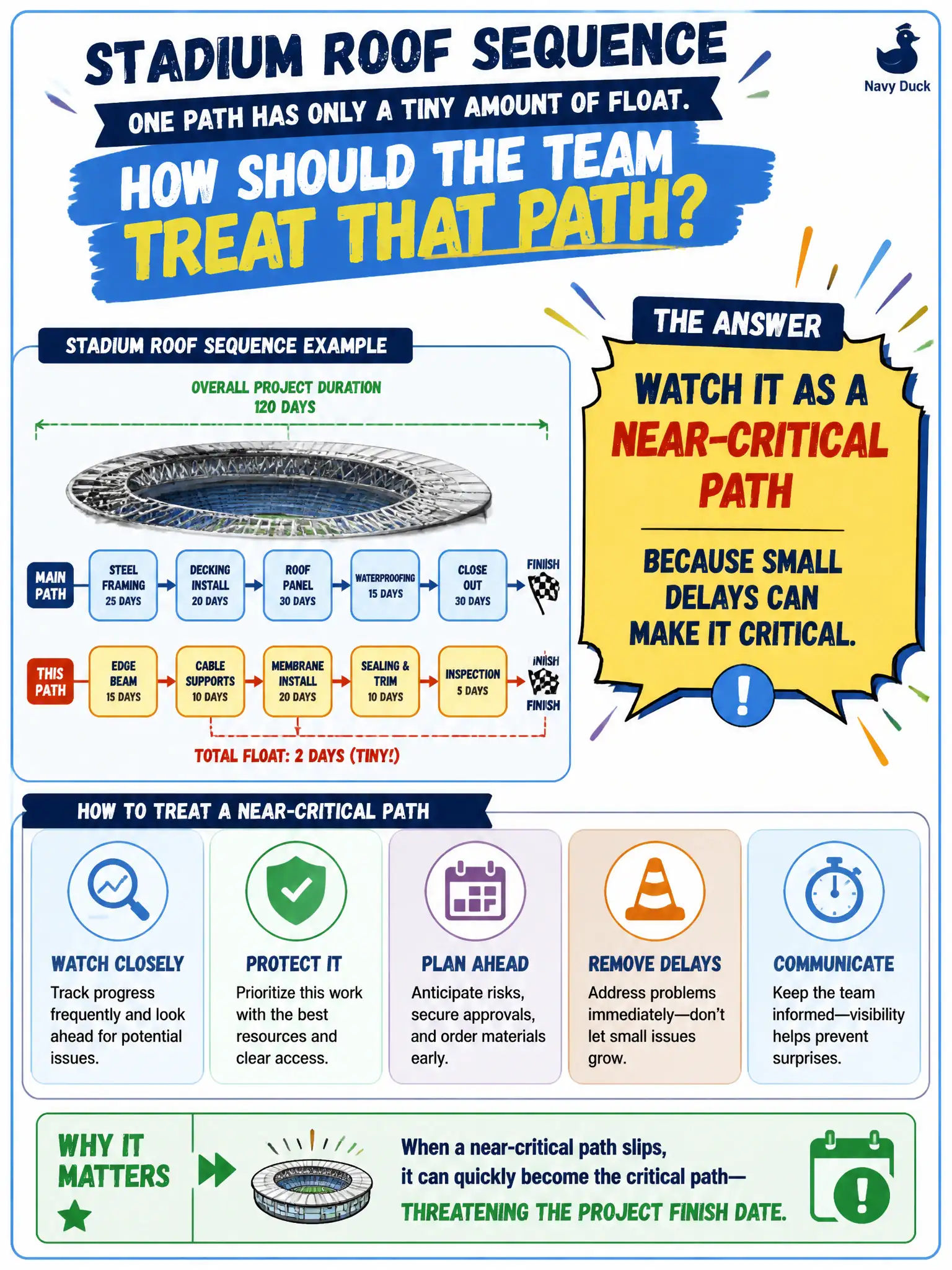
On a stadium roof sequence for a city venue, one path has only a tiny amount of float. How should the team treat that path?
Select an answer to reveal the explanation.
Short Explanation
Tiny float is a yellow light on that roof path—one bad weather day and it becomes the new critical chain. Near-critical paths deserve eyes, not a shrug.
Full Explanation
On a stadium roof sequence for a city venue, a path with only a tiny amount of float should be watched as a near-critical path because small delays can make it critical. Near-critical paths are schedule risks even when they are not currently the longest path. Predictive teams monitor them so civic opening nights are not surprised by a secondary path becoming critical.
Ignoring any float as zero schedule risk forever underestimates how quickly small float disappears. Deleting the path from the network to simplify float reporting hides risk rather than managing it. Converting the path into a cost baseline line item and stopping scheduling it abandons time control for that work.
Exam caveat: Associates should recognize near-critical path monitoring as part of schedule risk awareness, not only “the” critical path.
Operational check: flag paths with minimal float in weekly schedule reviews, report them alongside the critical path, protect them from avoidable delay, and recompute criticality after status updates. Quantify “tiny float” with hours or days in reports so sponsors understand sensitivity. Near-critical watch lists should be reviewed whenever status updates change remaining float.