
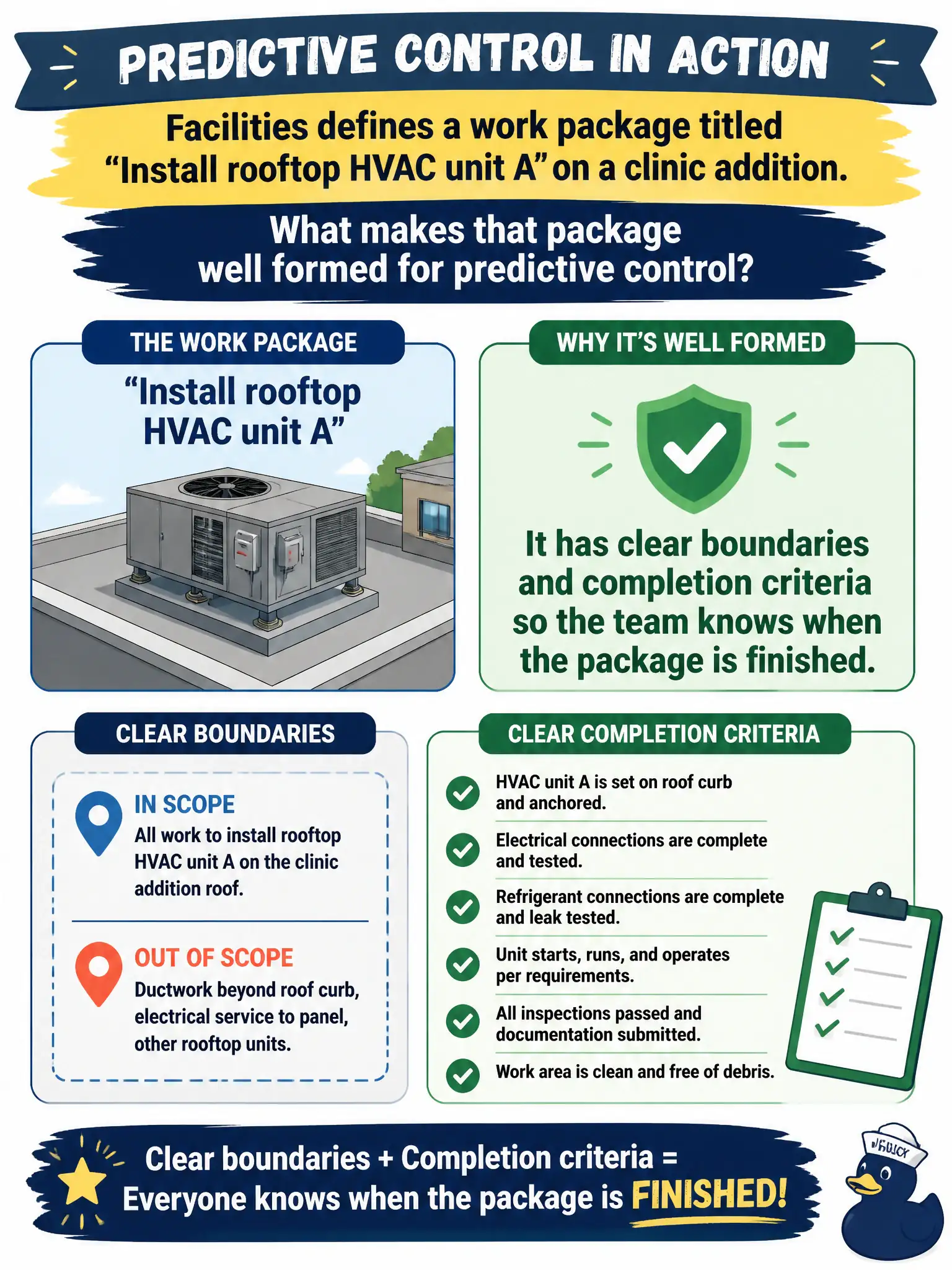
Facilities defines a work package titled “Install rooftop HVAC unit A” on a clinic addition. What makes that package well formed for predictive control?
Select an answer to reveal the explanation.
Short Explanation
A good work package is a clean finish line—“unit A is installed and meets the stated done checks”—not a fog bank. Clear boundaries keep the clinic addition measurable instead of endless.
Full Explanation
A work package titled “Install rooftop HVAC unit A” on a clinic addition is well formed for predictive control when it has clear boundaries and completion criteria so the team knows when the package is finished. Completion criteria enable estimating, progress claims, and acceptance. Civic facilities projects depend on that crispness to avoid endless “almost done” status.
Intentionally omitting completion criteria so crews invent “done” on site destroys objective control. Merging every HVAC unit campus-wide into one undated umbrella task over-aggregates and weakens monitoring. Listing only manufacturer logo colors without installation scope misses the actual work to be performed.
Exam caveat: CAPM work-package quality centers on manageable scope with clear done conditions. Vague or cosmetic packages fail predictive control tests.
Operational check: write explicit boundaries and completion criteria for unit A (installed, connected, tested, accepted), keep other units as separate packages, and use those criteria for progress and handover. Include interfaces (power, controls, structural penetrations) in boundaries so “unit A installed” cannot be claimed while unfinished interfaces remain. Completion criteria should be binary enough for acceptance.