
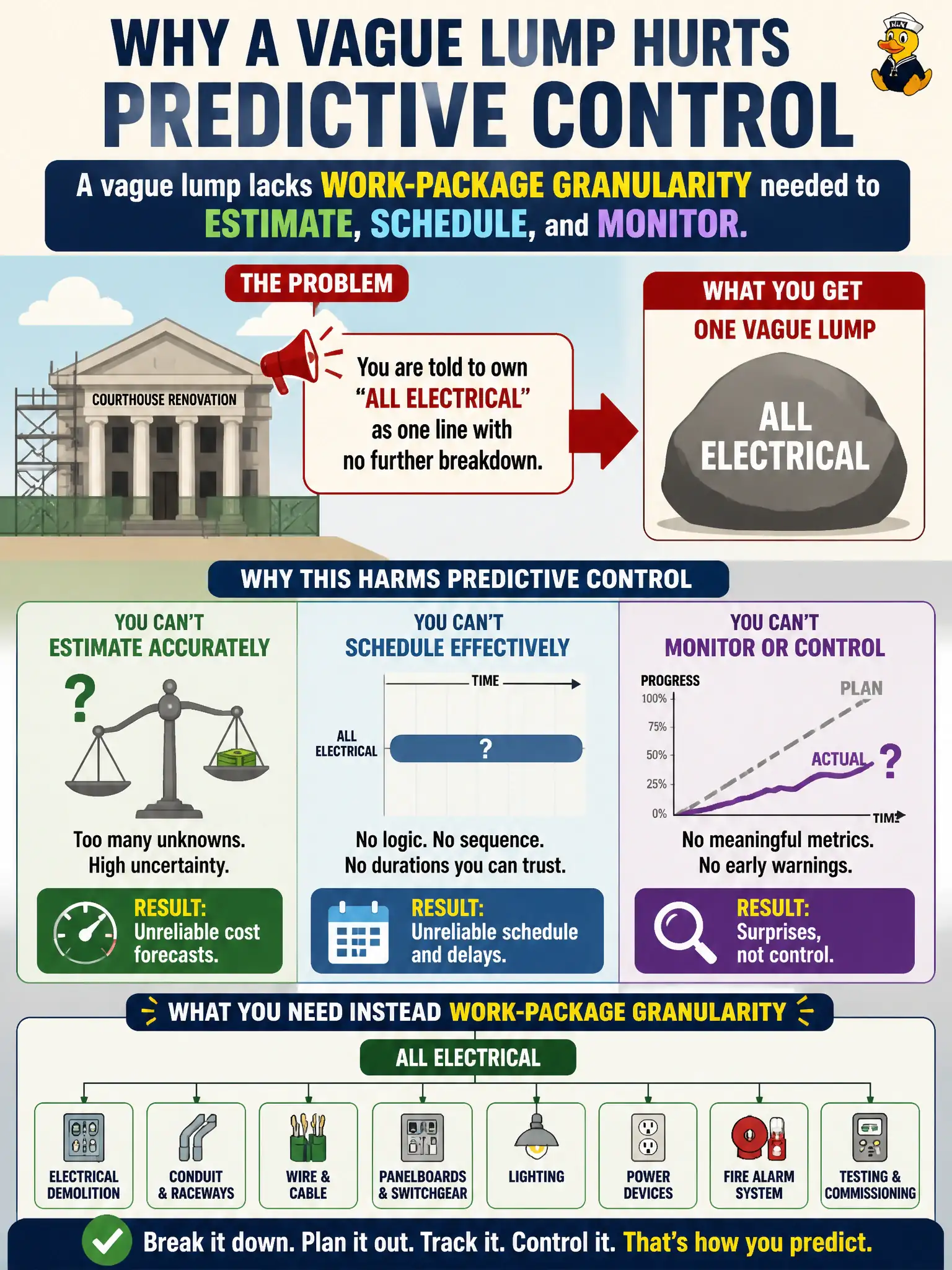
An electrical superintendent on a courthouse renovation is told to own “all electrical” as one line with no further breakdown. Why does that harm predictive control?
Select an answer to reveal the explanation.
Short Explanation
“All electrical” is like putting every wire, panel, and fixture into one unlabeled moving box—you cannot estimate, schedule, or spot trouble inside it. Break it into work packages so control has somewhere to land.
Full Explanation
Telling an electrical superintendent on a courthouse renovation to own “all electrical” as one undifferentiated line harms predictive control because a vague lump lacks work-package granularity needed to estimate, schedule, and monitor. Without decomposition, progress becomes subjective and variances lose meaning. Public-sector renovations still need hierarchical clarity even when one trade lead “owns electrical.”
Electrical work is absolutely allowed on a WBS in public-sector projects. Courthouse projects do not forbid hierarchy below the project name. Labeling “all electrical” does not automatically make it the critical path with zero float—path criticality comes from network logic, not from vague naming.
Exam caveat: CAPM emphasizes appropriate decomposition. Over-aggregation is a control failure mode associates should recognize and correct.
Operational check: break “all electrical” into work packages (for example, rough-in, gear, devices, testing) with completion criteria, then estimate and schedule each package and assign clear ownership. After decomposition, align control accounts and progress methods to the new electrical packages. A renamed lump without control redesign will not fix predictive monitoring.