
During kickoff for a civic center remodel, a council aide asks whether the WBS is the project timeline. What is the accurate contrast?
Select an answer to reveal the explanation.
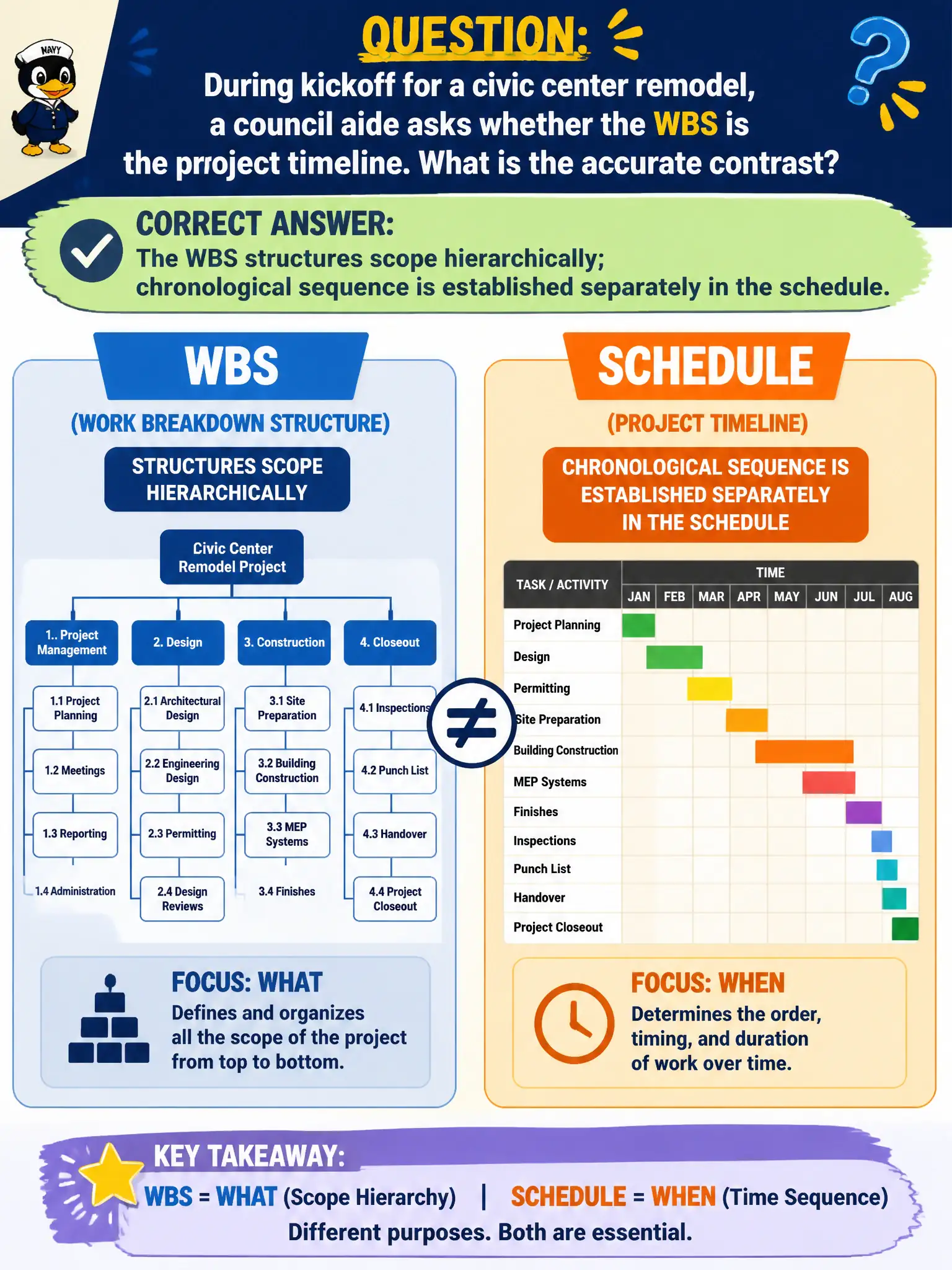
Short Explanation
The WBS is the packing list for the remodel—rooms, systems, finishes—not the calendar that says which box gets taped on Tuesday. You decompose first, then sequence and date the work.
Full Explanation
During kickoff for a civic center remodel, the accurate contrast is that the WBS structures scope hierarchically, while chronological sequence is established separately in the schedule. Decomposition answers “what,” not “when.” Council aides and other stakeholders often conflate the two, so associates must keep the distinction crisp for the rest of delivery or status meetings will argue dates using a scope tree.
The WBS is not the Gantt chart, and activity sequencing remains necessary after decomposition. The WBS does not replace the schedule baseline once a milestone is approved. The WBS is not a list of only risk owners with dates coming solely from the stakeholder register.
Exam caveat: CAPM predictive fundamentals separate scope breakdown from time networking. Both are required; neither substitutes for the other. Confusing them produces status debates about dates that belong in the schedule, not in the WBS tree, and scope disputes that cannot be resolved by moving bars on a Gantt chart alone.
Operational check: in kickoff materials, place the WBS and a summarized schedule on adjacent panels, narrate the what-versus-when distinction explicitly, refer questioners to the schedule when they ask about sequence, and keep scope boundary disputes anchored to the WBS and its dictionary.