
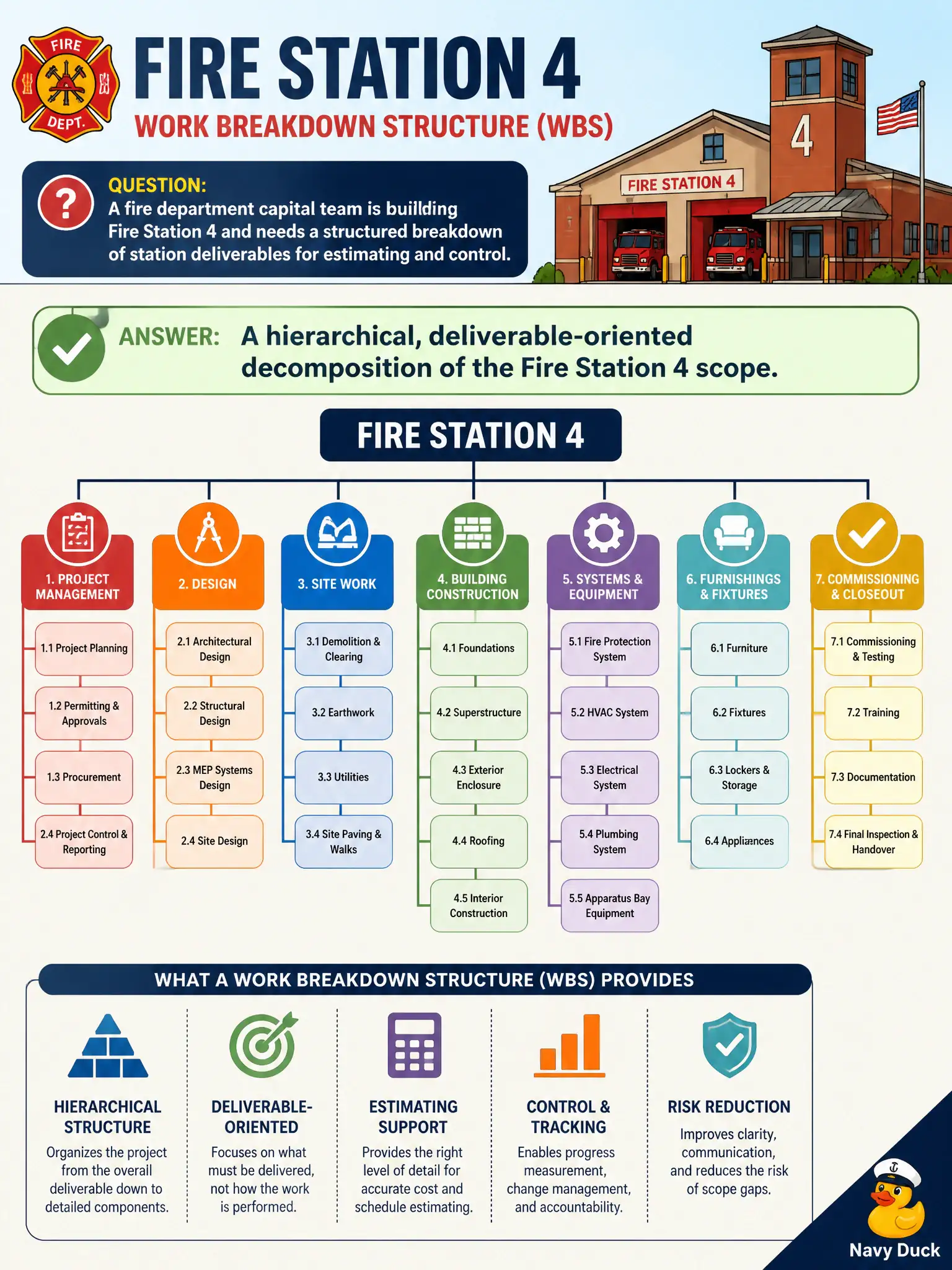
A fire department capital team is building Fire Station 4 and needs a structured breakdown of station deliverables for estimating and control. What does a work breakdown structure provide?
Select an answer to reveal the explanation.
Short Explanation
A WBS is the station’s family tree of deliverables—apparatus bay, living quarters, IT closet—broken into nested pieces. It is not the shift calendar or the invoice pile; it is how you carve the scope so everyone sees the same boxes.
Full Explanation
A fire department capital team building Fire Station 4 uses a work breakdown structure to obtain a hierarchical, deliverable-oriented decomposition of station scope. The WBS breaks the facility into manageable elements for estimating, assigning, and controlling work. That structure is the backbone of predictive scope planning for civic capital projects.
A day-by-day calendar of firefighter shifts is a staffing or operations schedule, not a WBS. A vendor invoice log sorted by purchase order date is a procurement/accounts artifact. A lessons-learned newsletter after occupancy is a knowledge-sharing output, not scope decomposition.
Exam caveat: Associates should define the WBS as scope hierarchy, not as schedule, invoice register, or communications product. Confusing those artifacts is a common CAPM trap.
Operational check: create a deliverable-oriented WBS for Fire Station 4 down to work-package level, use it for estimates and control accounts, and keep shift calendars and invoice logs in their proper subsidiary systems. Review the WBS with fire and facilities stakeholders to confirm deliverable orientation rather than a purely phase-based task list. Deliverable focus improves handover clarity at occupancy.