
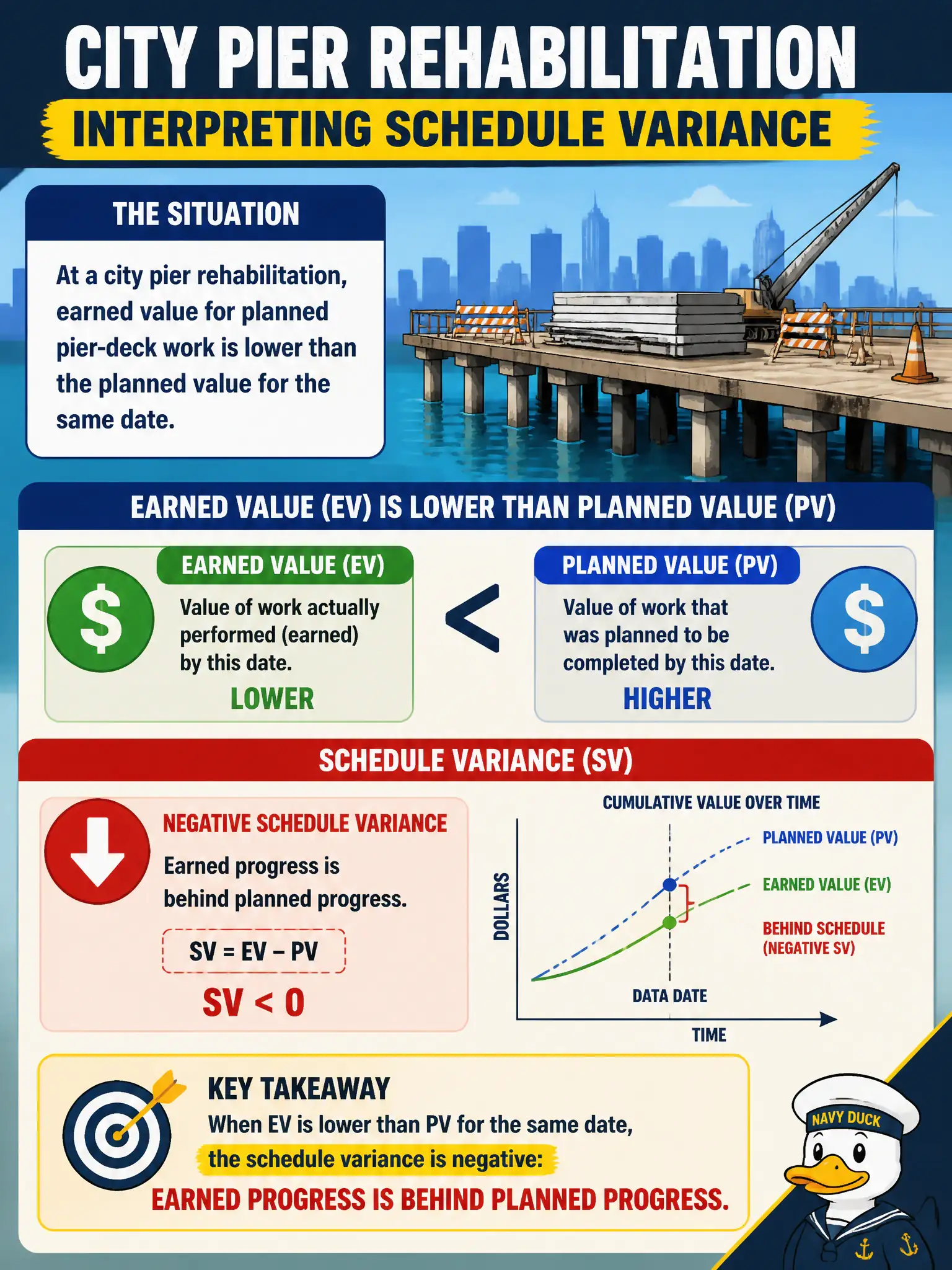
At a city pier rehabilitation, earned value for planned pier-deck work is lower than the planned value for the same date. How should the associate interpret schedule variance?
Select an answer to reveal the explanation.
Short Explanation
If the pier has earned less progress than the plan said you should have by today, you are behind—simple as a delivery truck that should have been halfway across town and is not. That gap is negative schedule variance.
Full Explanation
At a city pier rehabilitation, when earned value for planned pier-deck work is lower than planned value for the same date, schedule variance is negative: earned progress is behind planned progress. At CAPM depth, SV = EV − PV. A negative result means the pier team has not earned as much work as the baseline said should be done by now.
Interpreting that condition as positive schedule variance reverses the sign meaning. Claiming zero variance because pier jobs ignore planned value until closeout invents a special exemption. Calling it cost variance only ignores that SV is specifically read from earned versus planned value, while cost variance uses actual cost.
Exam caveat: Associates must keep SV and CV formulas distinct. EV versus PV speaks to schedule performance; EV versus AC speaks to cost performance. Sign interpretation is frequently tested.
Operational check: compute SV = EV − PV for the pier-deck package, report behind-schedule status if negative, investigate delayed work packages, and pair with CV before making funding or recovery decisions. Recompute SV after each status date rather than relying on narrative impressions of “busy.” Pair the pier SV reading with a short driver list (weather, materials, access) so recovery plans target causes.