
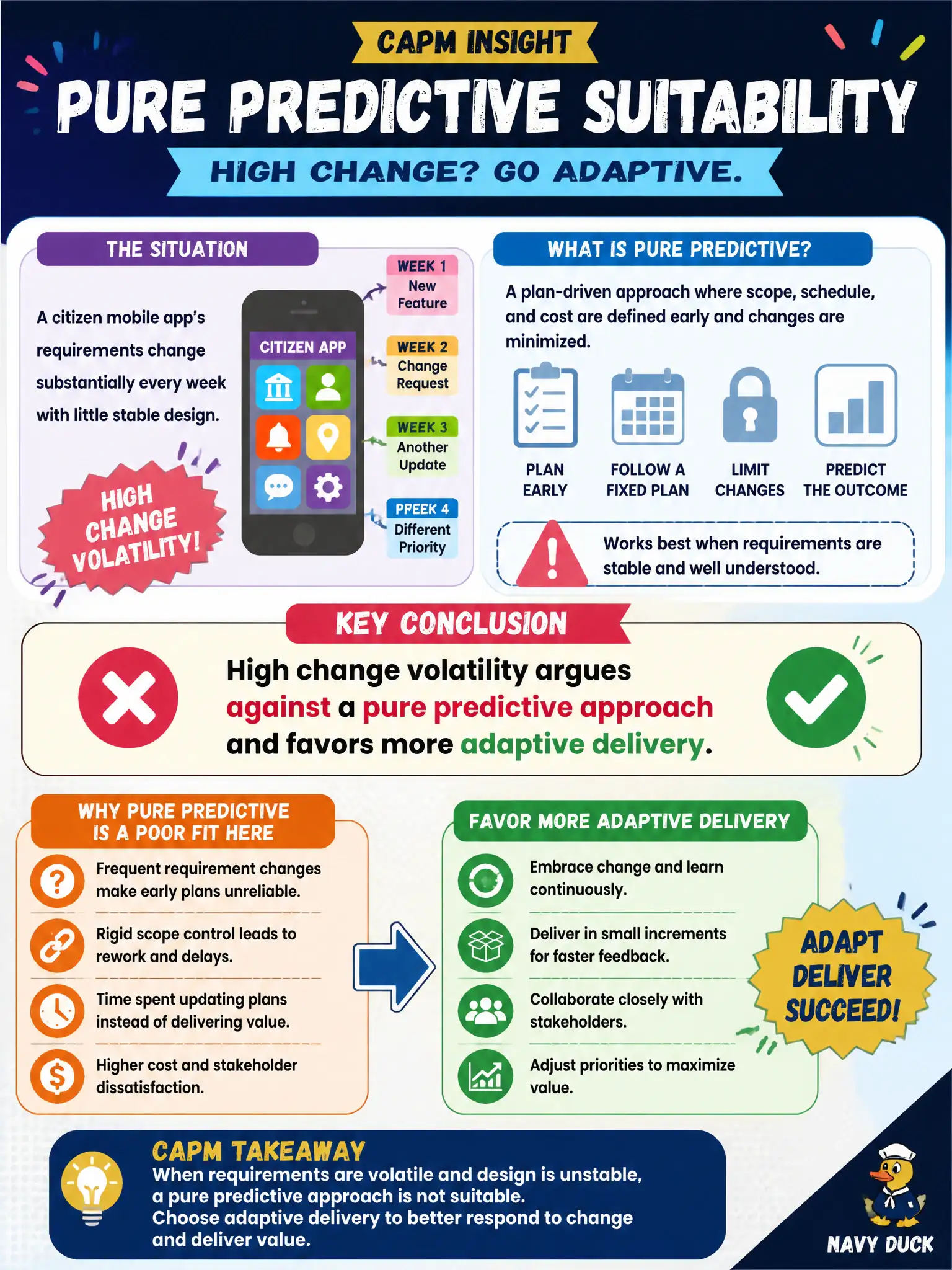
A citizen mobile app’s requirements change substantially every week with little stable design. What should a CAPM-level practitioner conclude about pure predictive suitability?
Select an answer to reveal the explanation.
Short Explanation
If the target moves every week, a thick upfront plan ages like milk. Pure predictive shines when you know the destination; weekly requirement churn says look at adaptive approaches instead. Suitability is about fit, not fashion.
Full Explanation
When a citizen mobile app’s requirements change substantially every week with little stable design, a CAPM-level practitioner should conclude that high change volatility argues against a pure predictive approach and favors more adaptive delivery. Life-cycle selection follows work uncertainty. Forcing a single locked baseline onto highly volatile civic digital products usually produces constant change thrash.
High weekly volatility is not the ideal setting for one locked predictive baseline. Predictive methods are not legally required for every municipal software effort. Change volatility absolutely affects life-cycle selection and should be an explicit decision factor.
Exam caveat: CAPM tests suitability reasoning, not dogma. Associates should choose predictive for stable, well-defined work and lean adaptive when discovery dominates—sometimes hybrid for mixed civic programs.
Operational check: assess requirement stability with sponsors, document why pure predictive is a poor fit, propose an adaptive or hybrid approach with backlog-driven delivery, and align governance expectations to frequent refinement rather than one frozen design. Record the life-cycle decision and its volatility rationale in governance notes so later pressure to “just baseline everything” can be answered with evidence. Revisit suitability if volatility drops after discovery.