
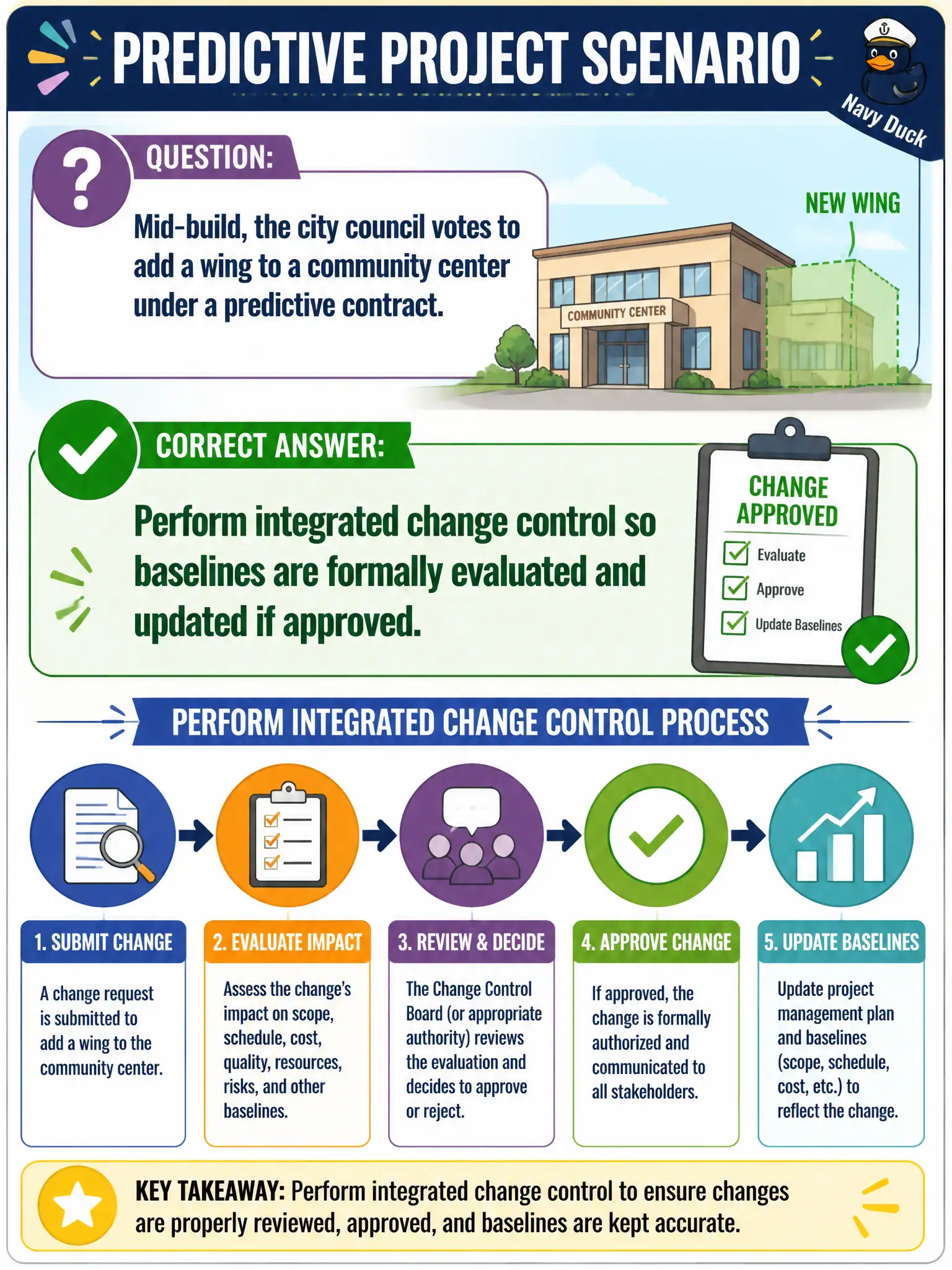
Mid-build, the city council votes to add a wing to a community center under a predictive contract. Which process activity best fits?
Select an answer to reveal the explanation.
Short Explanation
Predictive does not mean frozen forever—it means changes go through the gate. Integrated change control is how a mid-build wing addition gets analyzed against cost, schedule, and scope baselines. Scribbling on drawings without a formal path is how baselines die.
Full Explanation
When city council votes mid-build to add a wing to a community center under a predictive contract, the fitting process activity is integrated change control so baselines are formally evaluated and updated if approved. Predictive delivery does not forbid change; it channels change through evaluation of scope, cost, and schedule impacts. Council direction still needs controlled incorporation.
Silently enlarging drawings without updating cost or schedule baselines desynchronizes the plan from reality. Ignoring the council vote because “predictive forbids changes” misstates predictive practice. Deleting the project management plan for undocumented daily improvisation abandons control entirely.
Exam caveat: A frequent CAPM distractor is “predictive means no changes.” The correct associate stance is controlled changes via integrated change control, especially when baselines move.
Operational check: log the council-driven wing as a change request, analyze impacts across baselines and contracts, obtain configured approvals, update WBS/schedule/cost baselines, and communicate the revised plan. After approval, brief contractors on the revised wing scope and contract implications immediately. Integration fails if field teams learn of council-driven changes only through rumor.