
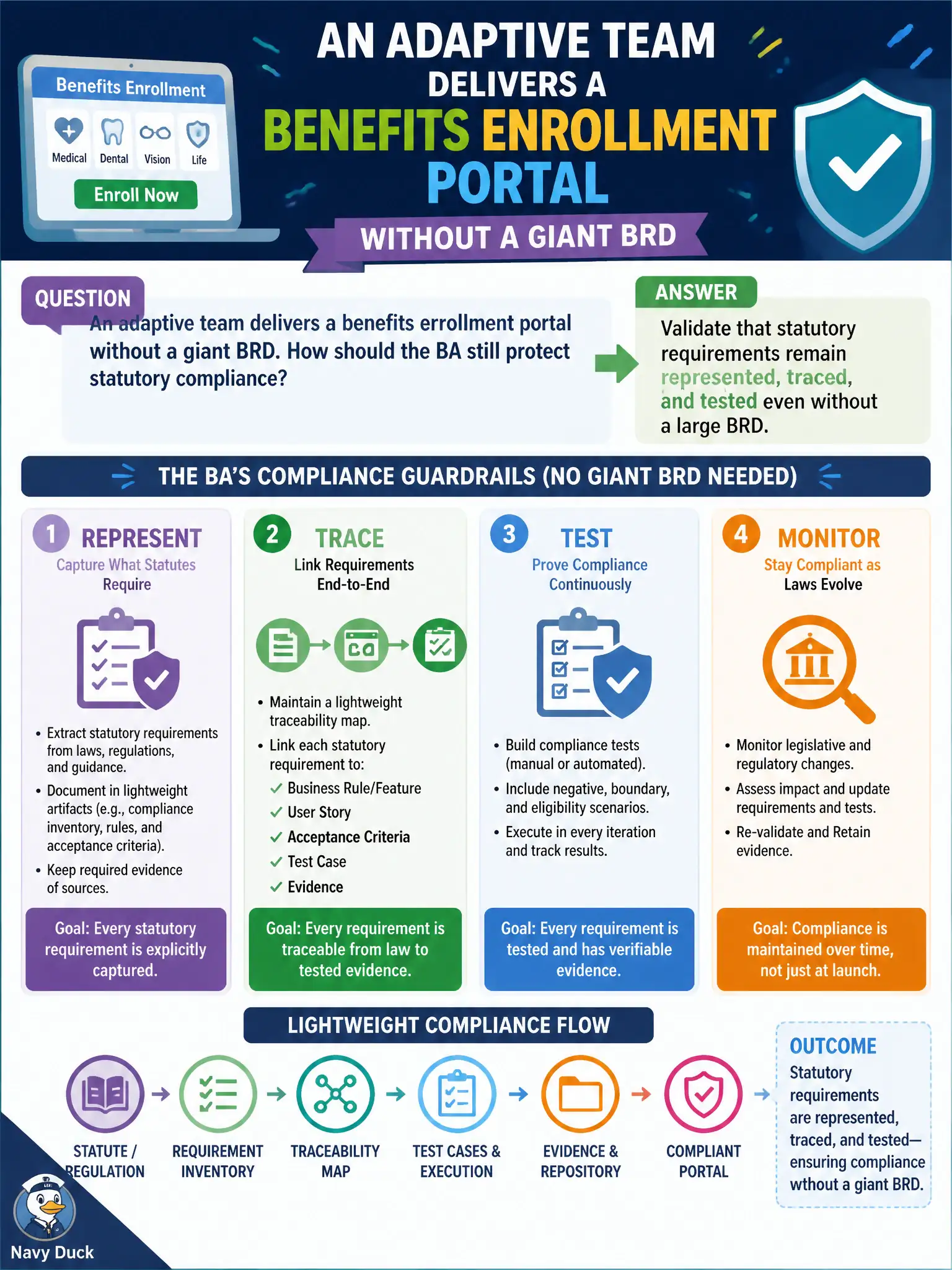
An adaptive team delivers a benefits enrollment portal without a giant BRD. How should the BA still protect statutory compliance?
Select an answer to reveal the explanation.
Short Explanation
No giant BRD doesn’t mean no laws. Adaptive still has to carry statutory must-haves in the backlog and prove they were tested—compliance hitchhikes on every approach.
Full Explanation
An adaptive team delivering a benefits enrollment portal without a giant BRD must still validate that statutory requirements remain represented, traced, and tested. Just-enough documentation does not mean optional compliance. Civic benefits systems can be adaptive in delivery cadence while remaining rigorous about statutory coverage through backlog representation, lightweight trace links, and acceptance tests that prove legal obligations still hold for residents.
Assuming agile delivery automatically satisfies every statute fails conceptually because methodology does not magically create legal compliance or replace verification. Deleting compliance stories so velocity looks higher fails because gaming velocity by removing statutory work is a governance and ethics failure, not a productivity win. Waiting until after public launch to discover legal gaps fails because residents and the city then bear preventable compliance harm and remediation cost.
Exam caveat: Adaptive civic delivery still requires statutory requirements to be present, traced, and verified even without a large BRD. Operational check: list statutory enrollment requirements, ensure each appears in backlog items with tests or RTM-style links, review coverage with compliance stakeholders before release, and block go-live if statutory gaps remain open on the benefits portal.