
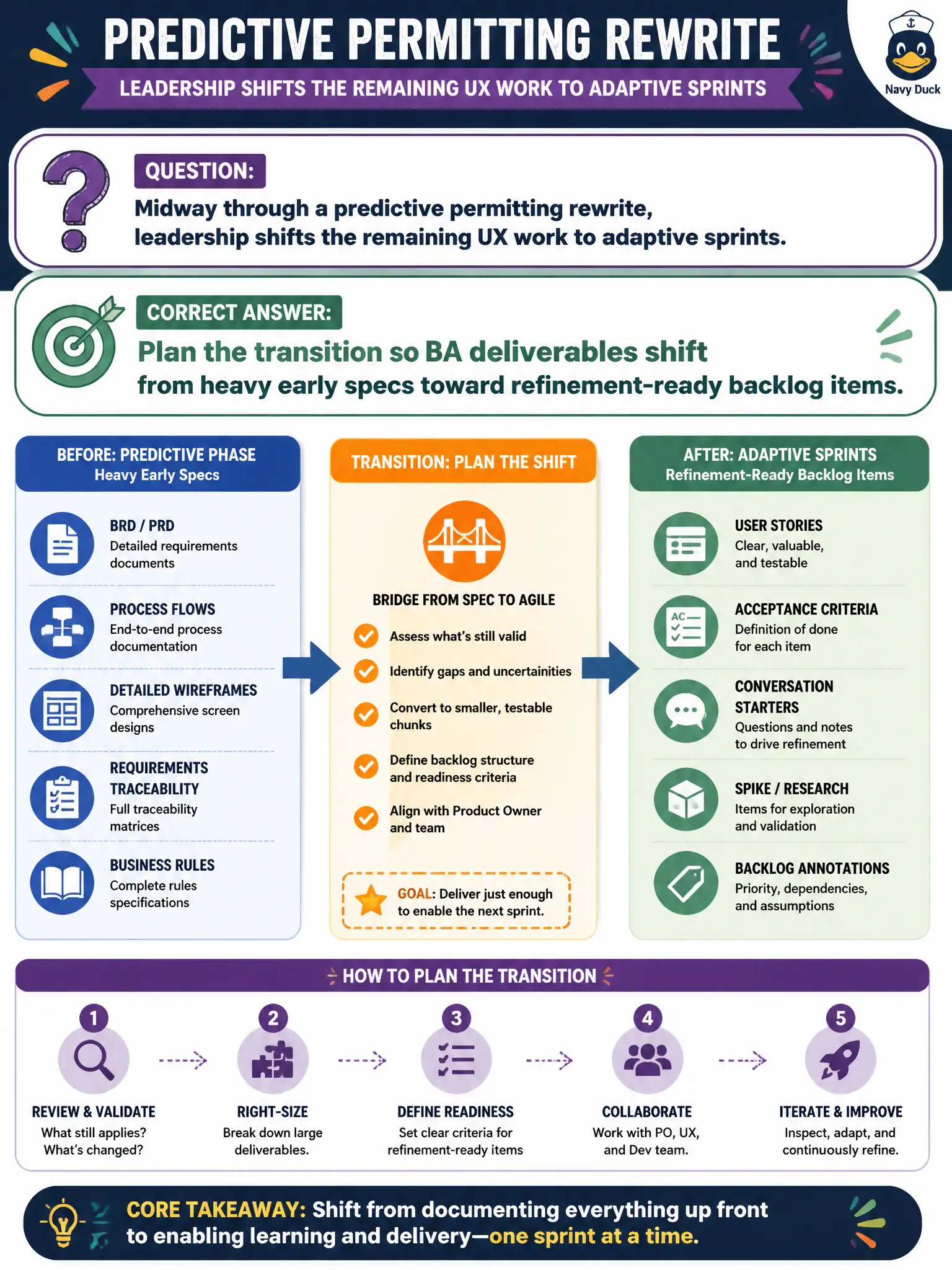
Midway through a predictive permitting rewrite, leadership shifts the remaining UX work to adaptive sprints. What should happen to BA deliverables?
Select an answer to reveal the explanation.
Short Explanation
Changing horses midstream means changing the saddle too—BA deliverables have to shift with the method. Plan that handoff so the team gets backlog-ready items instead of clinging to yesterday’s BRD-only world.
Full Explanation
Midway through a predictive permitting rewrite, when leadership shifts remaining UX work to adaptive sprints, BA deliverables should transition from heavy early specs toward refinement-ready backlog items. The BA plans that transition deliberately so prior analysis is not discarded and new adaptive work is not starved of backlog-ready stories. Civic hybrid shifts fail when teams either cling only to the old BRD or throw away usable requirements knowledge.
Keeping only the original predictive BRD and ignoring backlog needs fails conceptually because adaptive sprints consume backlog items, not a static BRD alone. Discarding all prior requirements because approach changes void analysis fails because valuable requirements knowledge should be migrated, not erased. Freezing analysis entirely until the predictive phase is fully closed years later fails because the adaptive UX stream needs ongoing BA support now.
Exam caveat: Approach transitions require planned BA deliverable shifts, not denial or amnesia. Operational check: inventory permitting UX requirements from the BRD, convert near-term items into refinement-ready backlog stories with acceptance criteria, and define which residual predictive controls still apply during the adaptive UX sprints.