
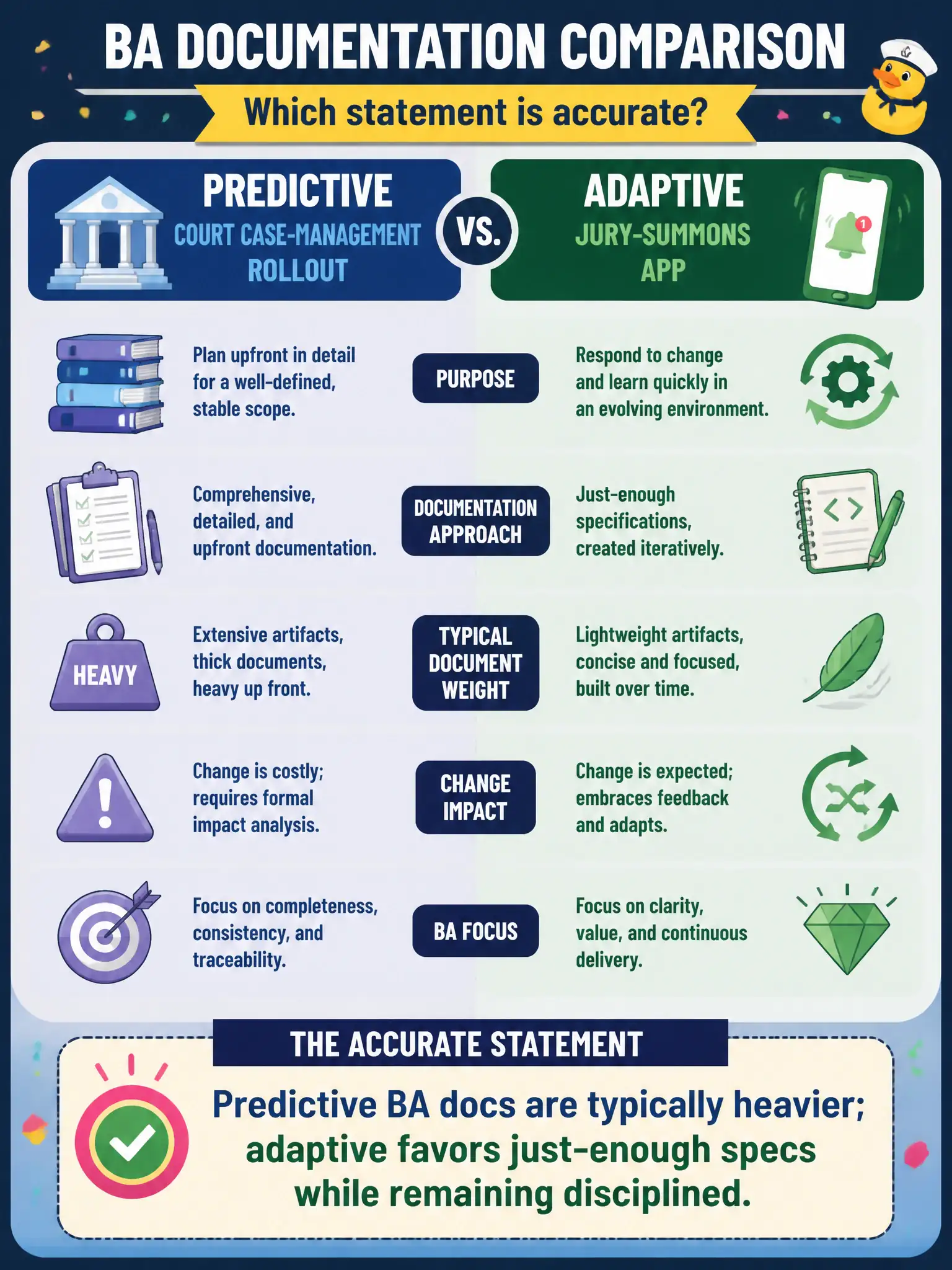
Comparing BA documentation on a predictive court case-management rollout versus an adaptive jury-summons app, which statement is accurate?
Select an answer to reveal the explanation.
Short Explanation
Predictive piles up the binders; adaptive keeps thin, sharp notes—but neither skips analysis. “Just enough” still means disciplined, testable requirements, not a free-for-all.
Full Explanation
Comparing BA documentation on a predictive court case-management rollout versus an adaptive jury-summons app, predictive BA docs are typically heavier while adaptive favors just-enough specs while remaining disciplined. Documentation weight follows uncertainty and control needs: courts case management under predictive control often demands richer baselines; adaptive summons work still documents stories and acceptance criteria without a giant binder. Neither approach is “no docs” or “infinite docs.”
Claiming adaptive projects require no documentation of requirements at all fails conceptually because adaptive teams still need clear stories, acceptance criteria, and often lightweight models. Claiming predictive projects must avoid written acceptance criteria fails because predictive work commonly uses explicit acceptance and verification. Claiming documentation weight is identical in every municipal methodology fails because life cycle and risk profile intentionally change how much is written when.
Exam caveat: Associates should expect heavier predictive documentation and leaner adaptive documentation—not zero documentation in agile civic work. Operational check: for case management, maintain richer baselined requirements and RTM links; for the jury-summons app, keep just-enough story and acceptance documentation updated each sprint; and avoid copying one documentation standard blindly onto the other.