
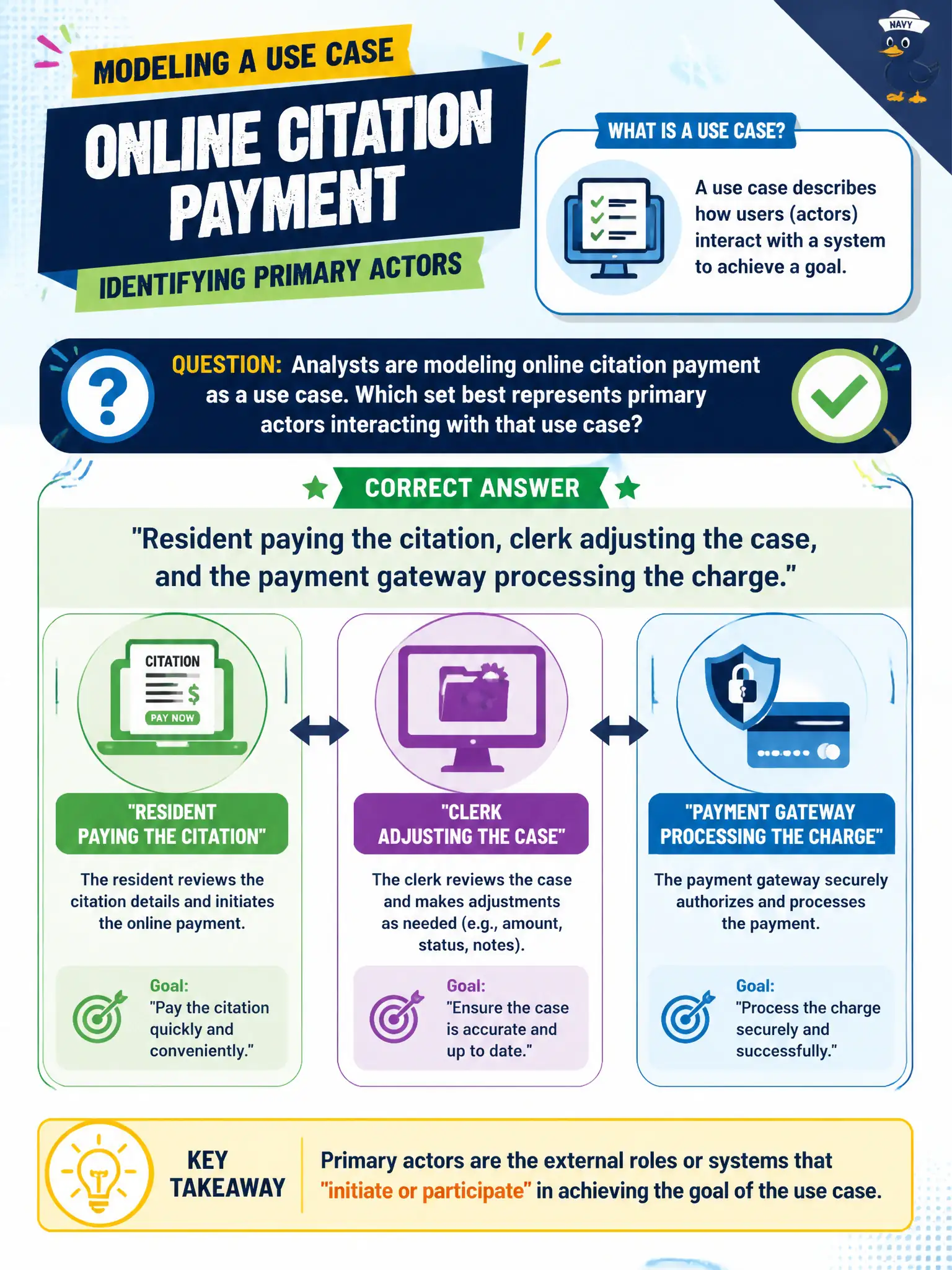
Analysts are modeling online citation payment as a use case. Which set best represents primary actors interacting with that use case?
Select an answer to reveal the explanation.
Short Explanation
Actors are the cast who touch the scene—resident, clerk, payment gateway—not the furniture (tables) or the paint (UI skin). Use cases care who starts and who responds in the flow.
Full Explanation
When modeling online citation payment as a use case, primary actors are the people or external systems that interact with the use case to achieve goals: the resident paying the citation, the clerk adjusting the case, and the payment gateway processing the charge. Actor identification keeps civic payment flows grounded in who initiates action and who responds, which drives alternate paths, interfaces, and acceptance checks for municipal collections.
Treating only database tables as actors fails conceptually because data stores are not actors; they are entities the system uses behind the scenes. Treating only the sponsor’s calendar invites as actors fails because governance meetings are not the interacting parties in the payment use case itself. Treating only color palette and logo files as actors fails because branding assets do not interact to accomplish payment goals and cannot define use-case behavior.
Exam caveat: Use-case actors are interacting roles or external systems, not data structures, meeting artifacts, or UI chrome. Operational check: list resident, clerk, and payment gateway as actors on the citation-payment use case, confirm goals and interfaces for each, and ensure alternate paths such as declines, adjustments, and failures are modeled before tests are written for go-live.