
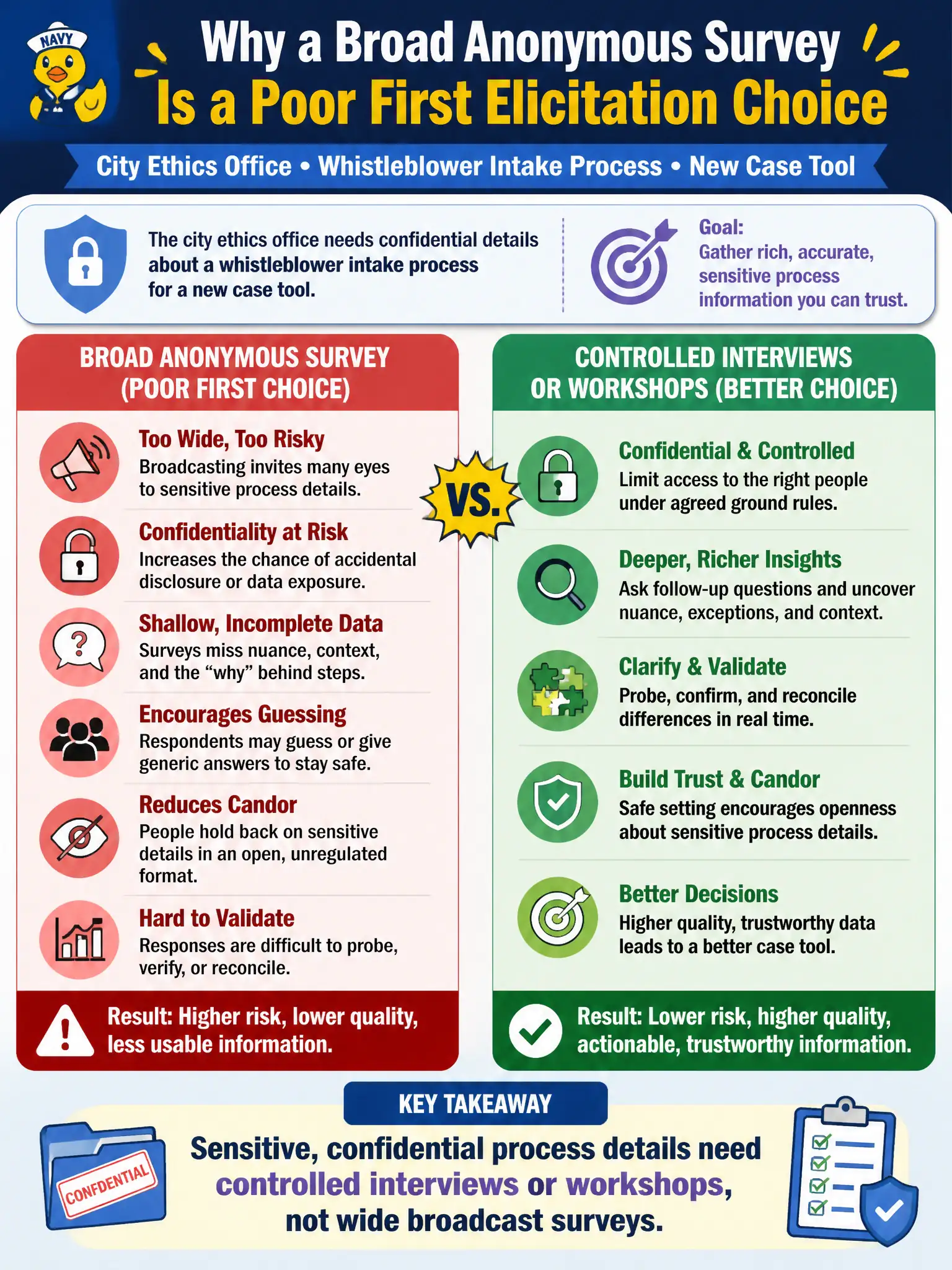
A city ethics office needs confidential details about a whistleblower intake process for a new case tool. Why is a broad anonymous survey a poor first elicitation choice?
Select an answer to reveal the explanation.
Short Explanation
You wouldn’t put whistleblower process secrets on a county-wide postcard poll. Quiet, controlled interviews or small workshops keep sensitive details from leaking while still getting the truth.
Full Explanation
A city ethics office needing confidential details about a whistleblower intake process cannot safely start with a broad anonymous survey. Sensitive, confidential process details need controlled interviews or workshops with appropriate access limits, not wide broadcast surveys that risk exposure, incomplete candor, or improper distribution of protected procedures. Civic ethics systems demand elicitation methods that respect confidentiality and need-to-know boundaries while still capturing accurate process requirements.
Claiming surveys always produce more accurate data than interviews fails conceptually because accuracy depends on context; for confidential processes, controlled dialogue outperforms mass broadcast. Claiming surveys are banned by CAPM for any public-sector work fails because no such blanket ban exists—the issue is fitness for sensitive content, not a universal prohibition. Saying surveys can only capture nonfunctional requirements and never process steps fails because surveys can capture many requirement types; they are still the wrong primary tool here for confidentiality and depth reasons.
Exam caveat: Match elicitation technique to sensitivity and depth needs, not to a universal preference for surveys. Operational check: replace the planned broad survey with controlled interviews or a closed workshop for ethics and intake SMEs under appropriate confidentiality rules, document process requirements securely, and limit distribution of whistleblower-handling details to need-to-know roles before any wider communication.