
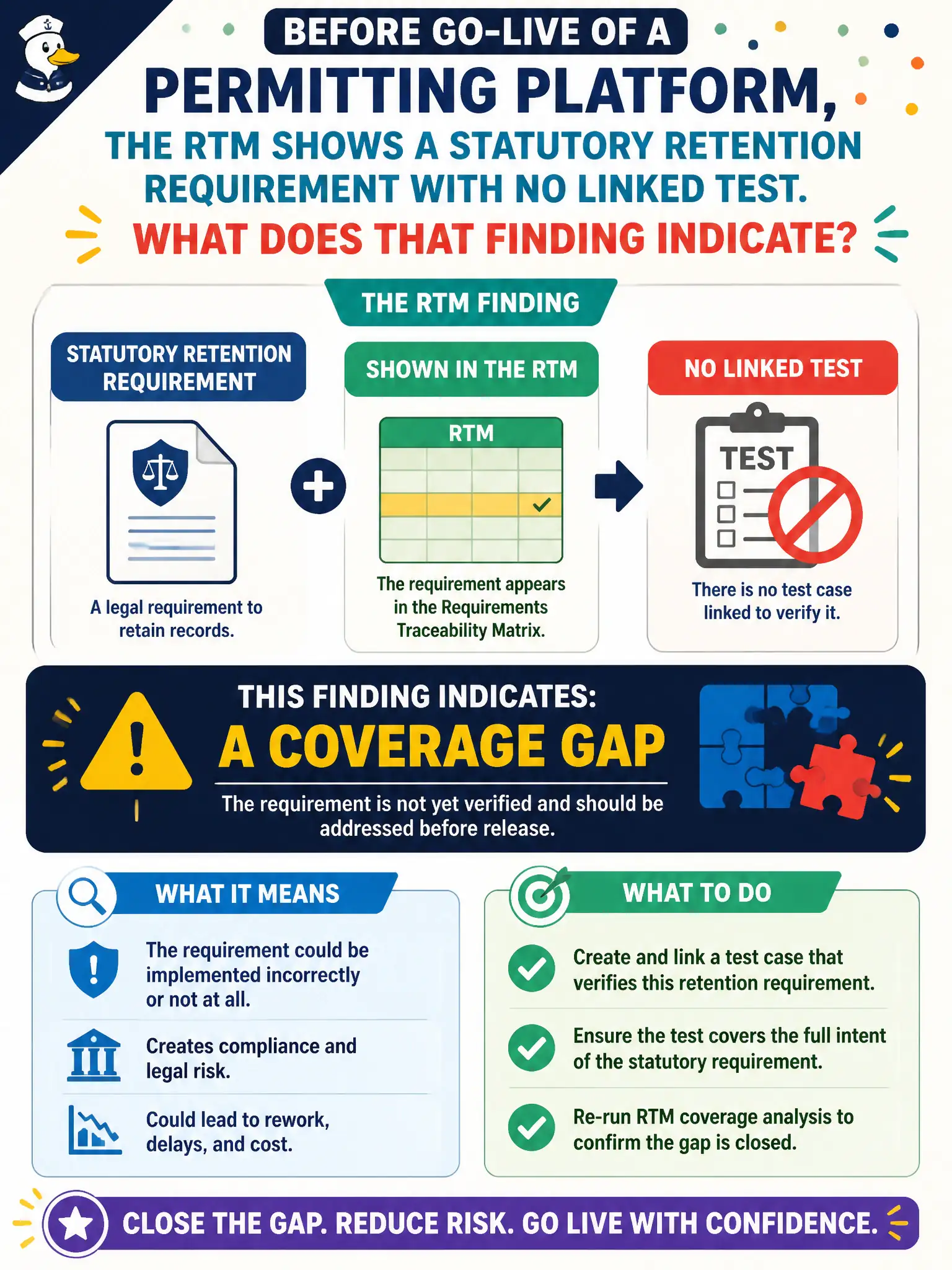
Before go-live of a permitting platform, the RTM shows a statutory retention requirement with no linked test. What does that finding indicate?
Select an answer to reveal the explanation.
Short Explanation
If the trail map shows a legal campsite with no path to a finish-line test, you’re about to go live blind on that rule. The RTM just waved a red flag—fill the gap before opening day.
Full Explanation
Before go-live of a permitting platform, an RTM row that shows a statutory retention requirement with no linked test indicates a coverage gap: the requirement is not yet verified and should be addressed before release. Traceability without verification is incomplete for civic statutory obligations that affect how long permitting records must remain available and protected. The finding is a readiness blocker signal for municipal go-live, not optional paperwork cleanup that can wait until after residents begin filing.
Treating the gap as proof that statutory rules never need testing fails conceptually because ordinances are not self-enforcing inside software; retention behavior, storage rules, and retrieval paths must be verified like any other requirement. Deleting the requirement so the matrix stays tidy fails because removing statutory scope to clean a spreadsheet is a governance and compliance failure, not configuration hygiene. Claiming a sprint retrospective can replace verification fails because retrospectives improve team process and collaboration; they do not prove retention controls work under test.
Exam caveat: RTM gaps on statutory requirements are release-readiness issues on CAPM-style questions, not optional matrix aesthetics. Operational check: create and execute tests for the retention requirement, link passing evidence in the RTM, scan for other unlinked statutory rows on the permitting platform, and only then present go-live readiness with complete verification coverage.