
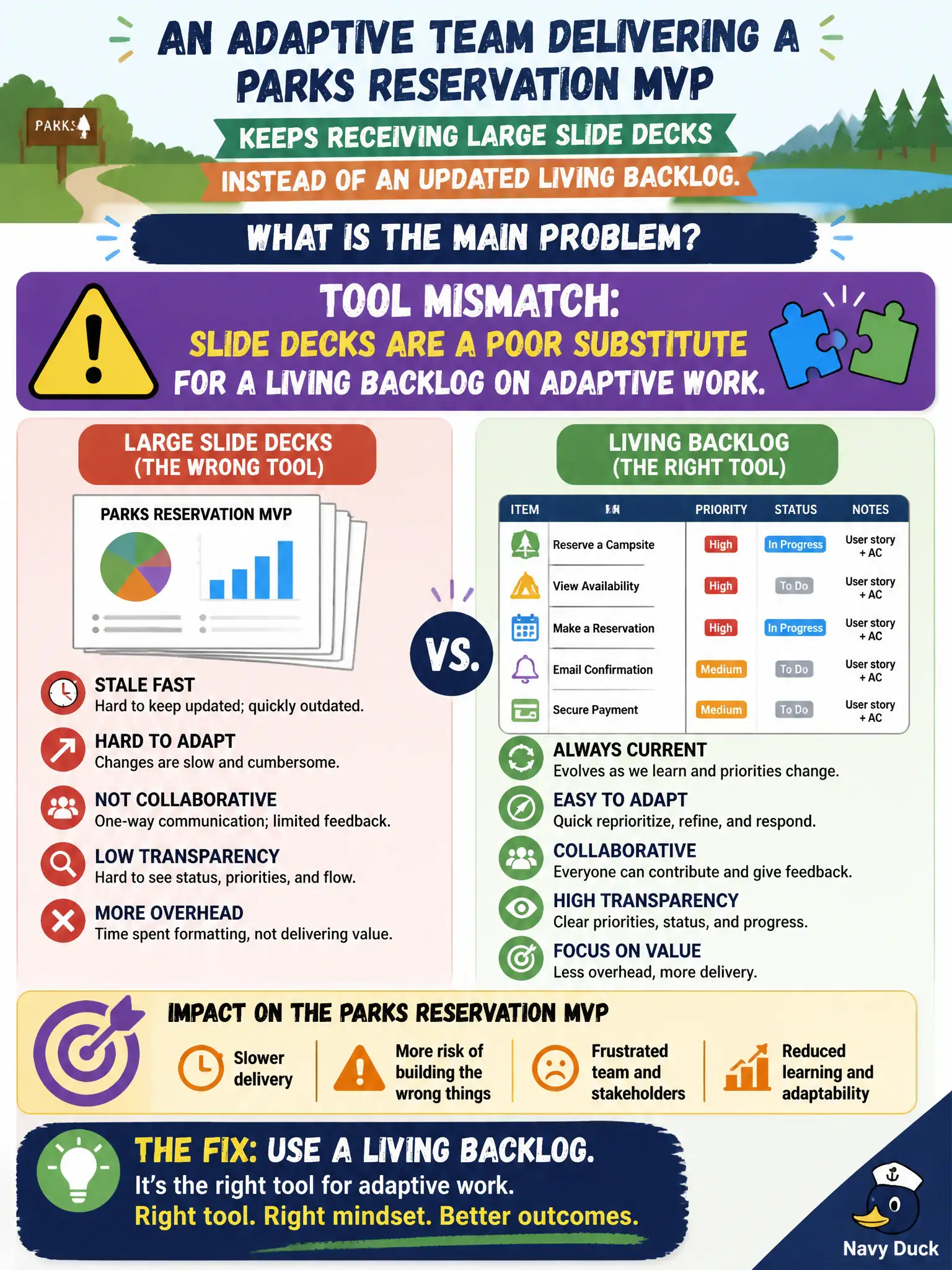
An adaptive team delivering a parks reservation MVP keeps receiving large slide decks instead of an updated living backlog. What is the main problem?
Select an answer to reveal the explanation.
Short Explanation
Adaptive teams live out of a backlog that changes with learning—not a freeze-frame slide pack from last month. Wrong tool, confused team.
Full Explanation
An adaptive team delivering a parks reservation MVP for a municipal recreation department needs a living backlog that changes with learning, ordering, and refinement. Large slide decks are a tool mismatch: they freeze a narrative snapshot and poorly support continuous prioritization, splitting, and acceptance of adaptive civic work. The main problem is using static presentation packs as a substitute for the backlog the team actually executes to open reservation capacity for residents.
Claiming slide decks are always required and superior to backlogs fails conceptually because adaptive municipal delivery centers on an ordered backlog, not slide theater for status audiences. Asserting living backlogs are only valid on predictive waterfall projects fails because the opposite is closer to practice—living backlogs are core to adaptive work on city products. Saying any artifact is fine if colorful and emailed weekly fails because format popularity does not equal fitness for prioritization and incremental delivery of parks services.
Exam caveat: Associates should match artifacts to life cycle; adaptive civic teams need living backlogs more than polished static decks. Operational check: stop treating the latest slide pack as the source of truth for the parks reservation MVP, migrate open items into an ordered living backlog, and run the next refinement from that backlog rather than from slides before the next municipal sprint planning.