
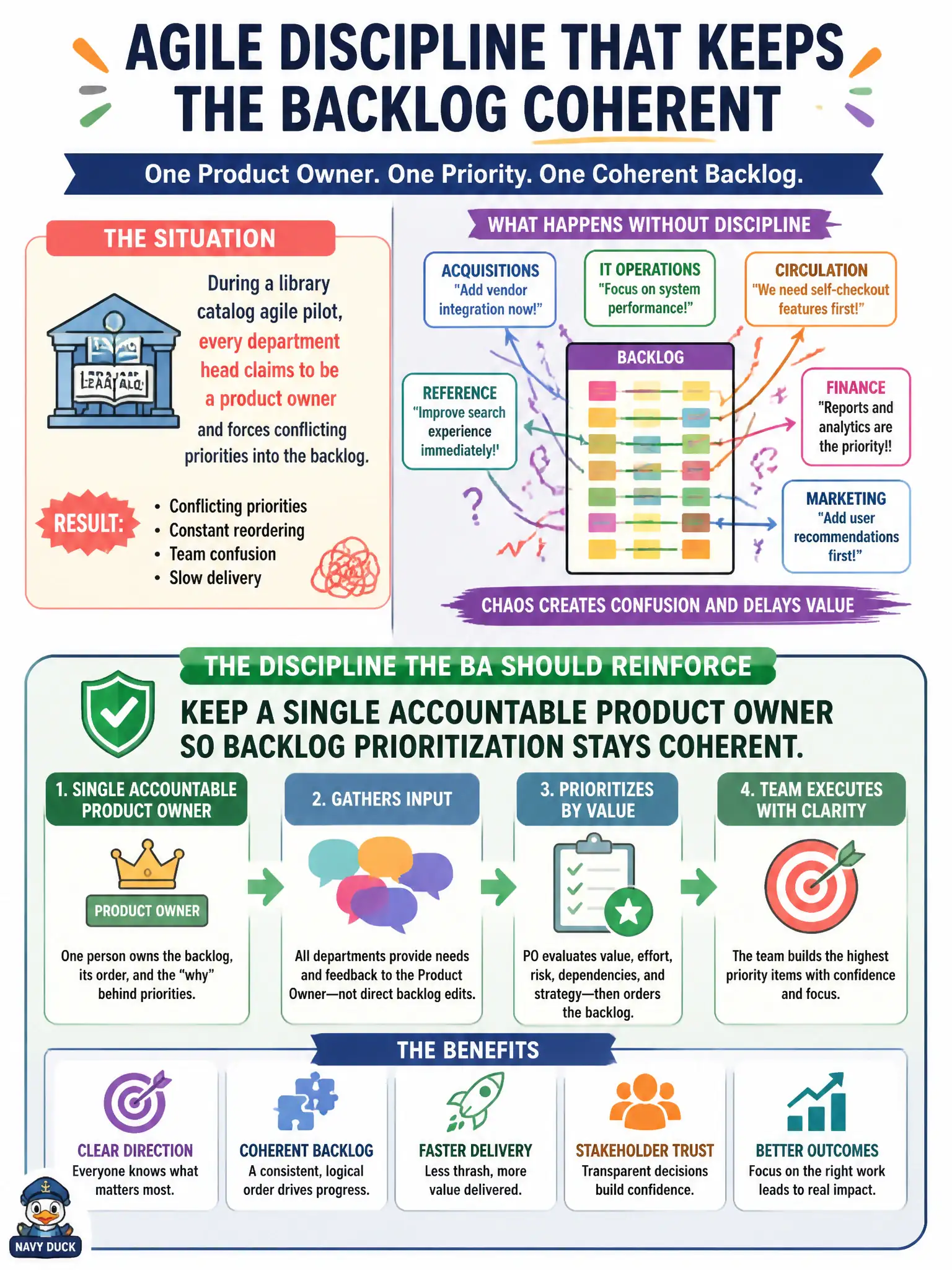
During a library catalog agile pilot, every department head claims to be a product owner and forces conflicting priorities into the backlog. What discipline should the BA reinforce?
Select an answer to reveal the explanation.
Short Explanation
If everyone is the product owner, nobody is—and the backlog turns into a wish list food fight. One accountable owner keeps prioritization honest for the library catalog pilot.
Full Explanation
In a library catalog agile pilot, backlog coherence depends on a single accountable product owner who prioritizes competing departmental wishes against value and capacity. When every department head claims product ownership, the backlog becomes a political wish list rather than an ordered delivery instrument. Reinforcing one accountable product owner restores prioritization discipline so the pilot can deliver a coherent catalog experience instead of oscillating between incompatible agendas.
Letting every department head co-own the backlog fails conceptually because shared ownership without a final decision-maker recreates conflicting priorities and freezes delivery. Rotating the product owner weekly fails because rotating authority prevents stable prioritization and learning across sprints; politics simply move on a calendar. Eliminating the product owner and prioritizing only by ticket age fails because age is not value, risk, or strategic alignment; oldest tickets can be low-value noise that crowds out catalog outcomes citizens need.
Exam caveat: Adaptive civic delivery still requires clear product ownership; multiple self-declared owners are not a balanced governance model. Operational check: name one product owner for the library catalog pilot in the team working agreement, route department requests through that owner’s prioritization, and confirm the next sprint backlog reflects a single ordered priority list rather than parallel departmental mandates.