
A downtown festival app backlog is overcrowded. Which approach best shows explicit adaptive prioritization for the next release slice?
Select an answer to reveal the explanation.
Short Explanation
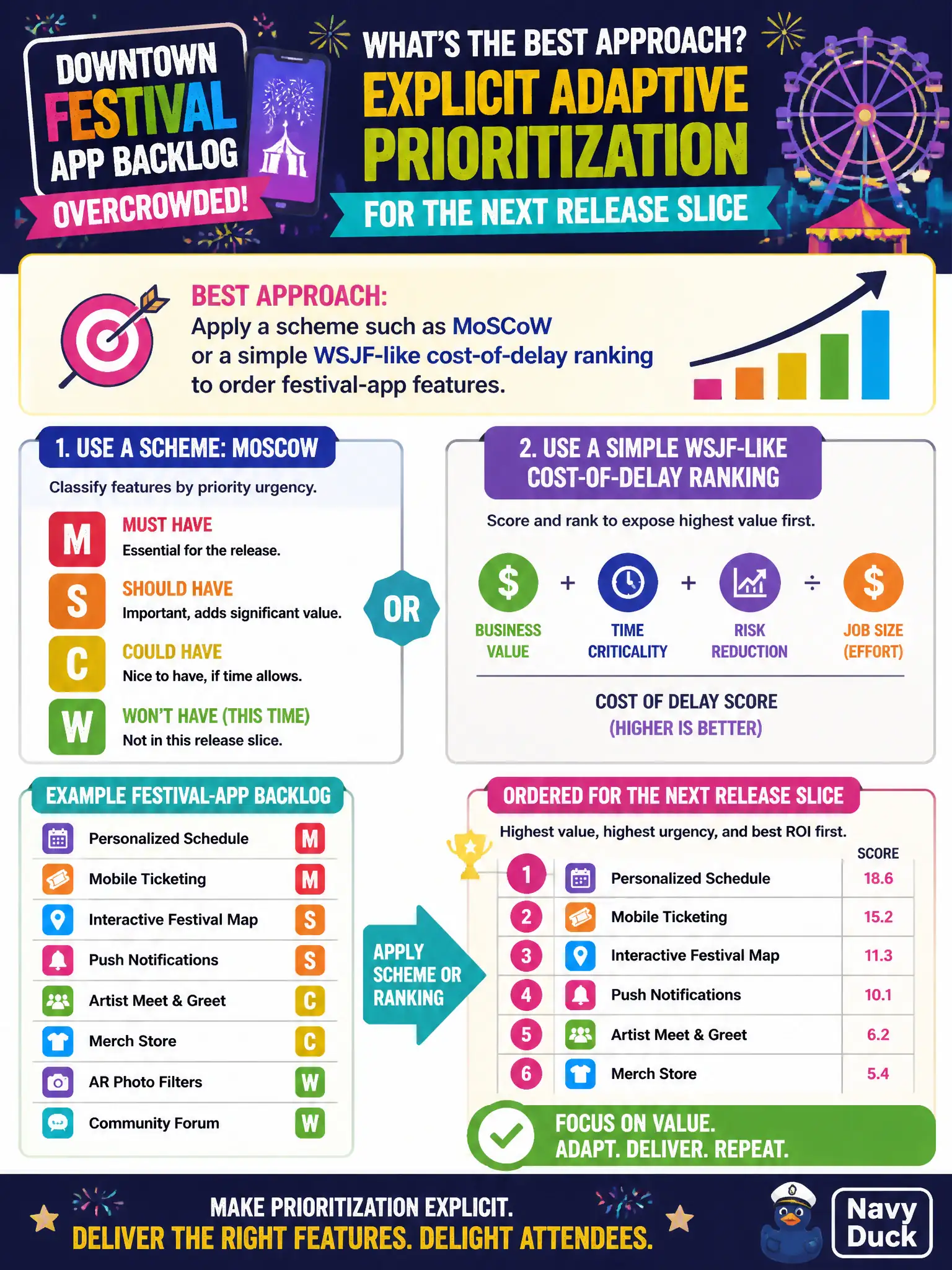
Crowded backlogs need a sorting hat—MoSCoW (Must/Should/Could/Won’t) or a lightweight WSJF-style ‘what’s the delay costing us?’ ranking. Explicit schemes beat gut feel when the festival date won’t move. Name the method, then cut the Coulds.
Full Explanation
When a downtown festival app backlog is overcrowded, the approach that best shows explicit adaptive prioritization for the next release slice is to apply a scheme such as MoSCoW or a simple WSJF-like cost-of-delay ranking to order festival-app features. Explicit ranking methods make value, urgency, and deferability visible so the civic team can defend what ships now versus later under capacity constraints.
Assigning every feature equal Must-have status so nothing can be deferred fails conceptually because universal Must-have status is not prioritization; it refuses trade-offs. Letting each council member veto stories without a shared ranking method fails because uncoordinated vetoes replace transparent value ordering with politics. Building features in the order tickets were filed, ignoring value, fails because FIFO ticket order is not adaptive value-based prioritization.
Exam caveat: Adaptive prioritization requires an explicit scheme—MoSCoW, cost of delay, or similar—not equal Musts, veto chaos, or arrival-order building. Operational check: facilitate a MoSCoW or WSJF-style ranking workshop for the festival app, publish the ordered release slice, and revisit ranks when new high-value items appear.