
A town manager says the recycling-route planner ‘should just do Agile’ and assumes Scrum, XP, Kanban, and SAFe® are interchangeable checklists. What should the project team explain?
Select an answer to reveal the explanation.
Short Explanation
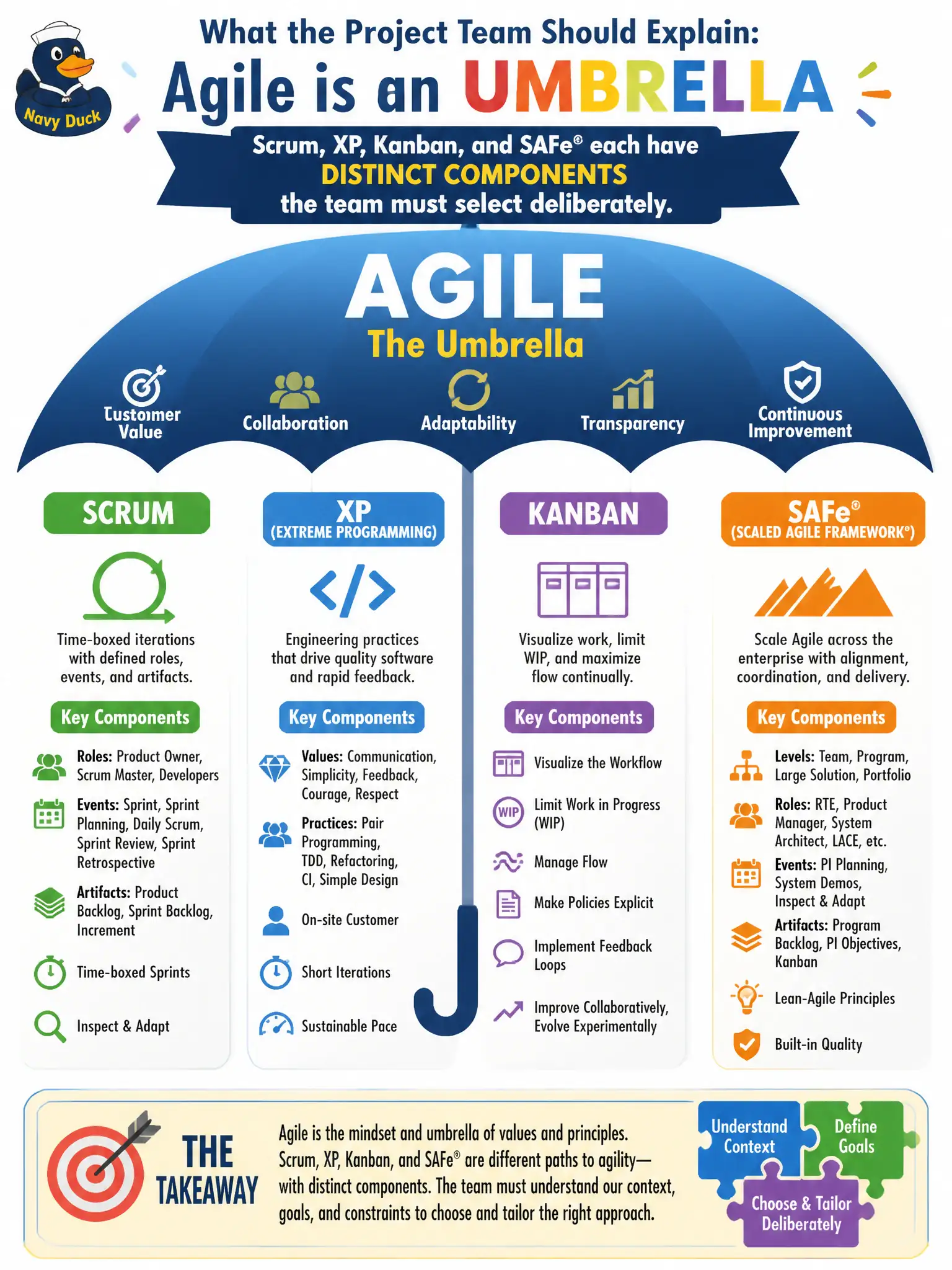
Calling everything ‘Agile’ is like calling every vehicle a car—motorcycles and buses both roll, but the controls differ. Scrum, XP, Kanban, and SAFe® sit under the agile umbrella with their own parts. Pick the components you mean, don’t mash the labels.
Full Explanation
When a town manager says the recycling-route planner "should just do Agile" and assumes Scrum, XP, Kanban, and SAFe® are interchangeable checklists, the project team should explain that Agile is an umbrella; Scrum, XP, Kanban, and SAFe® each have distinct components the team must select deliberately. Treating them as identical checklists hides real differences in roles, events, technical practices, flow rules, and scaling constructs that matter for municipal products.
Claiming all adaptive methods share one mandatory set of roles, events, and artifacts with no differences fails conceptually because the methods differ in prescribed components. Claiming only SAFe® qualifies as Agile so every municipal product must run PI Planning fails because Agile includes multiple approaches; SAFe is not the sole definition of Agile. Claiming Kanban and XP are predictive methods and cannot be labeled Agile at all fails because both are widely treated as Agile-aligned approaches centered on adaptive delivery ideas.
Exam caveat: CAPM expects awareness that Agile is an umbrella over distinct methods—not one interchangeable checklist. Operational check: pick components deliberately for the recycling-route planner (for example Scrum events plus selected XP practices), document the operating model for staff, and correct stakeholders who treat method names as synonyms.