
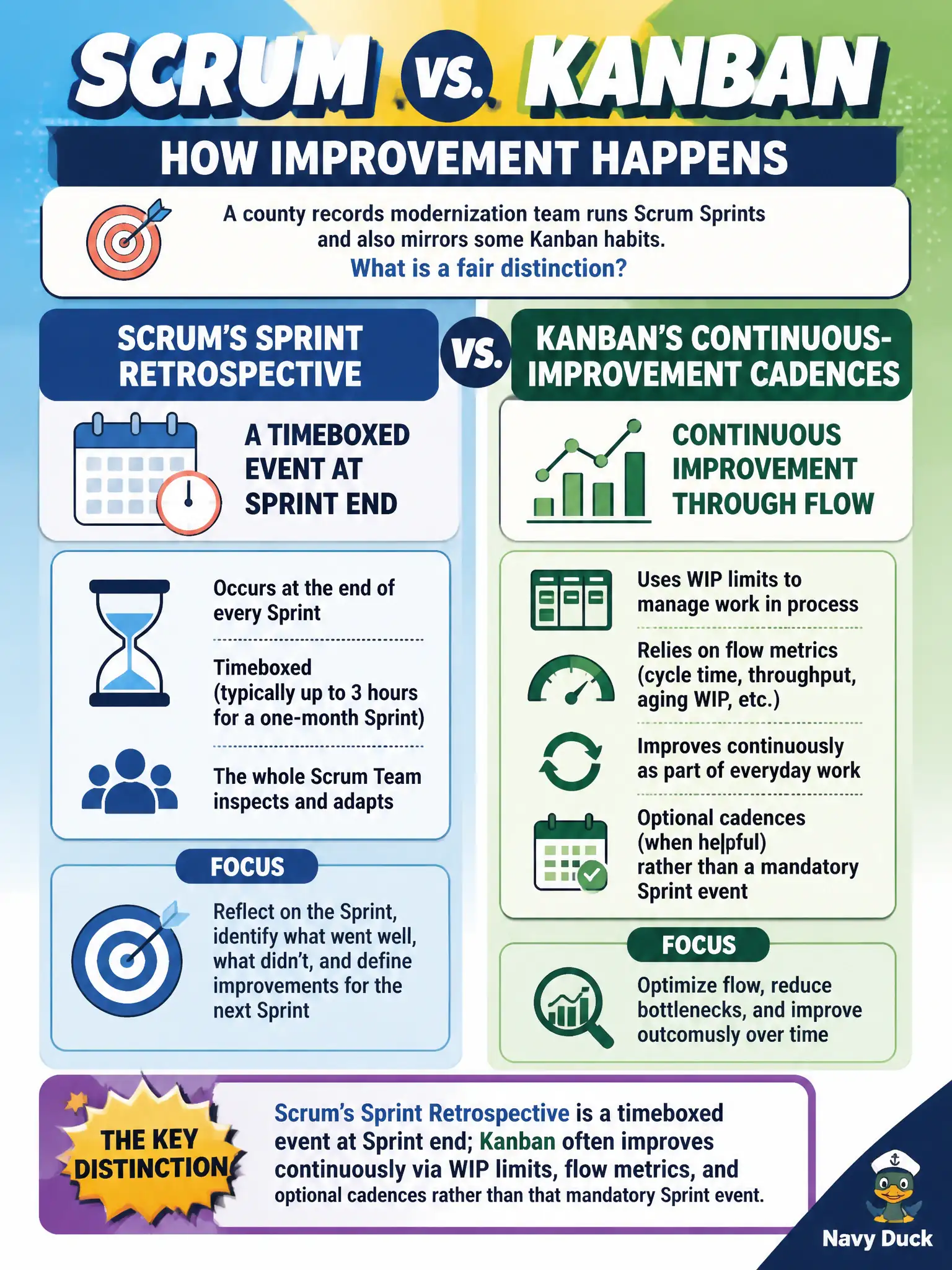
A county records modernization team runs Scrum Sprints and also mirrors some Kanban habits. What is a fair distinction between Scrum’s Sprint Retrospective and typical Kanban continuous-improvement cadences?
Select an answer to reveal the explanation.
Short Explanation
Scrum parks a dedicated ‘what should we tweak?’ meeting at the end of each Sprint. Kanban is more like fixing traffic flow every day with WIP limits and metrics—improvement is continuous and ceremonies are lighter. Related goal, different machinery.
Full Explanation
A fair distinction for a county records modernization team running Scrum Sprints while mirroring some Kanban habits is that Scrum’s Sprint Retrospective is a timeboxed event at Sprint end, whereas Kanban often improves continuously via WIP limits, flow metrics, and optional cadences rather than that mandatory Sprint retrospective event. Both pursue improvement; the cadence and mandatory event structure differ for civic delivery teams blending practices.
Claiming Kanban requires a two-day offsite retrospective every Sprint while Scrum forbids retrospectives entirely reverses and invents rules: Scrum requires a Sprint Retrospective, and Kanban does not mandate two-day offsites every Sprint. Claiming both methods mandate identical Sprint Retrospectives owned exclusively by the Product Owner fails because Kanban does not mandate Scrum’s Sprint Retrospective, and retros engage the whole team rather than being a PO-only ownership event. Claiming retrospectives exist only in predictive waterfall gates and never appear in adaptive work fails because retros are central to adaptive improvement.
Exam caveat: Scrum mandates a Sprint-end retrospective event; Kanban emphasizes continuous improvement without requiring that same Scrum event. Operational check: keep Sprint Retrospectives on the Scrum cadence for records modernization, and separately use WIP and flow metrics for Kanban-like habits—without pretending the methods share identical mandatory retro rules.