
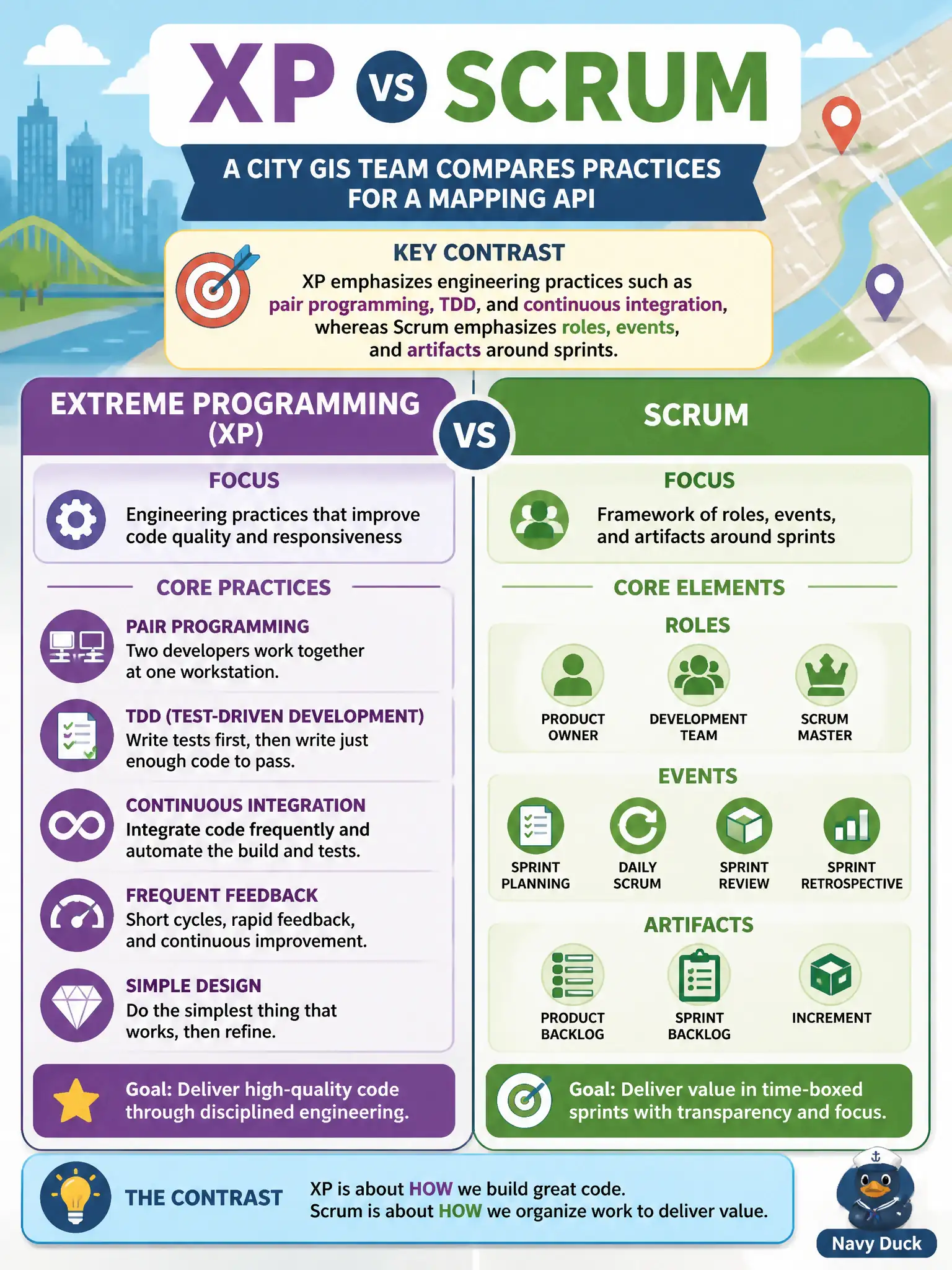
A city GIS team compares Extreme Programming practices with Scrum for a mapping API. Which contrast is accurate at associate level?
Select an answer to reveal the explanation.
Short Explanation
XP is famous for how you write code—pair up, test first, integrate often. Scrum is famous for how you organize the work loop—roles, events, backlog, sprint. Different toolbelts, both adaptive.
Full Explanation
When a city GIS team compares Extreme Programming with Scrum for a mapping API, the accurate associate-level contrast is that XP emphasizes engineering practices such as pair programming, test-driven development, and continuous integration, whereas Scrum emphasizes accountabilities, events, and artifacts structured around sprints. CAPM Task 4 asks candidates to distinguish those component sets rather than treat XP practices as Scrum’s official roles.
Claiming Scrum requires pair programming and TDD as its only official roles fails conceptually because Scrum does not prescribe those engineering practices as its role set. Claiming XP replaces all inspection events with a predictive critical-path baseline fails because XP remains adaptive and does not redefine itself as CPM predictive control. Claiming continuous integration is forbidden in XP and mandatory only in predictive waterfall fails because CI is a hallmark XP technical practice, not a waterfall-only rule.
Exam caveat: Keep XP’s technical practices distinct from Scrum’s framework components at CAPM depth without requiring specialist XP certification detail. Operational check: if the GIS API team wants XP practices, adopt pairing/TDD/CI deliberately alongside or inside Scrum events—and name which components come from which method when briefing sponsors.