
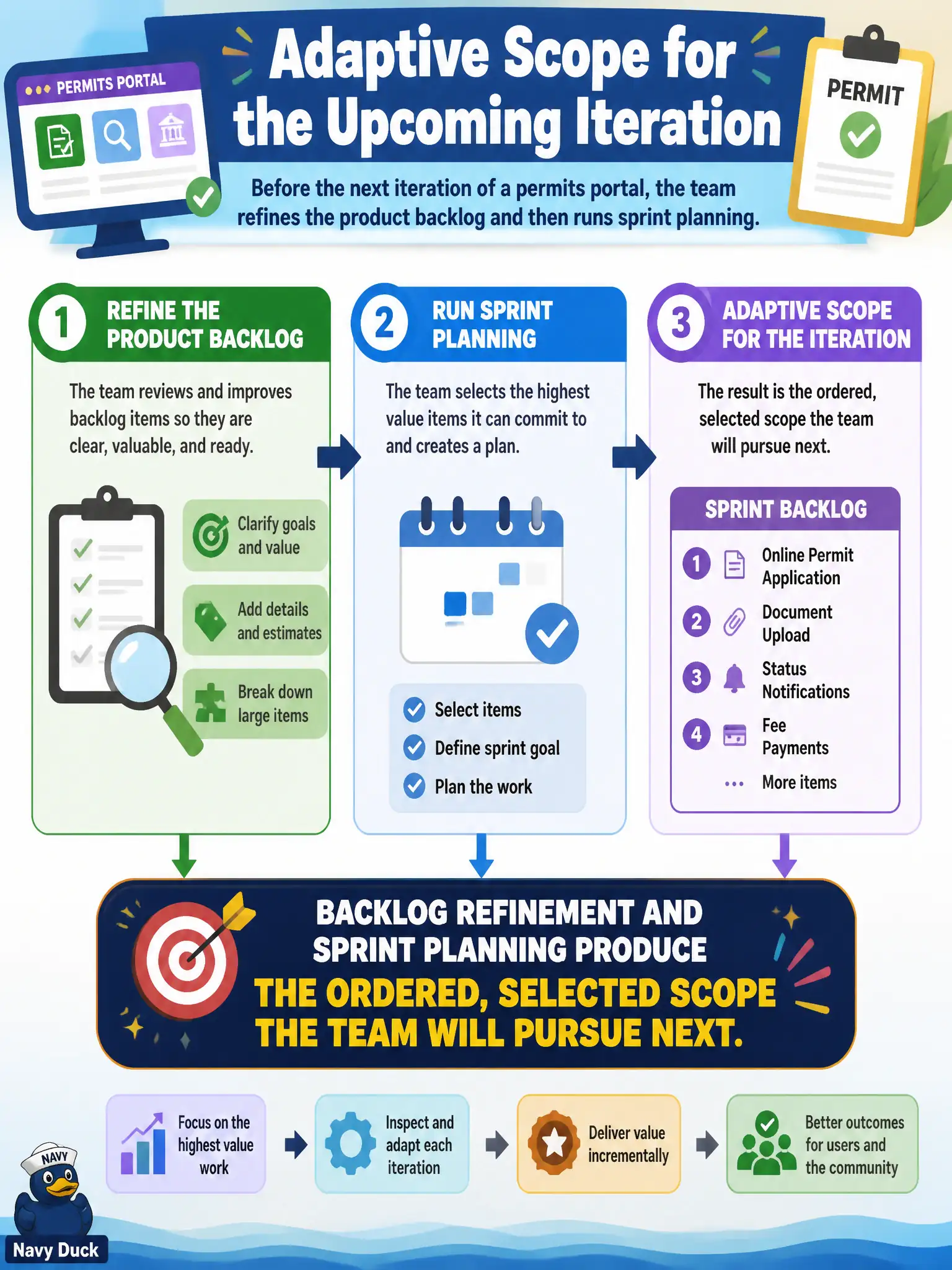
Before the next iteration of a permits portal, the team refines the product backlog and then runs sprint planning. How do those events relate to adaptive scope for the upcoming iteration?
Select an answer to reveal the explanation.
Short Explanation
Refinement clears the fog on upcoming items; sprint planning picks what fits the next box. Together they feed the scope the team will actually chase this iteration. They are not a sneaky swap for a year-long frozen WBS.
Full Explanation
Before the next iteration of a permits portal, backlog refinement plus sprint (iteration) planning produce the ordered, selected scope the team will pursue next. Refinement clarifies and orders upcoming work; planning selects what fits the timebox. Those planning events are primary inputs to adaptive iteration scope and do not substitute predictive-only artifacts as the sole scope mechanism.
Claiming they replace the product backlog with a predictive cost baseline as the only scope source fails conceptually because adaptive scope still lives in the backlog; cost baselines are not the primary adaptive scope list. Claiming they finalize a twelve-month WBS that forbids any later backlog reordering fails because refinement and planning are recurring and expect reordering as learning continues. Claiming they exist only to record schedule variance against an approved earned-value plan fails because their purpose is selecting near-term adaptive work, not EV variance accounting.
Exam caveat: Associates should connect refinement and planning to iteration scope selection, not to predictive baseline substitution myths. Operational check: refine the permits backlog, plan a realistic sprint slice with clear goals, execute, review the increment, then refine again—keeping the backlog as the living scope artifact.