
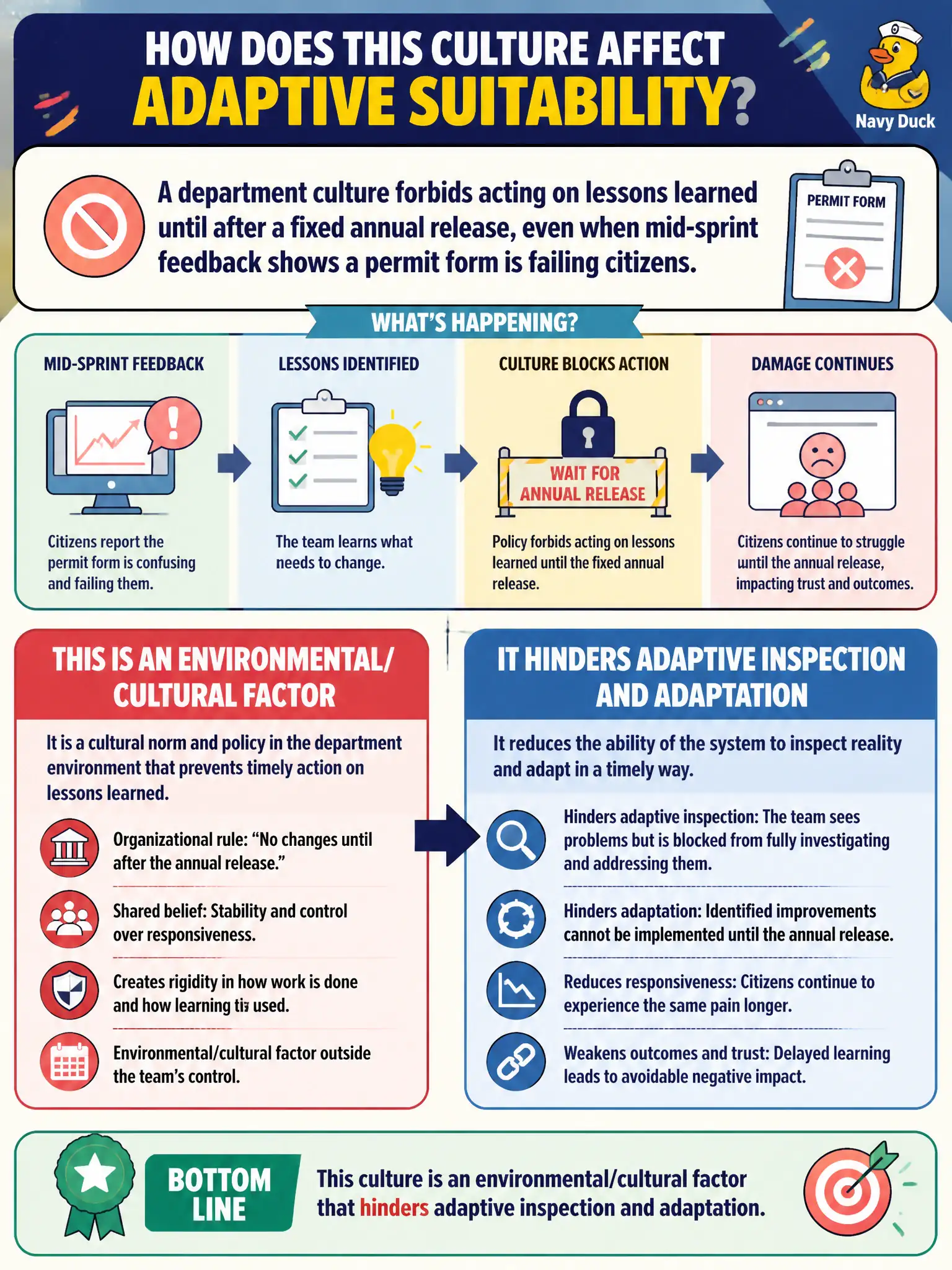
A department culture forbids acting on lessons learned until after a fixed annual release, even when mid-sprint feedback shows a permit form is failing citizens. How does that culture affect adaptive suitability?
Select an answer to reveal the explanation.
Short Explanation
If the culture says "do not change the permit form until next year's freeze," mid-sprint learning gets locked in a drawer — that culture is an environmental drag on adaptive work. Helpful playbooks and fast feedback are the opposite. Adaptive needs permission to inspect and adapt.
Full Explanation
A department culture that forbids acting on lessons learned until after a fixed annual release—even when mid-sprint feedback shows a permit form is failing citizens—is an environmental or cultural factor that hinders adaptive inspection and adaptation. Adaptive approaches depend on learning and adjusting within short cycles; a culture that shelves mid-sprint evidence until next year's freeze blocks that core mechanism. Suitability assessments should treat such culture as a real impediment to adaptive civic delivery, not as neutral wallpaper.
Claiming it proves adaptive delivery requires zero stakeholder contact fails conceptually because adaptive work requires more, not less, contact; the culture problem is delayed response to feedback, not a mandate for isolation. Claiming it is identical to a helpful Scrum playbook OPA that speeds learning fails because a blocking culture is an EEF-like impediment, whereas a playbook OPA would facilitate learning. Claiming it guarantees the fastest possible feedback loops fails because annual-only action is the opposite of fast feedback.
Exam caveat: Cultural EEFs can enable or hinder adaptive approaches; CAPM expects recognition when culture blocks inspect-and-adapt. Operational check: escalate the permit-form failure through governance that can authorize mid-cycle correction, record the cultural constraint in suitability notes, and seek leadership agreement that citizen-failing defects need not wait for the annual freeze.