
Labor union rules require 30-day notice before changing certain civic team roles mid-initiative. How should that constraint be recognized when assessing adaptive suitability?
Select an answer to reveal the explanation.
Short Explanation
Union notice rules sit outside the team's sticky notes — they are environmental constraints, like weather you plan around, not a playbook you wrote yesterday. That EEF can slow role flex that adaptive teams sometimes want. Calling it a sprint goal or a color DoD misses the category.
Full Explanation
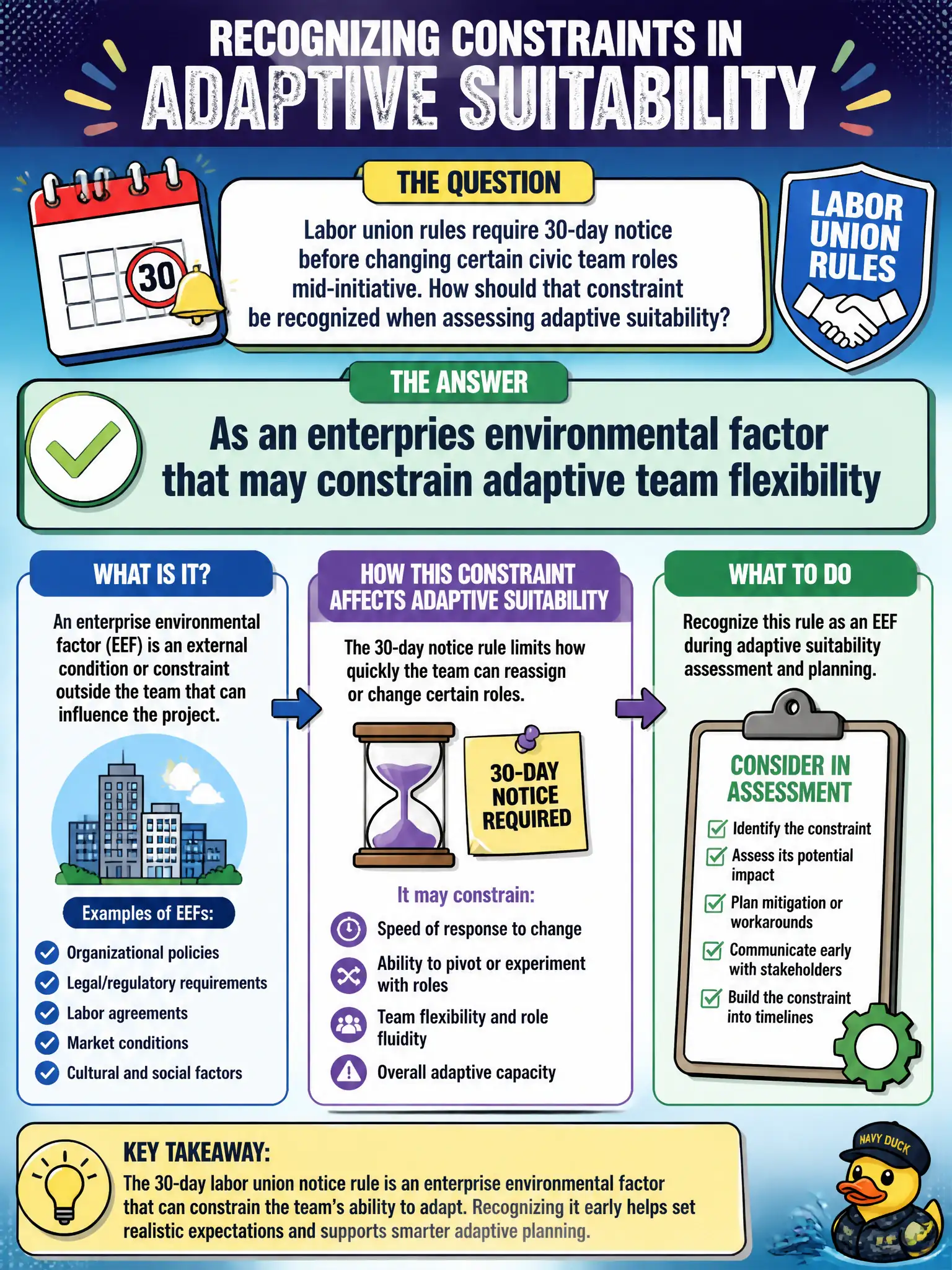
Labor union rules that require 30-day notice before changing certain civic team roles mid-initiative should be recognized as an enterprise environmental factor (EEF) that may constrain adaptive team flexibility. EEFs include external and organizational conditions—such as labor agreements—the project must operate within and cannot simply rewrite as a sticky-note preference. Adaptive suitability assessment must account for that notice constraint when role reshuffles or cross-skilling plans are proposed.
Treating the rule as an optional sprint goal the team may invent without external rules fails conceptually because sprint goals are team commitments for increment value, not substitutes for binding labor constraints. Treating it as a Definition of Done checkbox for user-interface colors only fails because DoD is a quality agreement for increments, not a classification of labor law or union notice. Treating it as an organizational process asset playbook the team authored last week fails because OPAs are internal process materials the organization maintains; a union notice rule is an environmental constraint, not a team-authored playbook.
Exam caveat: Associates must correctly label labor and regulatory constraints as EEFs when assessing adaptive suitability, not confuse them with OPAs, DoD items, or sprint goals. Operational check: document the 30-day notice requirement in the adaptive suitability assessment, plan role changes with the required lead time, and avoid promising same-sprint role fluidity that civic labor rules forbid.