
An administrator is troubleshooting a pilot deployment and wants the most appropriate next step. What is the best way to handle fairness evaluation while staying aligned with the certification objectives?
Select an answer to reveal the explanation.
Short Explanation and Infographic
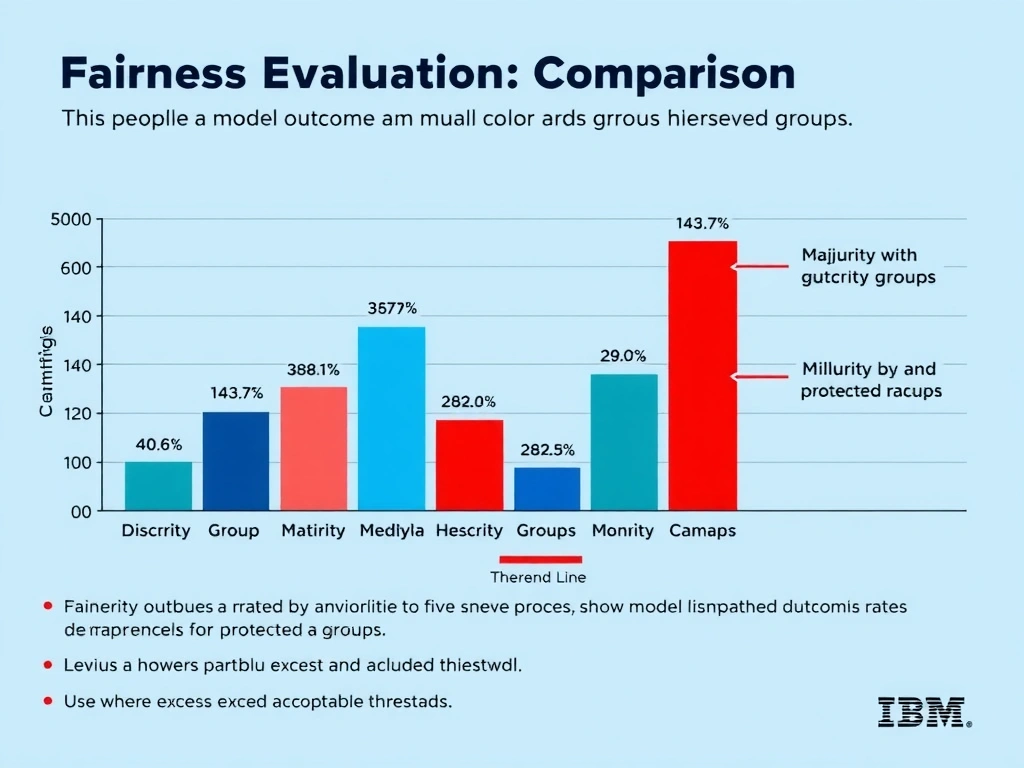
Fairness evaluation is like a food safety inspector checking every station in a restaurant — not just the tables visible from the front door. IBM watsonx.governance requires that you evaluate outcomes for protected or relevant groups specifically where fairness risk exists, because aggregate accuracy can mask serious disparities hiding beneath the surface. A model that is 95% accurate overall might be 60% accurate for a protected demographic, and aggregate accuracy would never surface that. Evaluate the groups that matter and you'll catch the problems that matter!
Full explanation below image
Full Explanation
The correct answer is A. Evaluate outcomes for protected or relevant groups where fairness risk exists. IBM's Configure Evaluation and Monitoring objective requires targeted fairness assessment for groups that could be subject to disparate impact based on characteristics such as age, gender, race, or other relevant dimensions. This group-level evaluation is necessary because aggregate performance metrics average away the disparities that cause harm to specific populations. Option B is incorrect because aggregate accuracy is a population-wide metric that does not reveal whether outcomes differ across demographic groups — a model can achieve high aggregate accuracy while systematically disadvantaging a minority group, meaning aggregate accuracy provides a false sense of fairness assurance. Option C is incorrect because sensitivity of data is precisely the condition under which fairness evaluation becomes most critical, not least critical — if a model is using sensitive attributes directly or as proxies, the fairness risk is elevated and evaluation is mandatory. Option D is incorrect because testing only the majority group by definition excludes the populations most likely to experience disparate harm — fairness evaluation is meaningless if it does not include the groups for whom fairness risk is highest. IBM watsonx.governance provides built-in fairness metrics and group-level monitoring capabilities for this exact purpose.