
A project lead is turning a proof of concept into a governed production workflow. What is the best way to handle AI risk management while staying aligned with the certification objectives?
Select an answer to reveal the explanation.
Short Explanation and Infographic
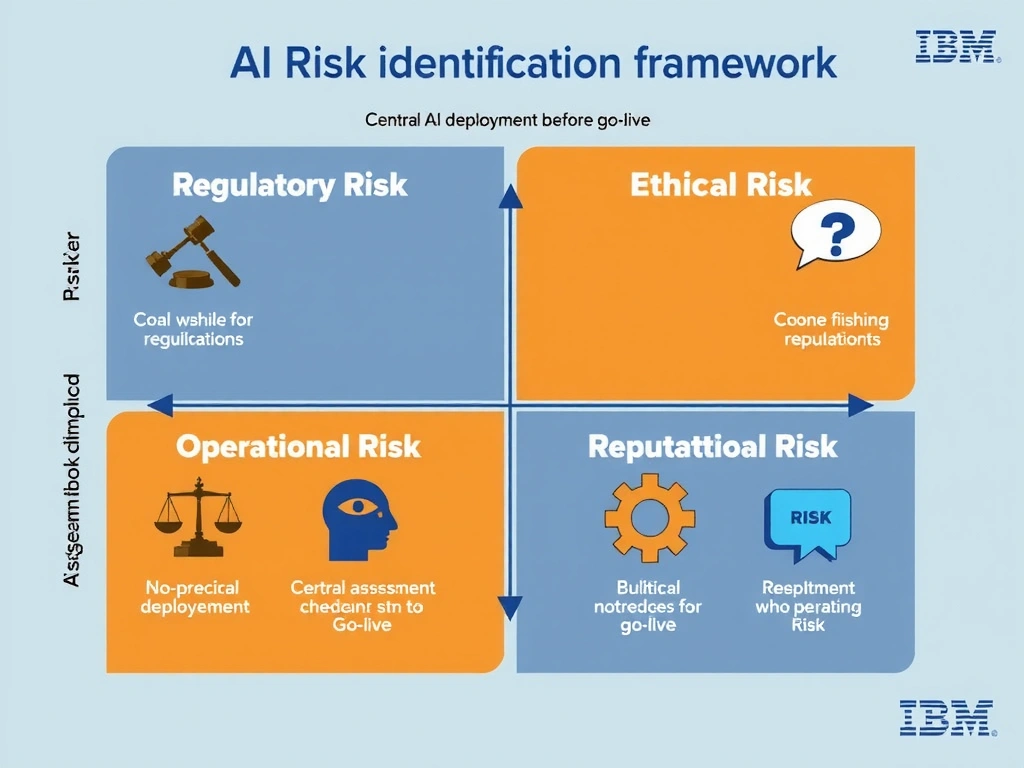
AI risk management is like buying car insurance before you drive off the lot, not after the first fender-bender — by then, the damage is already done. IBM's AI Governance Overview requires you to identify regulatory, ethical, operational, and reputational risks proactively, both before and during deployment, so controls can be built in rather than bolted on. Waiting for a regulator to ask about risk, or dismissing generative AI because it only produces text, misses the entire point of governance. Catch risks early and your production rollout becomes something to be proud of!
Full explanation below image
Full Explanation
The correct answer is B. Identify regulatory, ethical, operational, and reputational risks before and during AI deployment. IBM's AI Governance Overview emphasizes that risk management is a continuous activity spanning the full AI lifecycle. Regulatory risks include compliance with laws like the EU AI Act, GDPR, and sector-specific regulations. Ethical risks cover potential harms to individuals or groups from biased or unsafe model outputs. Operational risks include model failures, integration issues, and performance degradation under production load. Reputational risks arise when AI systems produce outputs that damage public trust or brand integrity. Option A is incorrect because reactive risk assessment — waiting for regulatory inquiry — means the organization is already in a compliance or harm situation before controls are applied, which is both operationally dangerous and legally costly. Option C is incorrect because blanket low-risk classification is an uninformed shortcut that bypasses the actual analysis needed to assign appropriate governance controls — high-risk use cases classified as low risk will receive inadequate oversight. Option D is incorrect because text is a powerful output medium: generative AI can produce harmful content, misinformation, discriminatory language, or confidential data leakage regardless of the modality, and these risks require explicit evaluation and controls. IBM's AI Governance Overview treats risk identification as a prerequisite to deploying any AI system.