
During a design review, an architect asks which choice best matches the IBM guidance. The team is focused on change management. Which recommendation is most appropriate?
Select an answer to reveal the explanation.
Short Explanation and Infographic
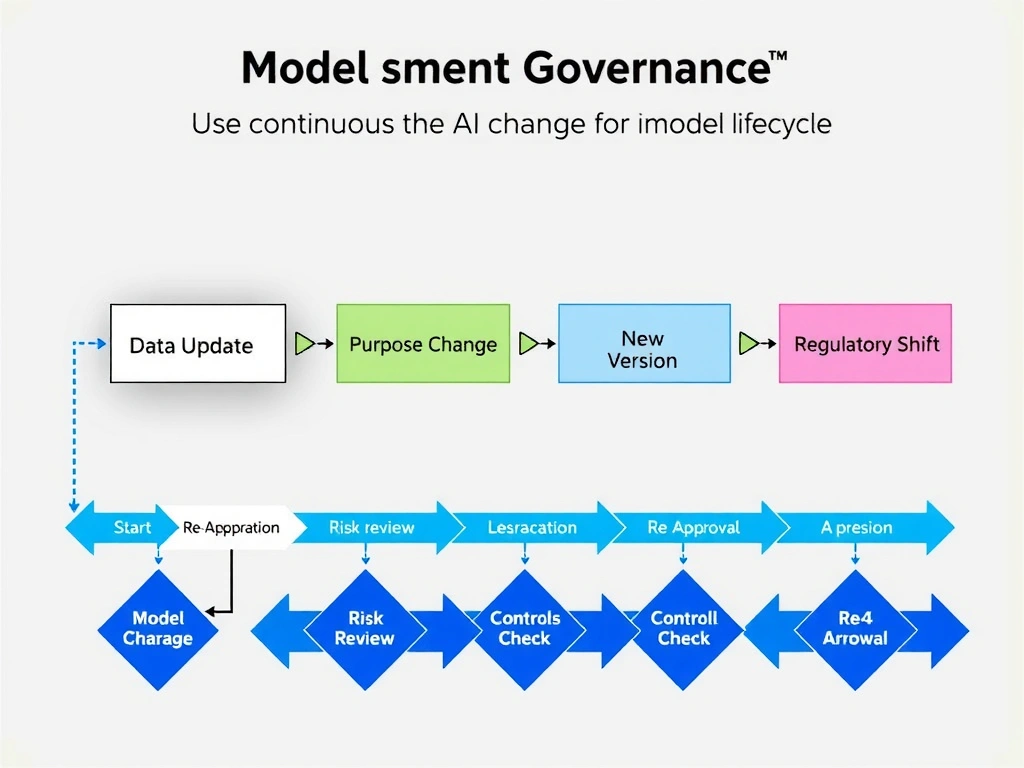
Think of AI change management like recertifying a pilot after they've switched aircraft types — just because they were cleared to fly a propeller plane doesn't mean the approval carries over to a jet. IBM watsonx.governance requires reassessment whenever data, purpose, version, or risk conditions change materially, because any of those shifts can invalidate the controls that supported the original approval. Treating a one-time approval as permanent is how a safe model quietly becomes a risky one without anyone noticing. Reassess on material change and your governance stays airtight!
Full explanation below image
Full Explanation
The correct answer is D. Reassess models when data, purpose, version, or risk conditions materially change. IBM's AI Lifecycle Governance objective recognizes that a model's risk profile is not static — it evolves as the training data is updated, the deployment purpose expands or shifts, new versions are released with different architectures or weights, or the regulatory landscape changes. A reassessment at each material change point ensures that the governance controls in place remain appropriate and sufficient. Option A is incorrect because treating approval as permanent assumes that the model, its context, and its risk profile never change — an assumption that is almost never true in practice and that would allow governance to drift silently out of alignment with reality. Option B is incorrect because prompt changes in generative AI systems can fundamentally alter the model's behavior, output safety characteristics, and bias profile — ignoring these changes is equivalent to ignoring a configuration change in a traditional software system. Option C is incorrect because monitoring only the first deployed version ignores all subsequent updates, which often introduce new risk surfaces or remove previously approved safety guardrails. IBM's change management guidance is explicit: governance is an ongoing process, not a one-time gate.